Eileen O’Grady
Harvard Staff Writer
New release finds the “Sherman’s March” filmmaker and emeritus professor returning to decades of family footage
/ Read time: 7 minutes
Harvard Staff Writer
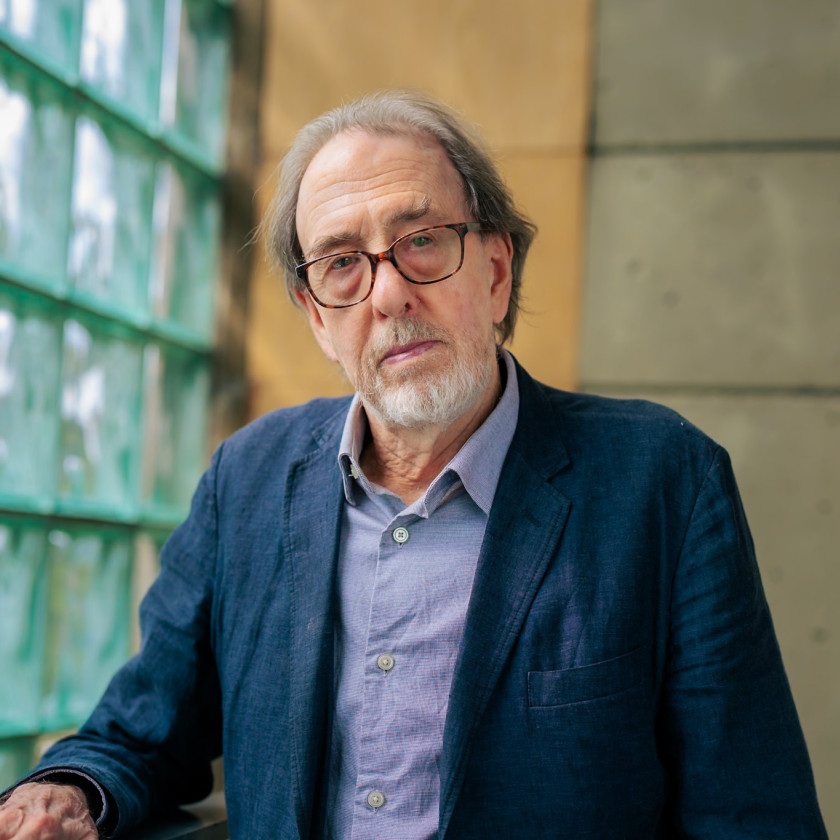
Ross McElwee has often set out to make a film about one thing, only for it to become about something else entirely.
Perhaps the best example is his 1986 film “Sherman’s March.” It started as a Civil War documentary but switched focus to his own love life. It’s a natural consequence of McElwee’s particular style of first-person documentary filmmaking, capturing real life scenarios as they play out in front of him.
His most recent film, “Remake” (2025), began similarly, as a wry documentary about a Hollywood producer’s attempt to remake “Sherman’s March” as a fiction film. But everything changed after the sudden, tragic loss of his 27-year-old son, Adrian, to a fentanyl overdose in 2016.
“I realized after my son died that this was not a film I was interested in making anymore. It seemed too ironic and potentially comic, and irony or comedy were just not part of my life at that point,” said McElwee, an emeritus research professor in the Department of Art, Film & Visual Studies. “It was a very long period of time before I actually began working on the film, which incorporates some moments from the remaking of ‘Sherman’s March,’ but became more and more, as it went along, about losing my son.”
“Remake,” a deeply personal tribute to his son’s life and battle with addiction, premiered at the Venice International Film Festival last year and won the 2025 Golden Globes Impact Prize for Documentary. After playing in select cinemas all summer, the film will air on PBS September 7 as part of the network’s “POV” series.
In an interview with the FAS Current, edited for length and clarity, McElwee discussed working through grief, revisiting his older films, and making documentaries in the age of social media.
Tell me how this film started.
In 2008, I got a phone call out of the blue from [director/producer] Steve Carr, who wanted to know if the option rights were available to “Sherman’s March.” He wanted to undertake a long-held passion project of his: remake “Sherman’s March” as a fiction film. I said, “It’s fine with me if you try.”
But I realized the contract should also give me the freedom to make a documentary about Hollywood’s attempt to make a fiction film out of my original documentary. That seemed an interesting project to undertake because the filmmaker (me) was actually getting older and older as the days and weeks and months roll by, yet the young Ross who’s in “Sherman’s March” remains the same. I thought there would be some way to integrate a meditation on mortality, among other things.
My son, Adrian, was intrigued by the possibility of a remake of “Sherman’s March” and really wanted me to give the option rights to Carr because he saw it as a way to move into making what he called “real movies” as opposed to documentaries. As he filmed me signing the contract, the scene became amusing to me because we got in a little argument about how to shoot it.
And how did you get to a point, after losing your son, where you felt ready to make a film about that grief?
I couldn’t even bear to look at the footage of him as a child in my home movies for a very long time. Three years after he died, I thought maybe the only way I can begin to deal with this would be to write about it. I asked a former assistant of mine to go through my older documentaries and choose two or three frame grabs in which my son had appeared and just assemble them as still photographs into a document that I can see. Maybe that would enable me to pass through some kind of barrier to begin to think about my son, and about losing him, as a theme in a film I would make.
I wrote to those still frames, and that helped a lot. It helped me to organize my thinking about what he was like as a child. He was such a delight. We both bonded over my filming and his being in my films. That whole process was just so enjoyable and memorable — even the later footage, where he was a little more obstreperous about being filmed but also really on some level still wanting to be filmed, which is typical of teenagers. Somehow, using the still images taken from the films gave me the confidence that I could, in fact, go back to my archives and begin looking at motion picture footage of my son and think of building some of them into a documentary.
Can you talk about your decision to include some of your son’s footage in the film?
My son was quite interested in filmmaking. He was, in fact, interested in a lot of things — trying to write a novel, start a clothing brand, have a music blog. But I think he claimed to be most interested in dramatic or fiction filmmaking, and yet most of what he left behind was documenting life around him as it was happening. After he died, I found, on his laptop and external drives, quite a bit more than I’d realized he’d filmed in Colorado.
He had asked me to film him after one of his rehab sessions, because he wanted to make a film about how opioids and heroin had wrecked his life. I did film him, and it was a long conversation between us about what he’d been through. At the time, I thought this would be something he would incorporate into his own film. He never did that. It ended up being perhaps the longest scene in “Remake.”
Your new film is leading a lot of people to revisit “Sherman’s March.” What's it like for you to rewatch that film now?
It’s bittersweet. Those years were really wonderful, being young and unattached and wandering around and letting curiosity lead you from place to place, not quite knowing what’s going to happen moment by moment, day by day. The kind of filmmaking that I practiced — or at least an aspect of it borrowed from cinéma vérité — did help me grope my way to the style of filmmaking I was most comfortable pursuing, a style which accounted for and to some degree told the story of not only what was being filmed in front of the lens, but also the life and times of the filmmaker himself.
The documentary filmmaker Frederick Wiseman made a number of films where you never hear or see Wiseman because he adhered to this approach of simply taking a camera and, as astutely as possible, observing what’s going on and then trying to piece that footage together in the editing room. For me, it was more interesting to try to include the filmmaker’s presence in what was being filmed.
The first-person documentary style of filmmaking was novel in the 1980s. How have cell phones and the internet changed things?
When I made “Sherman’s March,” with a big 16-millimeter camera that weighed 20 pounds perched on my shoulder, to walk up to someone and, after asking permission, just start filming was an odd thing to do. But people were amused and interested in being part of the process, because it was so novel.
Now, things have changed — and I’ve seen it in my own filmmaking students as they go out in the world and try to find subjects to film. They find, of course, that people are now very wary of the camera. They’re accustomed to it, because everybody’s always filming with their phones — it’s no longer novel — but they’re also very aware of social media and the fact that anything they appear in could conceivably end up being seen by millions of people.
For my students, there is a different kind of barrier that you have to go through in order to film people you don’t know. It’s harder for them to find subjects who are open to them. I keep wondering, when is this kind of filmmaking going to become impossible for students to undertake because of the way the world is now?
But that has not happened. They somehow fight their way through the obstacles and end up making films. And though I’m now retired from teaching, I do hear that the courses we have always taught on the intro, intermediate, and senior thesis levels are all still very popular at Harvard.
The leading stem cell scientist calls the $46 million award “dream-come-true opportunity.”
For more than three decades, the Harvard College First-Year Arts Program has served as incoming students’ first encounter with the breadth of artistic people, places, and pursuits awaiting them on campus.
New research from Erin Hecht’s Evolutionary Neuroscience Laboratory analyzes how human influence has shaped the canine brain to make dogs better communicators.