Kermit Pattison
Harvard Staff Writer
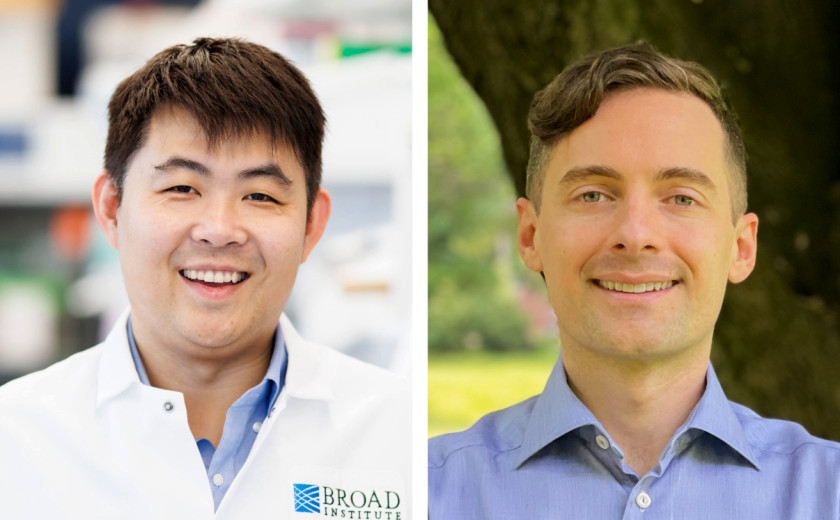
Fei Chen and Ryan Flynn were honored for promising investigations into cellular mechanisms of the disease.
Harvard Staff Writer
Two Harvard stem cell biologists have been recognized for promising research into underlying disease mechanisms and potential therapies.
Fei Chen and Ryan Flynn were each awarded $750,000 by the Pershing Square Sohn Cancer Research Alliance this week. They are among the 13 winners of the 2026 Pershing Square Sohn Cancer Prize for early-career scientists, announced May 5.
Chen, an associate professor of Stem Cell and Regenerative Biology in the Faculty of Arts and Sciences and a core member of the Broad Institute of Harvard and MIT, was recognized for developing a technique that allows researchers to record an archive of cellular history. His team develops tools to more precisely localize single-cell genomics in order to determine how cells are organized within tissues, how their states are influenced by local context, and how those states change over time.
The Chen team developed a technique called TimeVault, which enables researchers to create archival snapshots of cellular activity, a potential tool for investigating why some cancer cells become resistant to treatments.
With the new award, the Chen team plans to use TimeVault to study the gene programs that prime cancer cells to survive therapy. They will investigate lung cancer models carrying well-known mutations and identify molecular targets that prevent the cancer cells from developing resistance to therapeutic drugs.
“The impact of this work is the possibility of revealing the earliest cellular programs that allow tumors to survive treatment, opening the door to therapies that stop resistance before it begins,” Chen said.
Flynn is an associate professor of Stem Cell and Regenerative Biology in the FAS, associate professor of pediatrics at Harvard Medical School, principal investigator in the stem cell program of Boston Children’s Hospital, and principal faculty of the Harvard Stem Cell Institute. He won the prize for research into how RNA molecules on the surface of cancer cells are recognized by the immune system.
Flynn studies the relationship between RNA and glycans, which are sugar chains prevalent in cells throughout the tree of life. His team previously demonstrated that cancer dysregulates glycoRNAs, but that work was limited to cancer cells themselves. Flynn said the award will allow his team to expand its research and investigate a new area — the interface between the immune system and cancer cells.
“The positing of glycoRNAs on the cell surface, at a critical interface between cells and their environment, suggest they could be important for how cells operate in various contexts,” he said. “We believe understanding the functional roles of glycoRNAs could allow a deeper or more precise model for how cancer develops and thus eventually present a new molecule for therapeutic targeting.”
First awarded in 2014, the Pershing Square Sohn Cancer Research Prize seeks to support innovative research at early stages, before scientists can secure traditional sources of funding. Over the past 13 years, it has provided more than $58 million to 90 scientists in the U.S.

Why do so many people feel lonely in a world designed for connection? As Ian Corbin sees it, Americans are experiencing a crisis of belonging, which he attributes to some fundamental misunderstandings about what humans need to flourish.


Weiss, professor of the classics and an expert on ancient Greek culture plans, to prioritize the expansion of educational resources.