
A pen-to-paper thank you
At the 17th annual FAS Giving Thanks Open House, staff from across the Faculty of Arts and Sciences gathered to reflect and pen actual, physical notes for colleagues on stationery, to be distributed through interoffice mail.

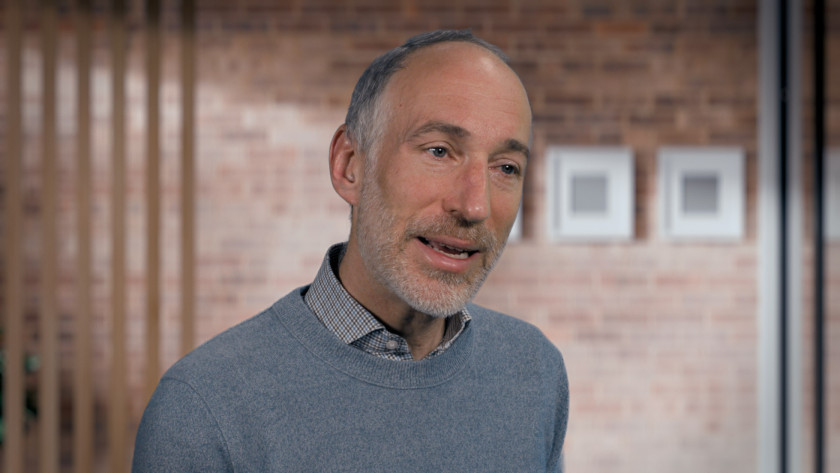
David Reich, professor of genetics at Harvard Medical School and of human evolutionary biology in Harvard’s Faculty of Arts and Sciences, explains how ancient DNA is rewriting what we thought we knew about human history. Drawing on more than 50,000 ancient and modern genomes his lab has studied, Reich shows that the people living in a place today are almost never the direct descendants of the people who lived there before — migration, mixture, and population turnover — are the rule across human history, not the exception. Reich argues that sweeping population mixtures — phenomena we typically associate with the last 500 years (as in the Americas) have deep parallels across Europe, South Asia, and Africa, uncovering connections between peoples that history and archaeology alone could never have revealed.
At the 17th annual FAS Giving Thanks Open House, staff from across the Faculty of Arts and Sciences gathered to reflect and pen actual, physical notes for colleagues on stationery, to be distributed through interoffice mail.

The discontent lurking under the surface of U.S. politics in recent decades has two primary sources, according to political philosopher Michael Sandel. One is disempowerment, a feeling that individual voices don't matter to those in power. The other is the loss of a sense of community.

A crowded auditorium at Zimmer Hall quieted to a hush without so much as a prompt from event organizers. It was the kind of weighted silence in anticipation of a rockstar taking the stage.