Eric Moskowitz
Harvard Staff Writer
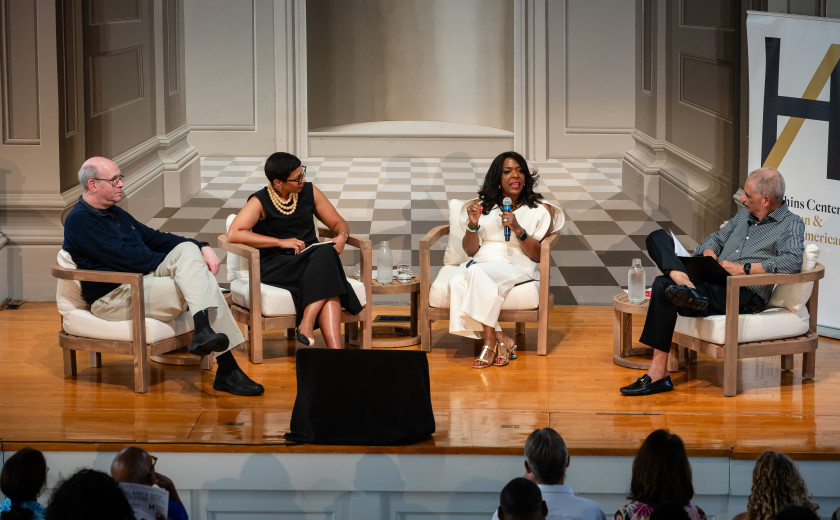
Hutchins panel dissected string of Supreme Court decisions they say have gutted protections against racial gerrymandering
Harvard Staff Writer
As part of the children’s choir at the historic Brown Chapel A.M.E. Church in Selma, Ala., Terri Sewell would watch as John Lewis and other “foot soldiers” from the Civil Rights Movement returned annually to reenact their March 7, 1965, protest march from the church to the Edmund Pettus Bridge — where law enforcement's brutal “Bloody Sunday” assault on the peaceful marchers, broadcast nationally, shocked much of the nation and galvanized passage of the Voting Rights Act.
Sewell — who would become the first Black valedictorian at Selma High School, before earning degrees from Princeton, Oxford, and Harvard universities — understood that the marchers were coming back so “the nation would never forget what happened.”
If she never conceived then that she would one day serve in Congress alongside Lewis, representing a House district that includes Selma, she also never imagined that those hard-earned gains would be eroded during her time in Washington, Sewell told the crowd at last week’s Hutchins Forum on Martha’s Vineyard, hosted annually by Harvard’s Hutchins Center for African and African American Research. The “Balance of Power: Redistricting, Courts, and the Right to Vote” was also livestreamed via PBS News.
That makes the issue “very personal,” said Sewell, J.D. ’92, of the U.S. Supreme Court’s decisions from 2013 to 2026 that have chiseled away at the Voting Rights Act. The latest ruling — an April decision in Louisiana v. Callais that effectively bars the use of race when drawing voting maps — could cost the Congressional Black Caucus up to 19 seats in the November midterm elections, she predicted. That would wipe out nearly one-third of a caucus that has grown from 13 members at its 1971 founding to 62 in the latest session.
“What it teaches all of us is that progress is elusive, and every generation has to fight and fight again to hold on to the progress that we as a nation have achieved,” she said. “We get one chance on this earth, and we’re all watching as the wheels are turning back.”
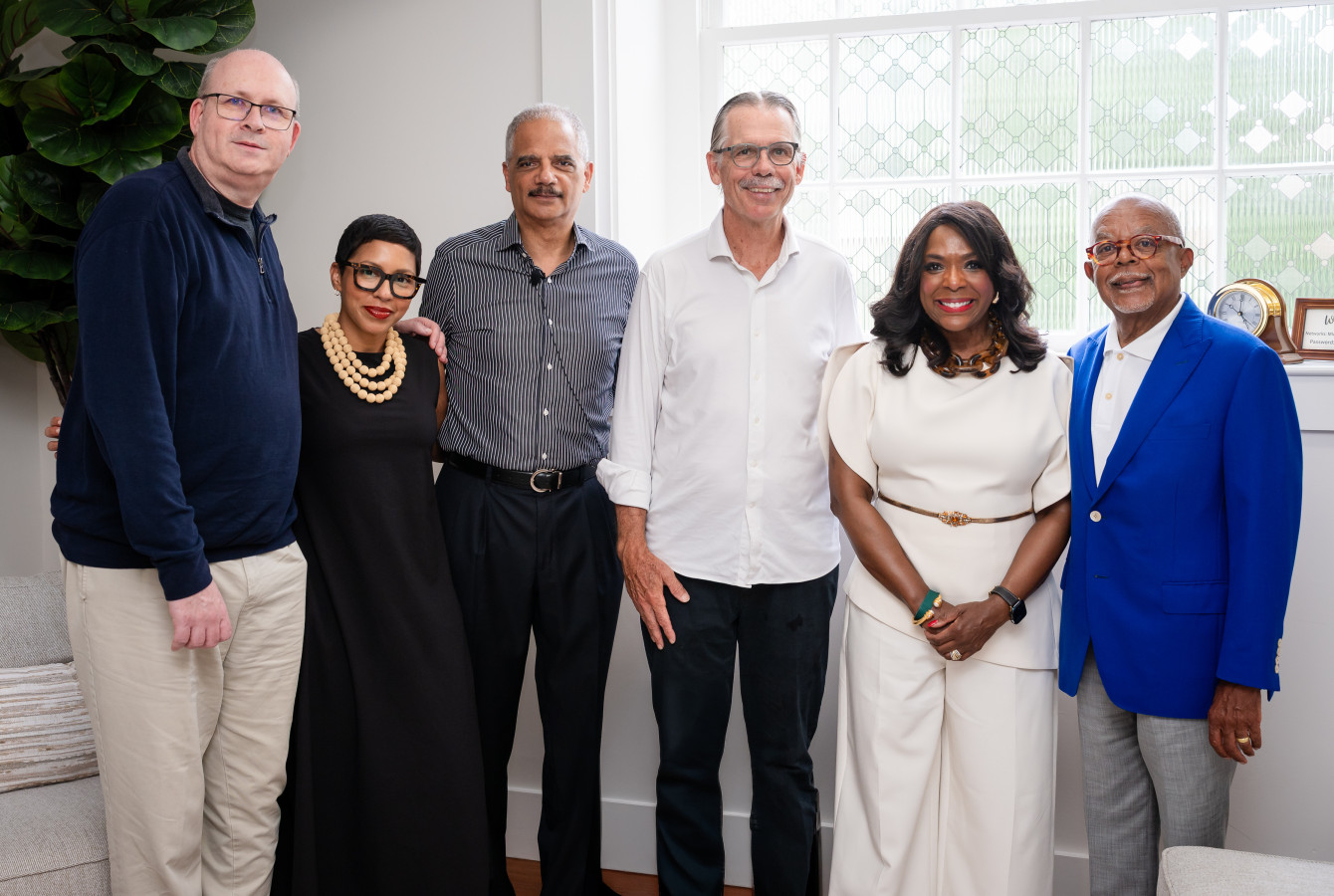
As a forum co-host, alongside Debbie Hutchins and Glenn Hutchins ’77, J.D./M.B.A. ’83, Hutchins Center director Henry Louis Gates Jr., called the highest court’s decisions since 2013 “an alarming, distressing trend” — and an echo of the 19th-century rulings that stripped away the Reconstruction Amendments while allowing Jim Crow discrimination to prevail across the South.
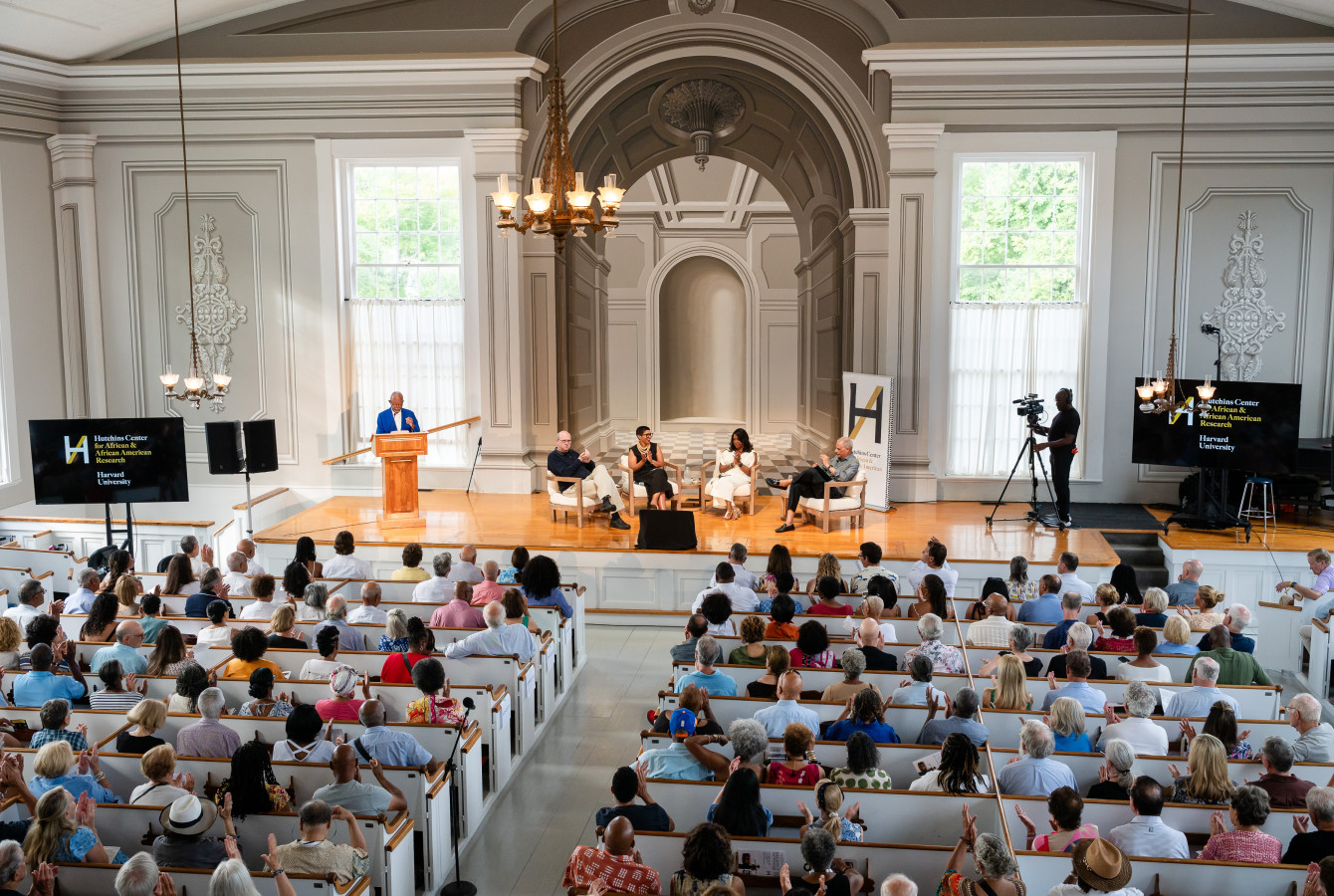
“I'm afraid the tide is going out once more,” said Gates, Alphonse Fletcher University Professor, in his introductory remarks at a packed Old Whaling Church in Edgartown. “The court has taken dramatic bites out of the Voting Rights Act while allowing the poison of partisan gerrymandering to spread, fueled by an unlimited supply of money that makes a mockery of the foundational idea of this country: government of, by, and for the people.”
“We are gathered tonight at a critical time, I think, in our nation’s history,” said former U.S. attorney general Eric H. Holder Jr., chairman of the National Democratic Redistricting Committee, which leads the Democratic Party’s strategies to counter Republican gerrymandering. By manipulating the levers of the legislatures and the courts, Holder, who served as the evening’s moderator, added, Republicans have undertaken “a concerted effort to displace people from their constitutional rights ... to make sure that one party rules not by gathering the greatest number of votes, but by using the system to come up with a way in which they hold on to the greatest amount of power.”
Holder was joined on stage for the discussion by Sewell; elections attorney Marc Elias; and Melissa Murray, law professor at New York University and author of “The U.S. Constitution: A Comprehensive and Annotated Guide for the Modern Reader.” (2026).
Murray detailed the relevant court decisions, focusing particularly on the Shelby case, which ruled in 2013 that states with a history of violating Black Americans’ voting rights no longer need to get preapproval from the Department of Justice or a three-judge panel before changing voting policies, and on Callais. After the Shelby ruling, changes to voting in these states could still be challenged in court — but the Callais decision “effectively eviscerates” that protection, she said; it banned the drawing of maps meant to prevent racial discrimination — while encouraging the creation of maps to serve the partisan objectives of the party in power. “It’s a really pernicious decision,” Murray said.
Sewell is the perennial lead sponsor of a bill named for Lewis to bolster the Voting Rights Act — which passed a Democratic-controlled House in 2021, only to be swallowed up by Republican filibuster in the Senate. She said Democrats not only need to win elections but need “to be bold” in exercising their authority once in office. “We have to do it in spite of our natural inclinations,” Sewell said.
Holder agreed. “Democrats are uncomfortable with the acquisition and the use of power, and that's got to change,” he said. Republicans are OK with the notion that they're going to be, in terms of popular support, a minority party as long as they have majority power, and we have got to use power in ways that we have not in the past — not in the way that they have, but to do good on behalf of the American people.”
Elias, who recorded more than 60 legal victories as the lead lawyer batting away election-fraud claims by Donald Trump in seeking to overturn the 2020 election, said the Supreme Court’s narrow 5-4 ruling in June on the constitutionality of birthright citizenship was the latest example of its descent into partisanship. “We need to recognize where we are,” he said. “The Supreme Court is not going to uphold protections of voting rights and civil rights.”
Elias urged the crowd to get involved, starting in their own “town square,” even if it’s just with a few trusted friends at the coffee shop.
Sewell turned to the example of her forebears in Selma — “those that marched, prayed, and some died, and most bled on a bridge in my hometown, for the equal right of all of us as Americans to vote.”
She acknowledged collective fatigue with American politics over the last decade, but reminded the room that the Selma demonstrators regrouped after Bloody Sunday and tried twice more, in greater numbers each time, before succeeding in marching the 54 miles to Montgomery.
“I can imagine all of you are tired. I'm tired,” she said. But “John Lewis said this over and over again: ‘We can't give up.’”
The technology, described in a new paper in Cell, could reshape how scientists investigate tissue function and disease.

The singer-songwriter, who recently released a concept album threaded with AI skepticism, appeared with two Harvard-affiliated researchers on the Singing for Science podcast.

Researchers in the Department of Chemistry and Chemical Biology combined biophysics, structural biology, and simulation to solve a manufacturing question.