Yahya Chaudhry
Harvard Staff Writer
Researchers discover the chemistry choreography the body uses to yield CoQ10
Harvard Staff Writer
When something goes wrong deep inside a cell’s power plant, the consequences can ripple across an entire organism. Mitochondria rely on a small molecule called coenzyme Q (CoQ) to generate energy and protect cells from damage. But the way cells manufacture this vital compound — through a multi‑step biochemical assembly line — has long been unknown.
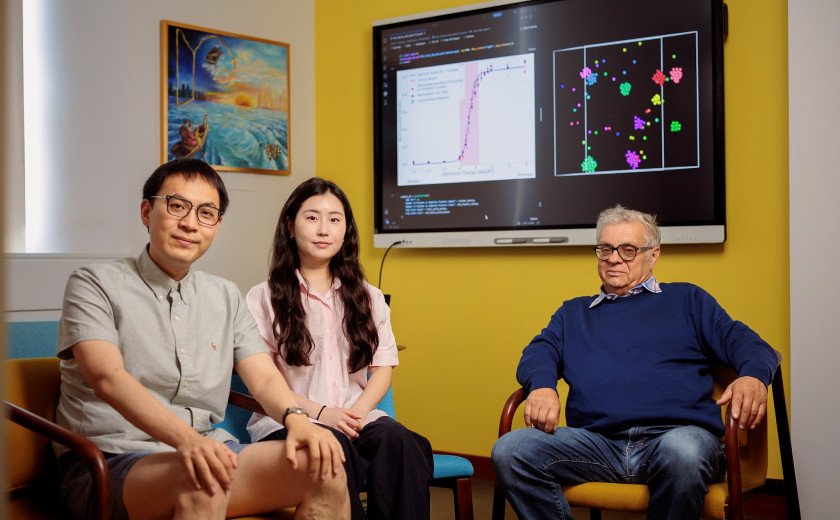
Now, researchers in the Department of Chemistry and Chemical Biology, together with collaborators at Italy’s University of Pavia and the Netherlands’ Utrecht University, combined biophysics, structural biology, and simulation to solve the manufacturing question. Focusing on the metabolon — a clustered assembly of sequential metabolic enzymes that makes CoQ — the scientists discovered how spatial organization and phase‑like behavior dramatically boost the pathway’s efficiency. Their research was published in Nature Communications in June.
“Coenzyme Q is a really important molecule,” said Dianzhuo Wang, the paper’s co-first author and a doctoral student in the Harvard Kenneth C. Griffin Graduate School of Arts and Sciences. “It’s vital for energy production, and it’s also needed to protect against oxidative damage. You might have heard of CoQ10 as a [dietary] supplement people take. It’s essentially the same thing.”
The final stretch of CoQ synthesis runs through a multi-reaction sequence handled by five enzymes embedded near the mitochondrial inner membrane. Researchers had long suspected these enzymes huddle together into a metabolon rather than working in isolation, but the forces driving them to cluster – and why clustering mattered – were poorly understood.
“The metabolon is definitely not a new concept,” said senior author Eugene Shakhnovich, Roy G. Gordon Professor of Chemistry, “but there are many aspects we discovered that are novel and change the way we think about the clustering.”
A central insight was that the enzymes don’t gather gradually. Below a certain stickiness, they stay scattered and apart; nudge that stickiness past a threshold, and they snap together into clusters. In the experimental simulations, each enzyme was modeled as a sphere with sticky patches drifting through a three-dimensional box; as the team dialed up the attraction between them, the system crossed precisely that threshold.
“Many biological systems operate at a critical point,” Wang said. “Small changes in cellular conditions, like binding, can have huge effects on the outcome.”
Evolution, he added, must balance “efficiency and responsiveness to changing conditions. We happened to observe that CoQ assemblies also lie in such a critical region.”
Experiments by collaborators in Italy and the Netherlands confirmed the model. They expressed and purified core CoQ enzymes, measured how strongly different pairs interact, and mapped the architecture of the complex. Most interactions turned out to be mid‑strength — strong enough to encourage clustering but weak enough to stay dynamic — with a few tighter “seeds” that likely nucleate the metabolon.
To probe specific contacts, the team used targeted chemical modification, attaching polymer chains to chosen protein surfaces to block binding.
“Targeted PEGylation basically disrupts protein interactions by chemically tagging individual proteins with PEG polymers,” Wang said. “After PEGylation, you must confirm that the proteins no longer interact but remain catalytically active. Otherwise, you can’t tell interaction loss from function loss.”
Simulations and experiments converged on a key principle: the cluster must be complete.
“Evolution seems to have tuned how these proteins grip one another, so they reliably form complete clusters, something random wiring just doesn’t achieve,” said Jio Jeong, co-first author and a doctoral student in the Harvard Griffin GSAS.
When all required enzymes could join a cluster, the products of one step flowed efficiently to the next, and CoQ yields were high. When clustering of even a single enzyme was blocked, production dropped — despite the enzymes remaining functional.
The clustering turned out to matter most for the pathway’s least efficient steps.
“Clustering rescues the reactions that would otherwise stall,” Shakhnovich said. “The slower the enzyme, the more it depends on the crowd around it.”
For Shakhnovich, the work illustrates a broader organizing strategy in biology.
“Organizing chemistry in space to make it more efficient is a very broad, very fundamental principle,” he said. “It probably acts on molecular, cellular, and even tissue scales.”
By pinning the CoQ metabolon at the edge of a phase‑like transition and showing how complete clustering drives efficient substrate channeling, the study lays out concrete physical rules for how cells choreograph chemistry in space.
“In a sense, we’re learning nature’s design rules for organizing chemistry in space,” Wang said. “Once you understand those rules, you can start to think about applying them across biology.”
This research was partially funded the National Institutes of Health, grant R35GM139571.
In a new milestone for stem cell research, Harvard neuroscientists have set a record for keeping alive lab-grown human brain “organoids” and proven that they mimic key developmental stages seen in living people.

The Harvard theoretical physicist and neuroscientist has won the Dirac Medal and Prize, one of the highest honors in physics.
Deep in the woods of Petersham, Mass., the Harvard Forest Summer Research Program in Ecology is cultivating a renewable resource — future generations of scientists.