Kermit Pattison
Harvard Staff Writer
Harvard Forest summer program has propelled hundreds of careers in research and ecology
/ Read time: 7 minutes
Harvard Staff Writer

Deep in the woods of Harvard Forest, ecologists are cultivating a renewable resource — future generations of scientists.
For three decades, the Harvard Forest Summer Research Program in Ecology has prepared undergraduates from around the globe for careers in the sciences. More than 700 students have spent their summers studying trees, soil, insects, and plants in the 4,000-acre research site roughly 65 miles west of the University’s Cambridge campus. According to surveys of the program’s recent alumni, 81 percent have gone on to STEM careers and more than half work in the ecological sciences. More than 30 alums currently hold faculty positions in colleges and universities, including one winner of a MacArthur Foundation “genius grant.”
“The overall purpose of our summer program is to reach promising undergraduates who may not have had a research experience before, immerse them in that, and make them feel like this is something they could do,” said Audrey Barker-Plotkin, director of the summer program and senior researcher and site manager at Harvard Forest. “It’s a very curated set of people and they’re all excited about ecology and excited about learning.”
The program aims to introduce students to research close to that performed by graduate students. The curriculum emphasizes professional development to help students discern their career paths and navigate the real world of academia and science.
This year, the program received about 500 applications for 20 spots. “The number-one criterion is potential student gain,” Barker-Plotkin said. “That is a synthesis of their interests matching what we have to offer — and having enough background to be able to swim in the environment here.”
The admissions committee also looks for evidence of teamwork, leadership, and non-academic work experience that shows some grit. “More bluntly, a crap job,” Barker-Plotkin explained. “It just shows some maturity. It also serves as a stand-in for someone with financial need.”
This summer, the cohort included three Harvard undergraduates plus students from a handful of other schools such as Brandeis, Bowdoin, Mount Wachusett Community College, three campuses of the University of Massachusetts, Cornell, Western Michigan University, and the University of Puerto Rico at Cayey.
Their projects — conducted under the supervision of Harvard researchers or visiting scientists — examined topics such as the effects of soil warming on salamander body sizes, the performance of sap flow sensors, the ecology of forest edges, and the root systems of black tupelo trees in swamps. Some students work on long-term research projects that began before they were born.
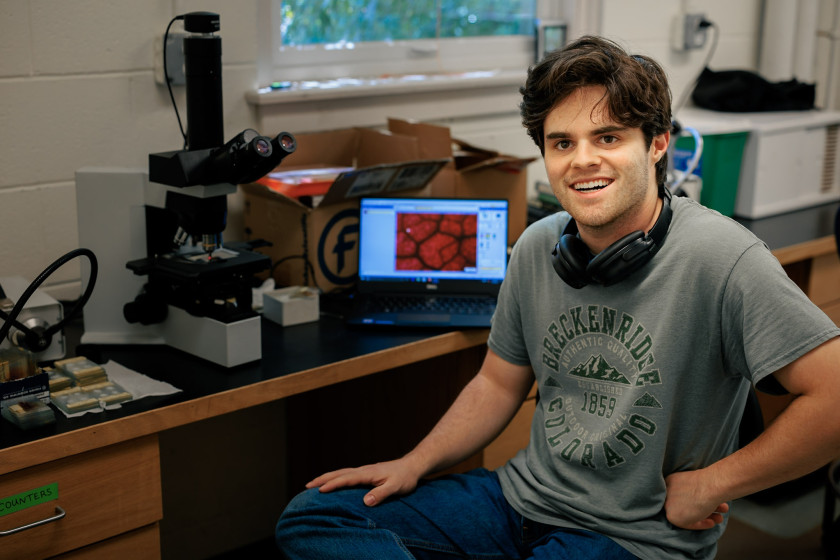
Participant Tom Weber, a wildlife biology major at Colorado State University, took his studies to new heights. He spent the summer researching how the microscopic anatomy of tree leaves varied with elevation within the tree canopy.
When interviewing for the program, he was asked whether he had a fear of heights. “I told them I was a rock climber,” he said.
Weber passed summer days perched on the arm of a bucket truck up to 90 feet above the ground. Sometimes the bucket swayed in the breeze. After getting over his initial jitters, he came to appreciate the serenity of the treetops and sounds of rustling of leaves.
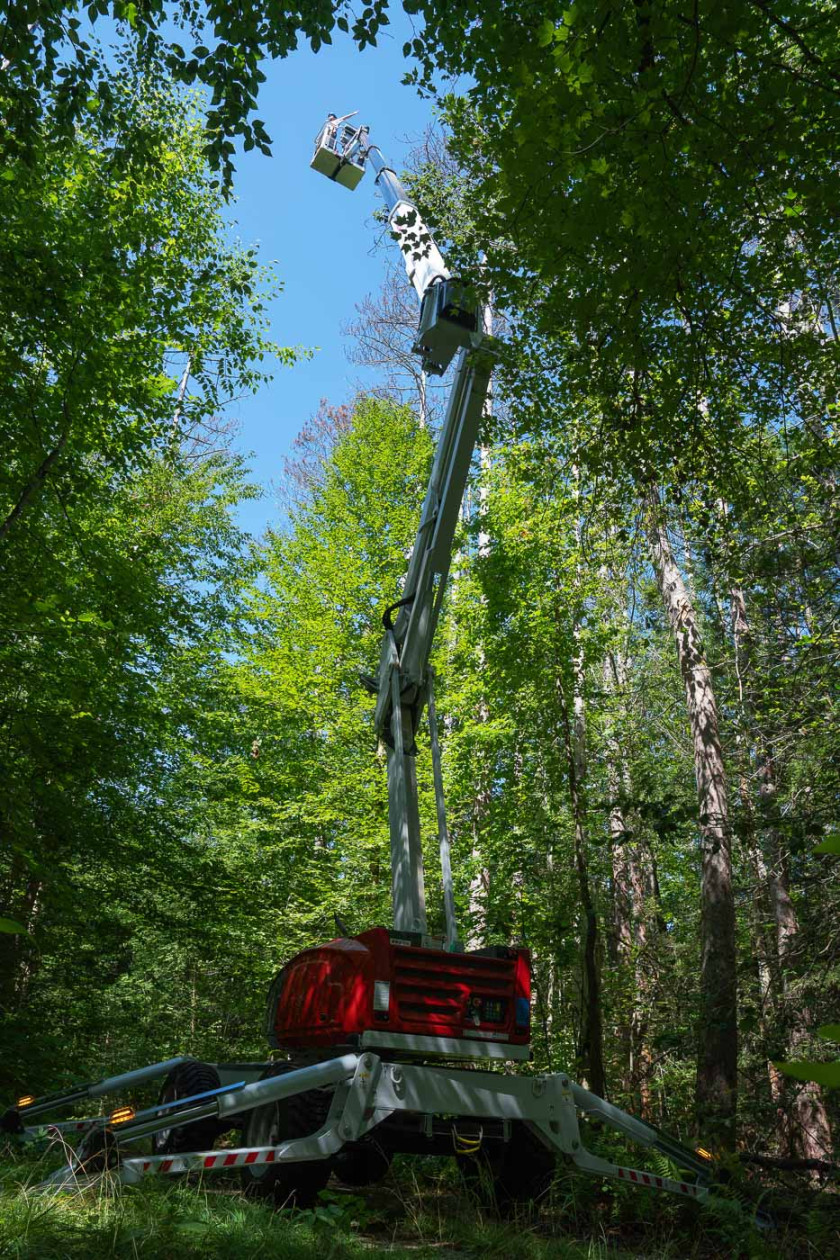
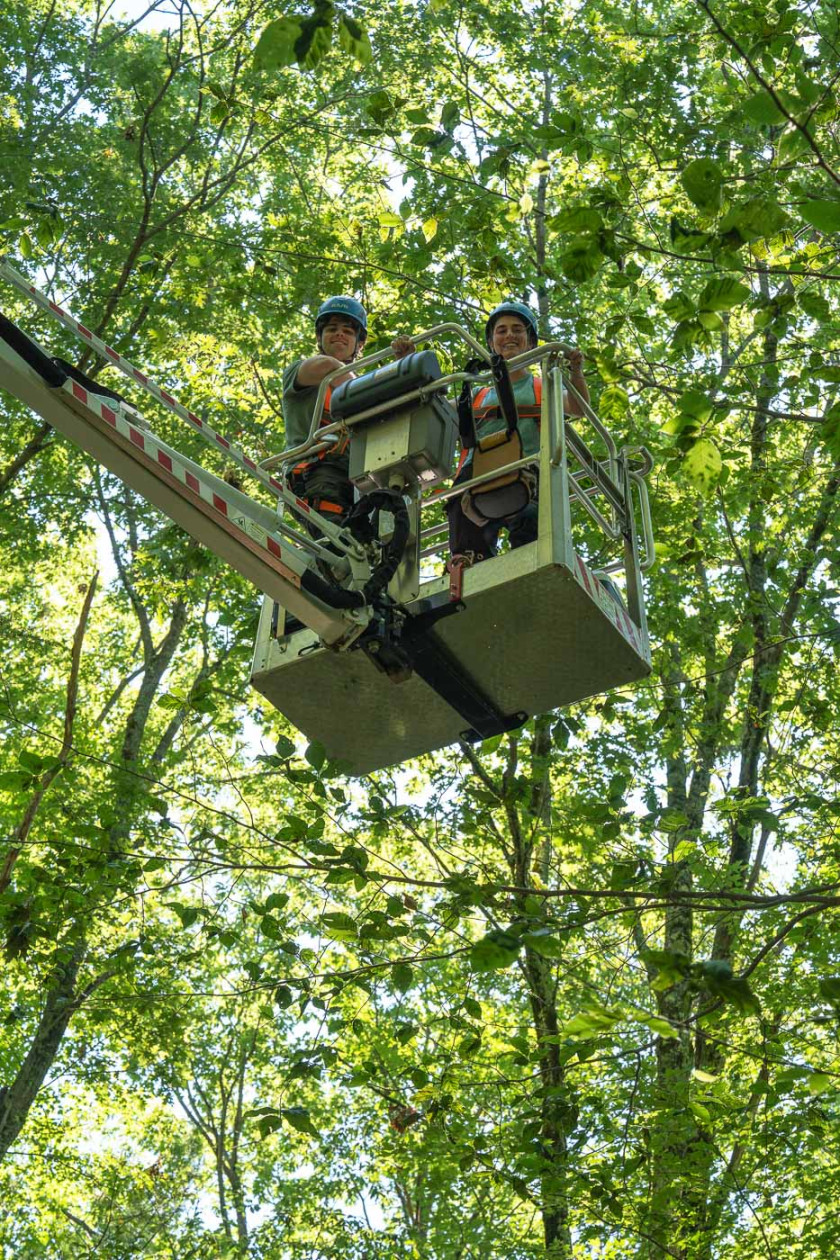
“We only have a few more days of collection, and last time we were up there, I actually got kind of got sad,” Weber said. “I feel very lucky because it’s just so cool to see the canopy that intimately.”
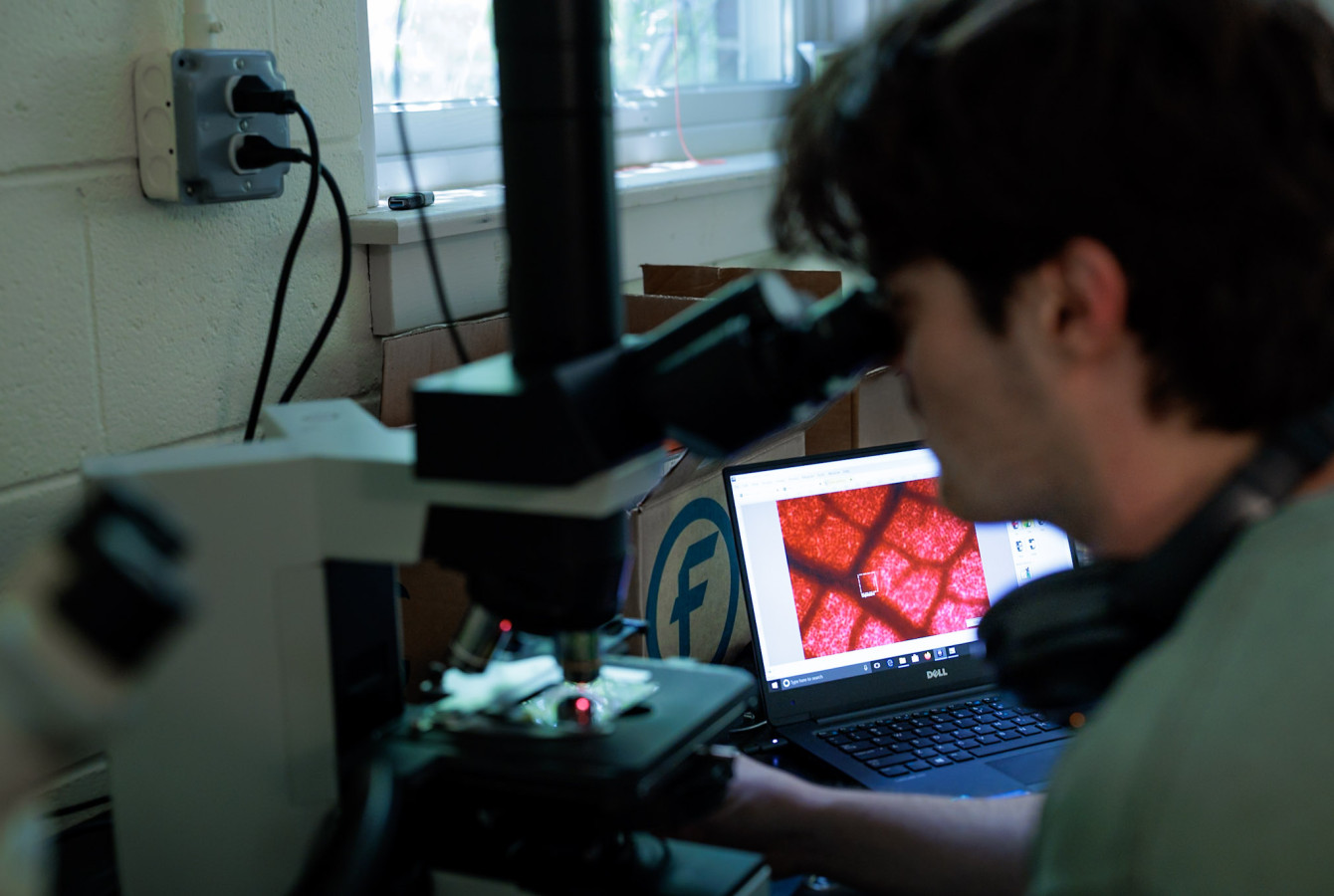
One summer afternoon, Weber sat in the lab beside a microscope examining the tiny veins of a red maple leaf. Even in a single tree, the leaves higher in the canopy had thicker veins than the ones on lower branches, perhaps because they must transport more water due to greater sun exposure and evaporation. At Weber’s suggestion, the researchers began using red stain to make the veins more visible.
“It’s been a really transformative experience,” Weber said of the summer program. “As an undergraduate, it’s very rare to get an opportunity to lead a real aspect of a project, and the independence was really eye-opening.
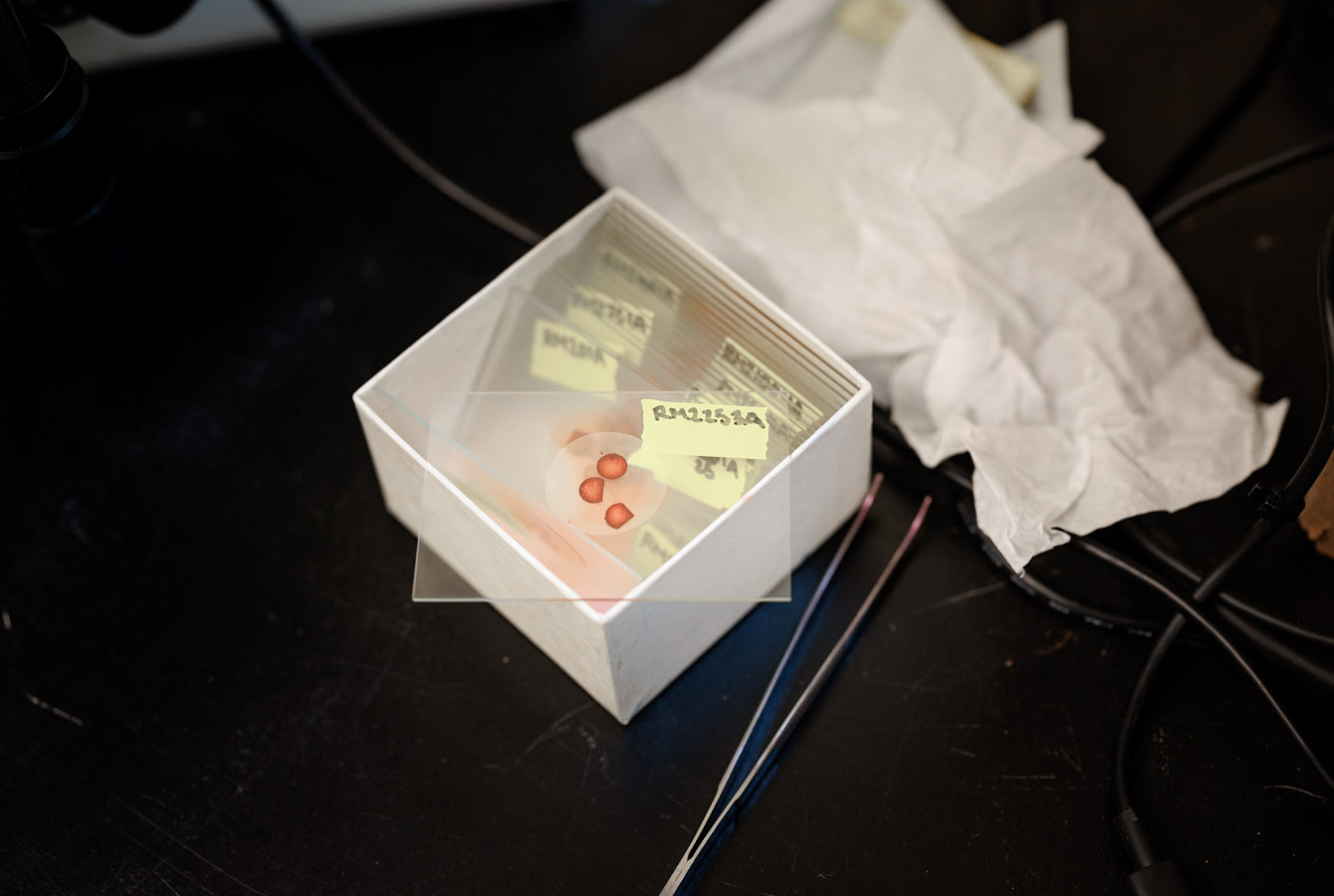
“It’s changed the way I view research, in a more humbling way,” he continued. “As an undergrad, you have this idea that researchers are these rock stars. From my experience here, I’ve realized that the greatest researchers are like a component of everyone who supported them. I learned that research is really a team sport and involves a lot of luck.”
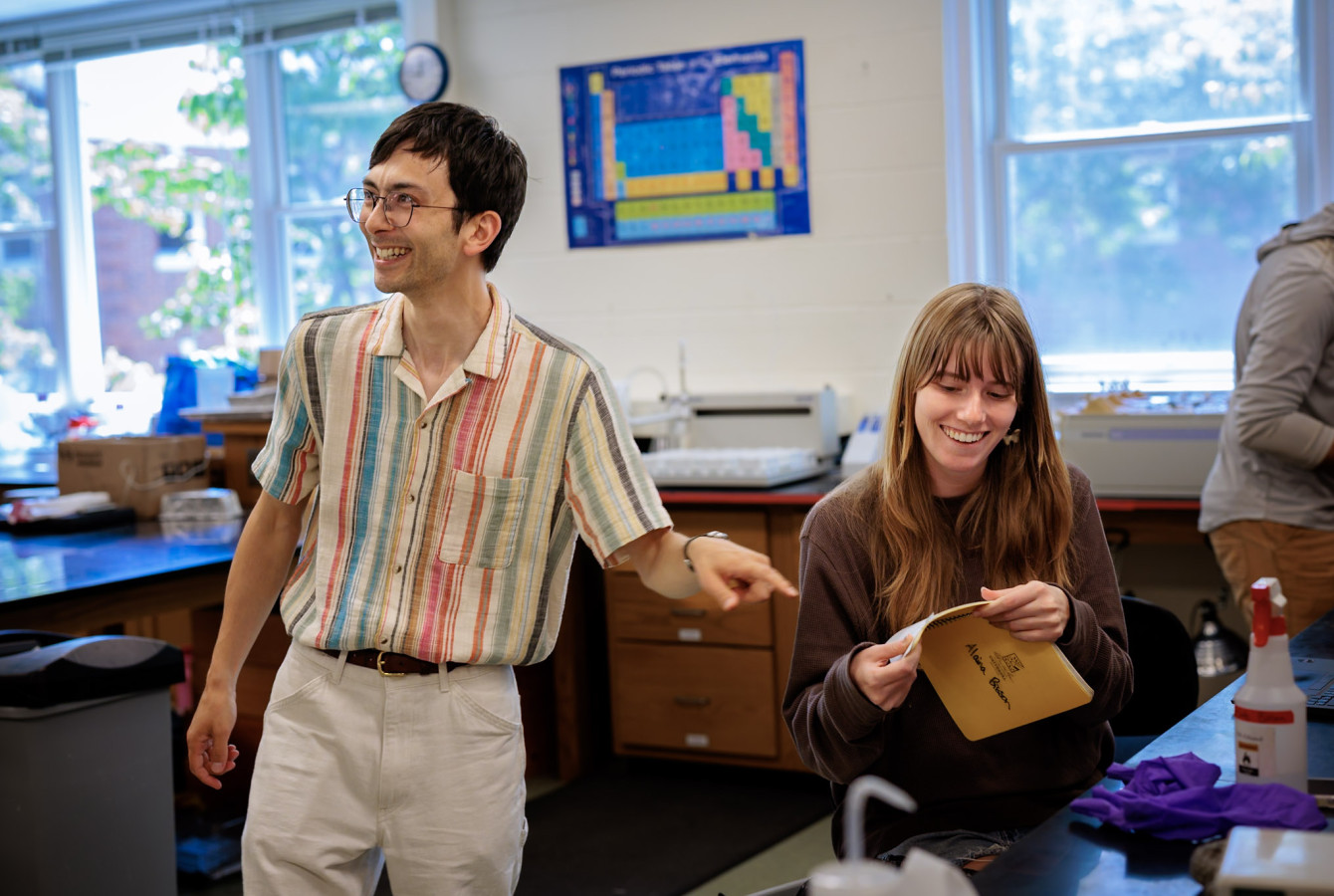
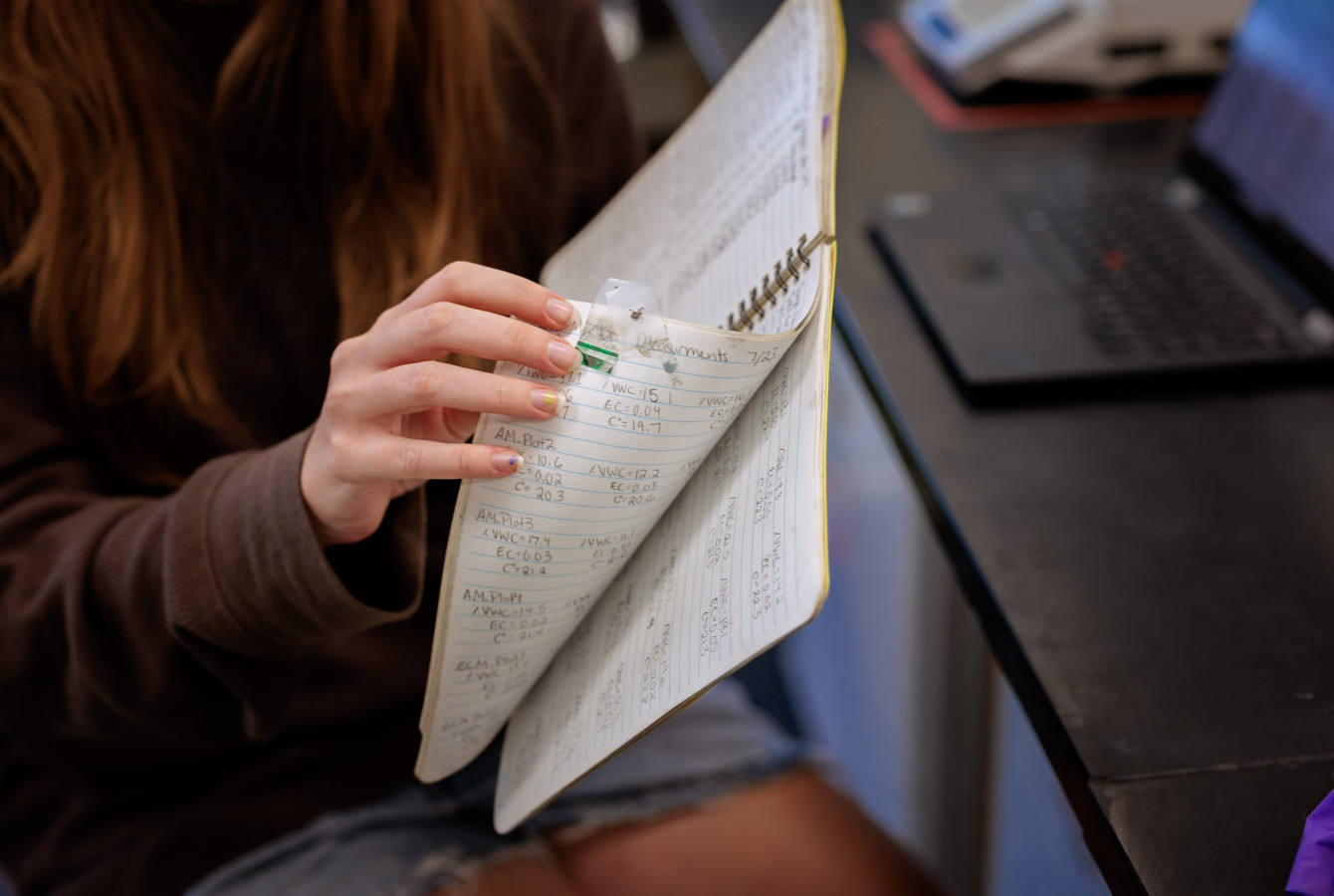
In the next room of the lab, Kyla Ritchie bent over a dirt-smudged notebook and entered data into a computer spreadsheet. Sections of her notebook were separated by homemade tabs — folded Scotch tape encasing ticks she had picked off herself during days of fieldwork.
A rising senior at the University of North Carolina at Chapel Hill, Ritchie spent the summer studying the symbiosis between fungi and plant roots in leaf litter — and the relationship’s effect on nitrogen cycling.
“It’s been awesome,” she said. “I was pretty sure that I wanted to do a Ph.D. and do research for the rest of my life, but I haven’t had an opportunity. It’s been really fun to be out in the field doing stuff that I’m excited about, and it’s confirming that I want to keep doing this.”
Lucy Hutyra had the same thought. Now a distinguished professor and chair of the Department of Earth and Environment at Boston University, she went through the summer program in 1998. At the start of her season, she was uncertain about whether to pursue a career in science. She spent the summer researching plant hydraulics and got her first exposure to laboratory work, with the project resulting in her first scientific publication.
“It was absolutely formative,” she said. “It introduced me to a different rigor of science than I had ever had firsthand exposure to. It was very hands-on, deep collaboration with the principal investigators, and I just saw a side of science I had never seen before — and I liked it. I would say it was my first real science exposure outside of the classroom.”
Hutyra went on to earn a Ph.D. from the Harvard Department of Earth and Planetary Sciences in 2007. She became a leading researcher of global carbon cycles and won a “genius grant” from the MacArthur Foundation in 2023.
For the last three decades, she has maintained her roots in the Harvard Forest, where she continues her research and occasionally mentors undergraduates in the summer program.
“The program has changed a lot of people’s lives,” Hutyra said. “And now it’s in massive jeopardy with all the changes in federal grant funding.”
The budding scientists also learn to make their own fun. Stuck in the woods in rural Petersham, Mass., participants are far removed from the normal amusements of campus life and college towns. The students live together in a house on the forest grounds and eat their meals in the dining room of the headquarters building. Every year, they bond over different activities. Some members of this year’s class have become country line-dancing enthusiasts.
“The cohorts quickly become very close,” said Ben Goulet-Scott, higher education and laboratory coordinator at Harvard Forest. “The program is extremely selective and students are ambitious, talented, and likely to have interesting careers. And because they become such close friends here, they really build an extremely relevant professional network while they’re still undergrads.”
Just then, a student excitedly approached Goulet-Scott in the dining hall.
“I found another wolf spider — with a moth in its mouth!” gasped Hollis Cole, holding up her phone to display a photo.
An environmental science major at UMass Boston, Cole spent her summer researching the decomposition of leaf litter at forest edges. As a side project, she attempted a nonlethal survey of spider populations at the research site to see if it was possible to study the arachnids without killing them. Catching a spider in the act of predation was a coup.
“It’s been a life-changing experience — I’m not exaggerating,” Cole said of her summer. “It’s kind of like a mini grad school. The independence has helped me grow a lot.”
Then she excused herself.
“I’m headed back to the house to get a portable charger,” she said, “so I can go back into the field and can take more pictures of spiders.”
Research described in this story received federal funding from National Science Foundation, grants DBI-2348924 and DEB-2145950.

Forget about the ancient Greek myth of Icarus. For the last 10 years, Jenna Samra, Ph.D. ’18, and her colleagues have been pushing technology to fly closer to the hottest part of the sun. Samra, an astrophysicist at the Center for Astrophysics, an institution jointly run by Harvard and the Smithsonian, leads a scientific quest to study the solar corona.
The incoming professor of English’s fourth novel, “Beginning Middle End,” follows a mother and her 12-year-old daughter as they travel to Sicily, where the duo is figuring out how to reconstruct their lives amid their encounters with the island’s daily life, its winds, waters, and volcanoes.

What happens when a healer, working in a plague-stricken medieval village, falls in love with Death himself? Moviegoers can soon find out when a black-comedy romance, which began as a Harvard College student production, lands on the big screen. “Death Do Us Part,” co-directed by Abigail Ory ’21 and David Chávez-Grant ’21, premieres at the Rhode Island International Film Festival August 9.