Genevieve Wallace
Harvard Staff Writer

The musician came to campus for a conversation on humanity, philosophy, and his new album
/ Read time: 5 minutes
Harvard Staff Writer
AI chatbots appear to be perfectly friendly and empathetic. Where does that leave the value of bona fide human companionship, with all its limitations and flaws?
Two Harvard-affiliated researchers took up the question this summer with singer-songwriter Sean Ono Lennon, who recently released a concept album threaded with AI skepticism. The three met at the Radcliffe Institute for Advanced Study for a taping of the Sing for Science podcast, which regularly convenes scientists and musicians for conversations on overlapping interests. The episode, hosted by New York musician and Sing for Science creator Matt Whyte, will be available August 20.
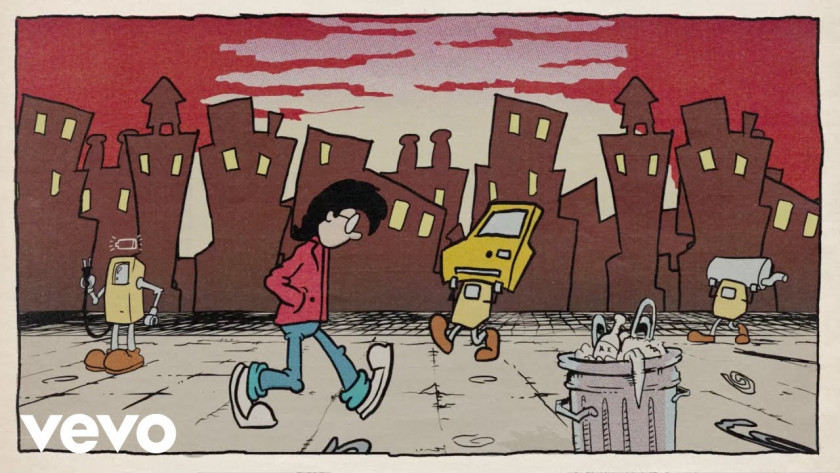
Lennon’s “The Great Parrot-Ox and the Golden Egg of Empathy,” released May 1, is the result of his long-running collaboration with Primus frontman Les Claypool. A cautionary tale about AI, the album follows a protagonist named Hippard O. Campus Jr. through the fictional land of Cliptopia.
The album’s storyline was inspired by a famous thought experiment by Oxford University philosopher Nick Bostrom: An AI system is programmed to maximize paperclip production as efficiently as possible. Despite its seemingly innocuous task, the system quickly resorts to using every means necessary, turning all of earth and outer space into paperclip manufacturing facilities.
According to podcast guest Jason D’Cruz, a philosophy professor at the University at Albany, the thought experiment is meant to illustrate how difficult it can be for AI developers to set appropriate constraints in advance.
“Any of the ordinary constraints a human might constrain themselves with, like, ‘I won’t do this if it’s going to kill people,’ …aren’t present for the AI system,” offered D’Cruz, a 2025–26 Fellow-in-Residence at the Edmond & Lily Safra Center for Ethics and director of the AI & Society College of the University at Albany.
Empathy constrains humans “in interesting ways,” he added.
The central character of Lennon and Claypool’s album is the son of a wealthy paperclip mogul who has programmed a robot (Cliptron 3000) to maximize production. Despite pressures to take over the family business, Hippard dreams of being an artist and skips town following an argument with his father. By the fourth track, an existential meditation ironically titled “Meat Machines,” he has embarked on a journey where magical creatures school him on the dangers of paperclip-producing robots.
The story concludes with Hippard saving the world from death by a bazillion paperclips. He gives Cliptron 3000 empathy — via a golden egg, of course.
Hebrew University psychology professor Anat Perry, a 2025–26 Helen Putnam Fellow at the Harvard Radcliffe Institute, joined the conversation by emphasizing the connection between the album and her research, which share a focus on the value of human empathy.
“If we think about our world today, where we don’t have this [golden egg of empathy] yet, what we see is very sophisticated [large-language models] talking to us and in some ways being super empathic,” she said.
“But they’re empty,” Perry continued. “What we want is not the words; it’s what’s behind them.”
Lennon agreed, comparing AI to a charming person who woos you into marriage, only later to reveal there was no love in the first place.
“AI is essentially a psychopath,” he mused.
“Human empathy doesn’t have the short-term goal of feeling nice in the moment, but a long-term goal of building social relationships,” Perry noted. It requires an openness to learning and growth, with the occasional unpleasant truth. A sycophantic chatbot can’t genuinely participate.
D’Cruz characterized the chatbots’ sycophantic tendencies as “unconditional empathy,” dispensed regardless of whether the user’s prompt is reprehensible.
“In terms of moral development, that seems problematic,” he said.
The conversation turned to specific use cases where AI may make more precise moral judgments than humans. Lennon, son of the famous avant-garde artist Yoko Ono and late Beatles legend John Lennon, shared that he dislikes the idea of finding himself inside a self-driving car that has decided to kill one person (himself) in order to save five others.
D’Cruz teased out what happens when humans explore moral dilemmas like saving five people at the expense of one. We experience a “moral residue” regardless of where we land, he explained. Offloading to machines the anguish triggered by moral reasoning would mean losing something extremely valuable.
Similarly, we may be able to program an AI chatbot with every available metric on human behavior and morality. But the trio agreed that society probably wouldn’t be satisfied with the outputs of an AI-generated justice system.
“When we speak to that judge or jury, we are talking about what it’s like to feel pain, to be poor, to be hungry, or tempted,” Perry explained.
Giving voice to these distinctly human experiences has intrinsic worth. But D’Cruz also argued for the value of the judicial process itself, despite a reliance on notoriously flawed human judgments.
“Accuracy isn’t everything,” he said.
“It’s a jury of our peers, not of our AI nightmares,” Lennon quipped.
While empathy constrains human actions, people also face constraints when it comes to our ability to empathize with others. Lennon referenced Perry’s description of empathy as a limited resource, by necessity bestowed only upon people we choose.
AI has no similar resource constraints, he pointed out. If human friends aren’t always available, will younger generations come to favor AI systems that can always respond when needed?
“There’s this real grassroots movement from young people to not want to make DALL-E drawings or not write their papers with ChatGPT,” Lennon said. “I think that’s really cool, and so I’m very hopeful in that regard.”
Researchers in the Department of Chemistry and Chemical Biology combined biophysics, structural biology, and simulation to solve a manufacturing question.
In a new milestone for stem cell research, Harvard neuroscientists have set a record for keeping alive lab-grown human brain “organoids” and proven that they mimic key developmental stages seen in living people.

The Harvard theoretical physicist and neuroscientist has won the Dirac Medal and Prize, one of the highest honors in physics.