Eric Moskowitz
Harvard Staff Writer
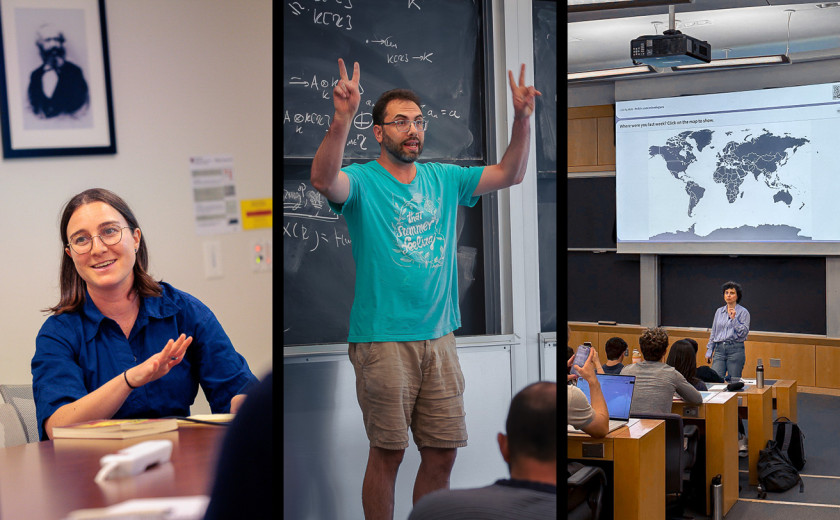
Three new Harvard faculty — in statistics, mathematics, and economics — opened their inaugural classrooms, each finding their own way through introductions, slides, and elusive chalk supplies
/ Read time: 8 minutes
Harvard Staff Writer
Amid the rhythms of the back-to-campus bustle — from Zimmer Hall to Barker Hall, Harvard Yard to labs in Allston — new faculty find themselves experiencing the same first-day excitement — and jitters. We dropped in on three, on the first day of their first classes.
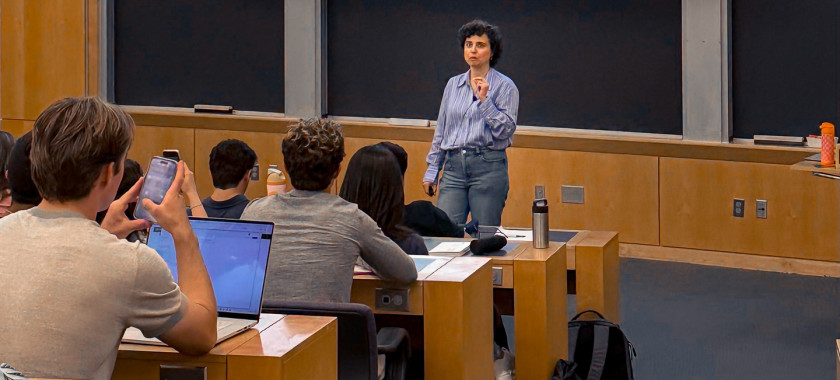
As 1:30 approached on the first day of the semester, Mine Doğucu walked the aisles of a 125-seat lecture hall at Maxwell-Dworkin, smiling and introducing herself to some of the students finding their seats for Introduction to Statistics. Then she went to the lectern, adjusted the settings on her laptop to optimize the slide display, and began.
“Hello everyone!” she said. “Welcome to STAT 100. I’m your professor, Mine Doğucu.” She narrated slides on how to pronounce her name (“Mi-neh Doe-uu-joo”), her first home (Mersin, Turkey, along the Mediterranean), and her most recent one, Los Angeles, where she spent seven years at the nearby University of California, Irvine.
“Just like our first-years in class, I’m new here,” she said.
She hadn’t planned to leave California, where she’d built a life with her husband, a painter. But last fall, after she reposted a job listing for a Harvard senior lecturer position — which she does often, to boost visibility for openings in her field — someone from the Department of Statistics reached out, encouraging her to apply. She flew in for an interview with modest expectations. On the return flight, she found herself asking a chatbot how to convince her husband to move to Boston. She accepted an offer in the spring and moved in June.
Doğucu shared some “fun facts” with the class: Turkish has no gendered pronouns; she has two cats (Mohsen and Mojdeh, pictured on screen gazing from a couch); and she lived in the 20th century. “That’s a very fun fact,” she said. “Those times were fun.”
That wasn’t as random as it seemed. She wanted to pack a lot into 90 minutes — dozens of slides, a robust introduction to the programming language R, breakout discussions, and a sprinkling of levity (a stand-up comedy clip about math, a Super Mario sound effect). She skipped a syllabus walk-through, instead emailing everyone in advance to take an open-ended quiz on the syllabus, so they already knew their first assignment would involve mining a Harvard Art Museums dataset for pieces acquired the year they were born.
She also shared a “not-so-fun fact” — she’d been a first-generation, low-income student herself, and offered to serve as a mentor. It tracked with an education calling she’d felt since childhood, when, at six years old, she led mock classes for neighborhood friends. She eventually earned her master’s in education and a doctorate in quantitative research methods, always knowing she wanted to teach undergraduates.
She reassured students they didn’t need programming experience or high-level math expertise, but they would need to push themselves at times. “I’m not telling you it will be easy — absolutely not — but it will not be so challenging that you’re going to lose your mind,” she said.
Speaking to the many first-years, she offered some practical advice, too: “If you cannot fit things on a calendar, you cannot do them. That is a skill to learn in college.”
She teased some of the questions statistics could answer — how companies benefit when employees work remotely, whether loneliness shortens lives, which Beatle wrote “In My Life” — before delighting in revealing that all three had come from Harvard research.
Reflecting later in the week, she was pleased she had imposed a no-tech rule in the lecture hall, impressed with the level of attention and interaction. She was glad she had mentioned being first-gen during her own time at Smith College. A first-year from similar circumstances came to her office hours the next day and thanked her.
“I think it helps students see that they can become Harvard faculty even if they have that kind of background,” she said.
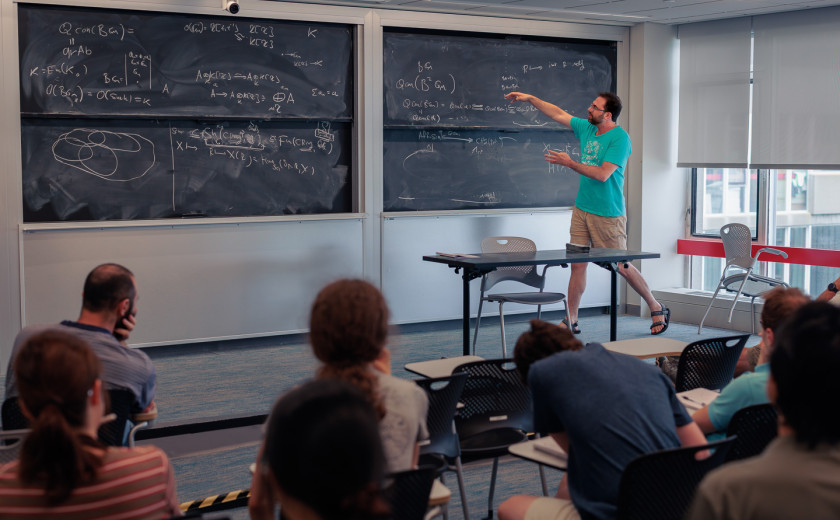
The 40 or so seats in the fifth-floor Zimmer Hall classroom were still filling when Tomer Schlank walked in for Math 290 (“Advanced Seminar on Gestalten Theory”) and began erasing the trio of blackboards. He wore sandals, shorts, and a graphic T-shirt proclaiming “that summer feeling,” but the expression on his face did not quite match those relaxed vibes. There was no chalk. He stepped out of the class for a minute, then returned, still chalk-less.
In a room of Gen Z graduate students from Harvard and MIT, a few eminent professors sat up front. Dan Freed, who first set foot at Harvard in the late 1970s as an undergrad and now serves as Shiing-Shen Chern Professor of Mathematics, rose to help. “You’re in your honeymoon period. After that, you get your own chalk,” Freed joked, before finding Schlank a piece.
Chalk in hand, the new professor of mathematics — whose teal T-shirt came from a concert for the cult-favorite singer-songwriter Jonathan Richman — dove right into the material, without introducing himself.
“OK, so what we’re going to do this semester is talk about this very exciting new theory developed by Scholze and Stefanich,” Schlank said. “The basic concept is this repeating phenomena in mathematics about a certain duality that we see between geometry” — “Hello, hello,” he added, as an arriving student and professor tiptoed past — “and algebra.”
He began filling the first chalkboard, as students took notes on tablets, laptops, and legal pads. Six minutes into the 3 p.m. class, Schlank was well onto the second board, speaking excitedly about “commutative rings” and “infinity-topos.” By 3:18, he was already peppering the third board with mathematical notations.
If he hadn’t quite realized that he didn’t introduce himself in the opening moments of Math 290, Schlank said afterward that it was because he felt less like he was starting a new class than rejoining an exhilarating, ongoing mathematical conversation.
The Thursday grad seminar is a longtime staple of the vibrant algebraic-topology and homotopic-theory communities bridging Harvard and MIT, organized by Michael Hopkins, George Putnam Professor of Pure and Applied Mathematics at Harvard, who has taught at both institutions. The topics change each semester, focusing on the latest discoveries in the field.
Though Schlank came to Harvard after serving on the faculty at the University of Chicago and the Hebrew University of Jerusalem, he had spent many hours in this room, during both a three-year postdoctoral fellowship at MIT and a later sabbatical in Cambridge. He knew about a third of the people present personally, and he figured the students he hadn’t met yet knew his name from enrollment. While he considered it an honor to have his name on the syllabus, he said it’s collectively taught, with a rotating cast of presenters.
Still, he’d been away long enough that some of the rhythms might have changed. An hour in, Hopkins raised his hand. “Tomer, it’s your show, but we have a custom of having a short break [at this point] so we can get tea,” he said.
Schlank may be new, but he shared a certain deadpan humor. “Maybe hearing me speak continuously without a break is hard on the soul, if not on the body,” he said. Ten minutes later, he was wielding the chalk again.
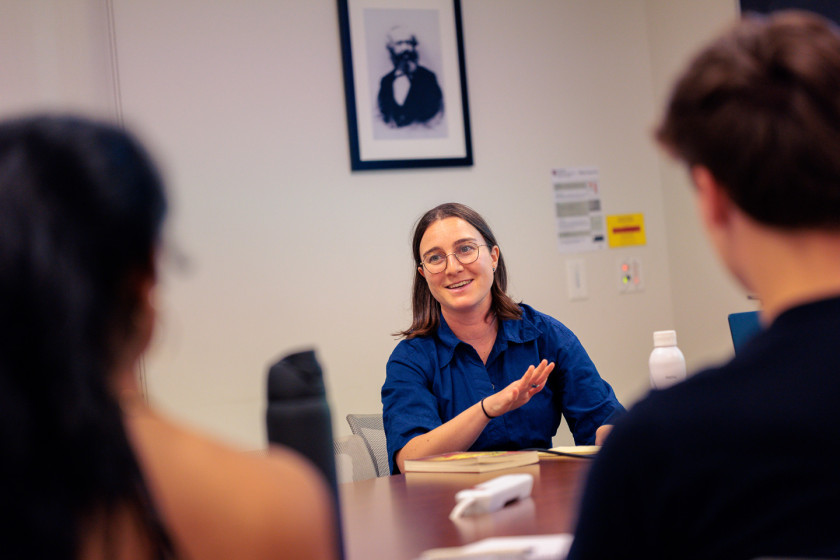
Unlike other new faculty, Anna Russo didn’t need to pack up and move. She had spent the last two years as a junior fellow in the Harvard Society of Fellows, with her appointment as assistant professor of economics and social studies waiting beyond it. But going into her first class with that new title, she carried a secret: She’d never formally taught. Her doctorate at the Massachusetts Institute of Technology had no teaching requirement.
“So it really is like my first day of school,” Russo said, preparing to teach “The Economics of Climate Change and Environmental Policy,” a junior tutorial for social studies concentrators.
She was more excited than nervous, eager to share her enthusiasm for the field of economics and for the tools and techniques of empirical research, in a class meant to guide juniors from coursework to independent research and scholarship.
She appreciated that the students, as interdisciplinary concentrators, would be bringing varied interests and levels of familiarity with economics. The class was capped at 10, and enrollment rose from three to nine in the week before class started.
A few students were already seated around the seminar table at William James Hall when Russo arrived. “Hi, I’m Anna — or, Professor Russo,” she said, catching herself. “This is my first time as a professor.”
“We’re really excited to be taking this class,” one student said.
“I’m really excited to teach it,” said Russo, who developed the course herself. “I wish I’d had a class like this when I was an undergrad.”
Russo quickly sketched her background. She’d entered grad school with broad interests in economic theory and research before gravitating to the environment, drawn to study its market failures and efficient and inefficient interventions. She now studies incentives and market design related to land conservation, climate-risk insurance, and clean-innovation funding.
Each week, she explained, the class would read a different economic paper, with a short writing assignment around it, and spend the first 75 or 90 minutes of class discussing those papers. “It’s OK — in fact, it’s more than OK; it’s expected — that there will be things you don’t understand,” she said. The rest of the two-hour class would be a “paper lab” to help them workshop the ideas and research that would become their final 20-25-page papers.
She asked students to share what drew them to the class or to social studies. They mentioned land use in Vermont, energy and geopolitics, music and “third spaces” in rural New England. Sylvie Wurmser, the lone senior, had already completed her junior-tutorial requirements but said the class seemed like the perfect way to incorporate quantitative analysis into her senior thesis on AI, agricultural regulation, and the level of trust between French farmers and their government.
“Awesome!” Russo said. “I have a co-author who’s actually doing an economic analysis of CAP” — the European Union’s Common Agricultural Policy — “so if you’re interested in talking to him, he’s nice.”
Wurmser beamed. “Already a win,” she said.
Then came the slides — “economists love slides, and I am a slide lover, but it’s not going to be a lecture” — and soon Russo was clicking through a series of images and graphs, from the choking “pea soup fog” of industrial London in 1928 to a hypothetical fishery-pollution scenario, engaging in a give-and-take with the students. The time passed briskly.
“Thank you, guys,” Russo said, gathering her backpack and filing out with them. “Hopefully see you next week.”
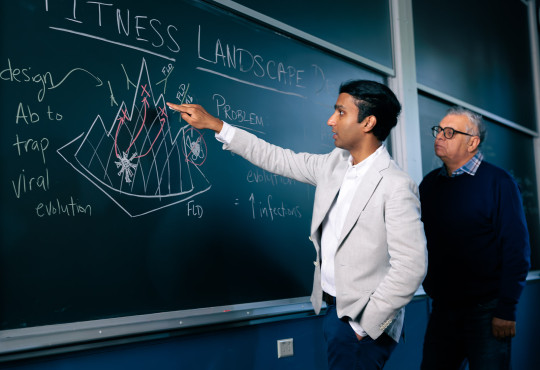
Two Harvard scientists describe a way to engineer the evolutionary landscape that viruses experience, pushing them away from dangerous variants and into evolutionary dead ends.

As the sun sinks below the horizon, two scientists perch quietly beside a darkening field and wait for flashes of light. They have traveled far outside the city in search of research sites, because they study a group of creatures that have been driven to the margins of human settlements: fireflies.
Through the Research Accelerator Challenge, donors raised $100 million for new endowed doctoral fellowships.