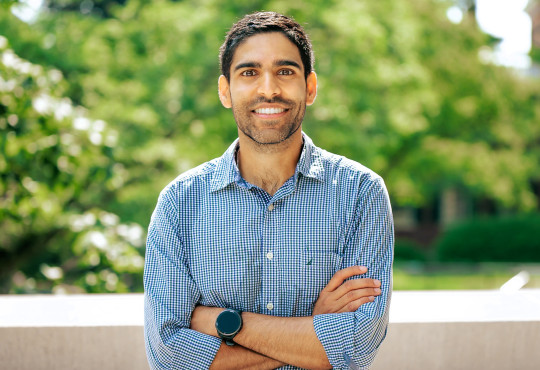
The “jobless recovery” from the 2008 Global Financial Crisis was the most severe in U.S. and Western European history — a marker Gita Gopinath, Gregory and Ania Coffey Professor of Economics in the Faculty of Arts and Sciences, attributed in her 2024 paper to the well-documented cycle of companies investing in automation during good times, but only shedding jobs at first sight of a downturn.
Today, the labor market’s exposure to artificial intelligence is “of a much bigger magnitude,” Gopinath recently observed. “The risk is that if we end up having a recession in a few years … we could go through a transition of very large job losses which is much bigger than what was seen after the Great Financial Crisis.”
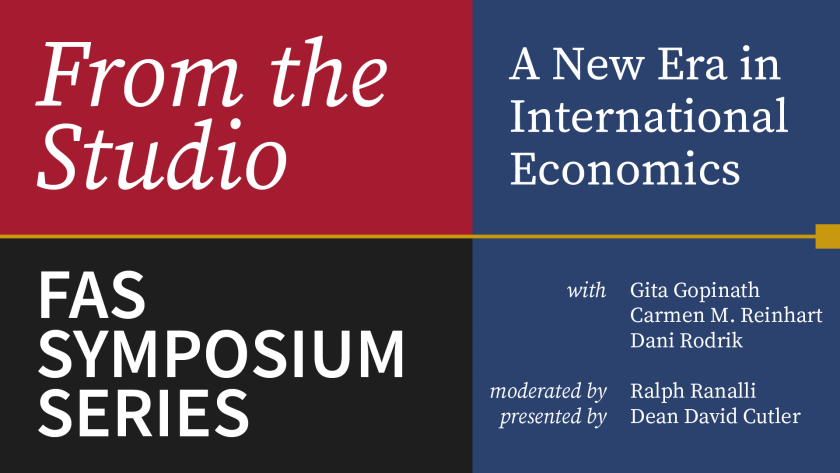
The former First Deputy Managing Director of the International Monetary Fund was one of three faculty experts to appear at this month’s “From The Studio” FAS Symposium. The live-streamed conversation, hosted by FAS Dean of Social Science David M. Cutler, touched on geopolitical hostilities, shifting trade alliances, technological disruption, and other topics of urgent importance to the global economy. A recording can be found on YouTube.
Dean David Cutler: Hello. I'm David Cutler, Dean of Social Science in the Faculty of Arts and Sciences here at Harvard University. Thanks for joining us From the Studio PFAS Symposium series. This initiative was designed to engage Harvard faculty on the most urgent and interesting topics of our time. Today, we've invited three experts to take stock of the current upheaval in international economics. For decades, the US sat atop the global trade and financial system. However, events of recent decades, including the 2008 financial crisis, the 2020 pandemic and the return of tariffs, have shaken the foundations of that world order. Our global economic system faces what one national leader described as, quote, "A rupture." What are the prospects for global growth? Will the dollar remain king? Who are the winners and losers in what's going on? Those are the questions we want to ask. I'm sure you have questions of your own for today's panel of experts. We put out a call for viewers to submit questions in advance of today's event. If you missed your opportunity, keep an eye out for future installments in our series. This will not be your last chance to pose questions to our esteemed Harvard faculty experts. I'd now like to introduce our excellent moderator charged with leading today's discussion. Ralph Ranalli is Host and Co-producer of the Economics for Inclusive Prosperity podcast, which is based at the Reimagining the Economy project at Harvard Kennedy School. In his eight years working for Harvard, Ralph has also been the Host and Co-producer of Policy Cast, the Kennedy School's flagship podcast. A former journalist, Ralph has worked as a television news producer at WGBH Boston and an editor at reporter for The Boston Globe. Ralph, take it away.
Ralph Ranalli: Thanks, Dean Cutler. These days, I'm finding it hard not to get vertigo when I'm just walking to the coffee maker in the morning. We're living in a truly dizzying moment, especially when it comes to global economics, when it often seems that the only certainty is that each day will bring more uncertainty. But, thankfully, at Harvard, there are also days like these, when you and I get to sit down with leading scholars and brilliant minds to ask questions and have discussions that shine the light of knowledge and insight through the fog. So it's my privilege to first get to introduce the members of this stellar group we've assembled here this morning. First to my right is Professor Dani Rodrik, the Ford Foundation Professor of International Political Economy at the Harvard Kennedy School. Professor Rodrik is the Co-founder and Co-director of the Reimagining the Economy Project at the Malcolm Wiener Center for social policy at HKS, and a visionary voice on the post-globalization world economic development, international economics and political economy. He's also a former President of the International Economic Association and a Co-founder of Economics for Inclusive Prosperity, an international network of economists committed to an inclusive economy and society. His latest book is titled Shared Prosperity in a Fractured World, A New Economics for the Middle Class, the Global Poor and Our Climate. Welcome, Dani. To Dani's right is Professor Carmen M. Reinhart, who is the Minos A. Zombanakis Professor of the international financial system at Harvard Kennedy School. Professor Reinhart is the former Senior Vice President and Chief Economist at the World Bank Group, and a former Policy Advisor and Chief Economist at the International Monetary Fund. She has advised numerous other institutions, including the Federal Reserve Bank of New York and the Congressional Budget Office. She's a member of the group of 30, and a senior fellow at the council on Foreign Relations. Widely recognized as one of the top economists in the world on financial crises, sovereign debt, and international capital flows, her influential book—This Time is Different, Eight Centuries of Financial Follies—has been translated into 20 languages. Carmen, welcome. And to Carmen's right is Professor Gita Gopinath, who is the Gregory and Aeneas Coffey Professor of Economics at Harvard University. Professor Gopinath is the former First Deputy Managing Director of the International Monetary Fund. Prior to that, she was the IMF's Chief Economist and Co-authored the Pandemic Proposal, which set globally endorsed targets for vaccinating the world. She's a leading voice on the dominance of the US dollar, exchange rates, trade and investment, international financial crises, monetary policy and debt. She's also a member of French President Emmanuel Macron's G7 economist group on global imbalances, a member of the European Investment bank's global advisory council, and co-editor of the handbook on international economics. Welcome, Gita. So let's get started. Well, I thought we were going to open with maybe the future of the dollar as a reserve currency or perhaps tariffs, but as the old saying goes, no plan survives the first shot being fired. So, the US and Israel have started a War with Iran, and critics are saying that the Trump administration has given mixed signals about what the objectives are beyond regime change. In response, Iran is attacked Gulf states and the Strait of Hormuz, a transit corridor for 20% of the world's oil, which is now effectively closed. Oil prices are surging, adding to the global economic stress already caused by a year of tariffs and uncertainty. So I'd like to ask the panel what they think the global and US economic fallout will be from anything other than a very short conflict. So, Carmen, you wrote the book on crises, would you mind starting us off?
Carmen M. Reinhart: Well, of course, the big unknown is how long the war will last. And the estimates range from the initial few planned weeks to who knows. But, directionally, you've already alluded to the obvious, the spike in oil prices. The spike in oil prices, in turn, is reminiscent to some degree of the double whammy that we had when Russia invaded Ukraine, in which you had a surge in oil prices, accompanied by a surge in food prices. At the moment also things like fertilizer prices, shipping prices are all on the rise. Translation, higher inflation risks. Higher inflation risks imply that a lot of the forecast of a very gradual but nonetheless decline in interest rates in the US and elsewhere is being questioned. So, worse inflation outcome, worse growth outcome, more uncertainty—you've already alluded to that—that is the nuts and bolts of the impact of the war globally. However—I will conclude here—for those that had already sounded the death toll on the US dollar's role as a reserve currency, we have seen a resurgence in the dollar as the classic flight to quality has taken root.
Ralph Ranalli: Yeah. I definitely want to get to the dollar next, but, Dani, what's your thoughts on—
Dani Rodrik: Well, I agree with everything that Carmen said. As she said, directionally, we know what the immediate effects are going to be on market prices and so forth. But I think trying to draw out some of the broader implications, I think it's important to—I mean, we live in a world where it's—the world—the future is always uncertain. And if you get to—if you're really in a bad state, if you're asking economists to project not just the future of the economy or the global economy, but to make projections based on what the global geopolitical situation is going to be. But, I mean, it's much worse than that because in the past, we could say, well, we can assign worldly probabilities to different outcomes. Today we're in a world where what economists call it's really a world of Knightian uncertainty, or complex uncertainty where there are outcomes that we can't even imagine, that we cannot really—so, the usual kind of risk assessments that we do are not very appropriate. The way I think about it is that we're already a year and a year and a half now with—certainly with Trump coming into office, we've had a lot of shocks to the world economy, a lot of uncertainty being thrown into the system. And the world economy as a whole has actually proved resoundingly, surprisingly, unexpectedly, relatively unaffected by that. But I also suggest that there is a kind of a disconnect between the fundamentals and the actual performance. I think in the US, it's driven by a kind of expectations about this AI boom, there are optimistic expectations, but the psychology I think is very fragile. So I think the big unknown here is, beyond the immediate effect on prices, if this kind of a crisis fundamentally leads to a dissipation, dissolution of this kind of optimism that is still driving US growth and is driving a certain amount of stability in the rest of the world, then I think that's—if you ask me what kind of probability you would put on that, even though I just said you can't put probabilities, I think it's a decent probability. It's a 20% chance that we might be really looking at something much worse.
Ralph Ranalli: What are your thoughts on fallouts and in this incredibly complex situation we're in?
Gita Gopinath: Yeah, no, Dani and Carmen made several great points. And, actually, there are several specific points I wanted to respond to. So, firstly—just building on what the economic consequences will be—yes, it does depend on the duration of this war, but we know that it affects different countries differently. And we saw that during Russia's invasion of Ukraine when energy prices went up, it was not so—I mean, the US was on the positive side of that trade because the US exports a lot of energy. On the other hand, Europe was on the negative side of that trade and got negatively impacted by it. If you're a country that's obviously in the region, in the Middle East, it's a problem not just because of living in a war zone, but also the loss of tourism that comes around, usually, when you have a conflict of this kind. So, completely seconding what Carmen said about those who are asking about what—is this the end of the dollar and dollar dominance and so on, I think what played out these last few days—just to tell you that end the story, I will also mention that since this administration has invoked section 122 saying that the US has a fundamental international payments problem, I think what we saw in the last few days will tell you that I don't think the US has an international payments problem. When there is any kind of a crisis or an emergency, you do see most of the flows moving towards the US. You saw it pulling out of emerging markets. If you see where the stock markets have corrected the most, they've corrected mostly in emerging markets, a little more in Japan too, in Europe, least in the US, and the dollar has strengthened. Now, the dollar strengthening also has to do with the inflation that could come about in the US and the consequences of that and keeping interest rates higher. And the reason that the markets have reacted the way they have is because energy prices have different effects in different parts of the world. If this all ends in four weeks, we are talking about—in terms of global growth—a very small effect of 0.1 percentage point, maybe, and maybe even less than that. But the duration really does matter.
Dani Rodrik: Can I just come in on the dollar here because I just want to say something maybe that puts a slight disagreement on. I agree that the effect of the current crisis, the Iran crisis on the dollar, has been to strengthen it, to show that maybe the US is still the safe haven and so forth. But if we go just a few months, a year earlier, we looked at how the effect—what the effect on markets was when Trump first started putting on its tariffs. There we got, actually, a result that was very different because usually we expect that when the US puts trade restrictions on, then we expect the dollar to appreciate. That's normal economic mechanism. But in that case, actually, dollar depreciated. I thought at the beginning of the Trump administration, the response of the US markets to what Trump was doing was actually a very clear vote of no confidence in the US. So, I think if we just take a bit of a longer perspective, I'm not so sure—I think the problem is, of course, there are no clear alternatives to the dollar, but it's no question that people just want to get away from the dollar if they can.
Gita Gopinath: I mean, Ralph, I know you're going to want to ask more questions, but I think there are ways to—
Ralph Ranalli: No, take it away.
Gita Gopinath: I think that episode should not be read the way Dani read it. I think there is a nuance to, I guess, what Carmen and I said, but I think is more nuanced than a big difference. So, how do you interpret what happened to the dollar when the Trump tariffs were first put in place? So what happened when the tariffs were put in place, well, there were two shocks. There was one, there was the tariff itself. But there was also this tremendous increase in uncertainty. And a sense that the US did risk entering a recession, which is what was some of the big remarks that were made. Which, obviously, has an implication for interest rate policy, and then, therefore, that could have an effect on the exchange rate. But I think that got reinforced with the fact that I think people realized that the dollar can actually depreciate after a whole decade of just constantly appreciating, that the dollar could depreciate. And so you had many foreign companies hedging their dollar exposure. And so I don't think you necessarily need geopolitics to explain it. You've had periods when the dollar has appreciated for 10 years and then depreciated for several years. And so even without the geopolitics, you could—there's a good reason to hedge the currency, and that hedging is, I believe, playing an important role on the currency. Now, again, I'm not saying that there has not been certain shifts in how people view investing in the US and the dollar and so on. I think I'm trying to make a very stark point by just saying that for those who think that, OK, we're at the end of dollar dominance, I think we're far from that.
Dani Rodrik: I totally agree with that.
Ralph Ranalli: Can I bring Carmen here, because, Carmen, you had said back in December that you were worried that US officials were complacent about the dollar's continued role in the global economy. What did you mean when you said there was complacency?
Carmen M. Reinhart: Well, I will go back to the dollar issue. That, importantly, had to do with complacency regarding being able to place any amount of debt at the usual low interest rates that historically the US has faced. And, indeed, if you look at debt servicing costs for the US, they have risen significantly after the pivot in Federal Reserve policy. So, that was the context of that. But while we're on the dollar, look, I think the dollar goes up, the dollar goes down, the dollar goes sideways. That's short term. I think the question of dollar dominance is a secular one. And the absence of alternatives is very important. And China's enormous footprint on the global economy doesn't translate to a convertible currency. I always cite Rudi Dornbusch when he said that people go to a party when they know they can leave whenever they want to, and capital controls are a big impediment to a global currency. Europe has a single currency, the eurozone single market, but the debt markets are very fragmented. Greek debt is not the same as Irish debt, it's not the same as Spanish or German debt, so we don't have the unified alternative to the Treasury market. That said, I take very much Dani's point that we have seen some de-dollarization in some pockets—importantly, starting with Russia, China. The appetite for treasury seems to have diminished, yet the appetite for other dollar assets the US equity market and US corporates, US corporate bonds, have been quite frothy.
Gita Gopinath: So, I wanted to lens out in the bigger picture because the dollar—I think dollar dominance is going to be affected structurally by what's going on with deglobalization and—potentially what you could call reglobalization. So the question, I think, is are we undergoing deglobalization or reglobalization? And what are the—and what's taking the place of the system now? I think what we are seeing are shifting trade linkages. So, the overall headline number for global trade doesn't signal in either direction whether there's an increase in global trade to GDP or there's a decrease in global trade. It's relatively flat. I think what we should also keep in mind is that the more countries have to reroute how they sell goods to other countries, that's just going to mechanically make trade to GDP increase because we keep counting them many times over. So that's a less interesting statistic at this point. What is interesting is to look under the hood and to see what's happening to who trades with who. And so I have some research on that, which we did with co-authors, which basically what we do see based on data that precedes the past year, but based on that data, you did see that countries are trading more with—they're trading their allies than they are across with other countries that are not their allies.
Ralph Ranalli: Was that the 2024 IMF paper?
Gita Gopinath: Yes, unchanging—
Carmen M. Reinhart: Yes.
Ralph Ranalli: Can you talk about those parallels between what's going on now and that Cold War era of trading blocs?
Gita Gopinath: So, based on that particular paper, what we showed was that there was this similarity in the sense of trading more within your bloc as opposed to across blocs. But what was different, or what is different this time around is the role of the non-aligned countries who have played the role of connector country. So, prior to 2025, we saw, for example, Vietnam, and even Mexico, playing the connector country role. So while China was not directly trading with the US, China through its factories in Vietnam, and through also its factories in Mexico and also some of it just simply through rerouting through Vietnam, was telling to the US. That was a phenomenon that didn't play out in during the Cold War. But I do want to point out that 2025, things have started changing a bit, which is that previously, while Mexico played an important connector country role, it looks less like it's playing a connected country role. And I think that is because of the pressure that's been put on Mexico from the US in terms of their trade relations with China. So, who is your ally? Who's not an ally? Is now a less clean classification.
Ralph Ranalli: Yeah. Dani, you as long as a decade ago, you were counseling people not to be over concerned about deglobalization, saying it would open the door to things like progressive tax reform, enlightened industrial policies. Has your thinking on that changed at all or—
Dani Rodrik: Not really. So, I think—I'm glad you mentioned reglobalization, which I'm going to interpret a little bit differently. But I think the whole debate about, are we going furthering globalization or de-globalization, I think misses lot of the nuances, the kinds of things that, for example, Gita is talking about, the redirection of trade. It looks like, US imports from China have collapsed, but you look at now there is a corresponding increase in Vietnam and recently to—from Mexico and so forth. So it's really—if you look at, again, at the long stretch of history, globalization has really gone through many, many different cycles and different forms. And the only time that we can really say that we had significant de-globalization ever since the Industrial Revolution, if you will, is the interwar period between the First and Second World Wars where there was—went alongside with the Great Depression. Instead, what we've seen are different forms of globalization. The gold standard was one form. We've got the Bretton Woods regime, which was a different form. And then we got what I've called hyper-globalization or post-1990 regime with free financial flows and the WTO, and so forth. So I think now we're coming—we're getting into different types of globalization where I do think, as Gita said, that trade will tend to be much more regional, much more intra-bloc trade, but not without a huge amount of reduction in trade per se. We can't go back to the Cold War because there's—the production and supply chains are still so integrated that it's impossible to imagine a world in which the China does not remain a very large supplier of goods on world markets. So it'll be qualitatively different. I think countries are going to pay a lot more attention to domestic problems. Those issues of equity, how you build a middle class, how you answer—you respond to questions about the environment, climate change, those are going to layer economic policies in ways that it didn't really necessarily exist in the last three or four decades. So it's going to be a different form of globalization.
Ralph Ranalli: Carmen.
Carmen M. Reinhart: Let me stay on the, first, the kind of philosophical issue and globalization. I think economists did a very poor job in explaining globalization. Trade was often seen as a win-win, right. Everybody is better off. And in a lot of the trade models that is grounded on, assume that the losers get transfers, those transfers never happen. So I would say the illusion of globalization as this universal good was punctured a while ago. I would also say that since the global financial crisis, we've seen a significant—notwithstanding the important very regional changes in the pattern of trade that has taken place—the overall growth was cut in half since the global financial crisis.
Dani Rodrik: The overall growth—
Carmen M. Reinhart: In global exports.
Gita Gopinath: To GDP.
Carmen M. Reinhart: Real global exports. So, a global measure of trade. And I don't see that entirely as an accident. You had the crisis then you had Brexit, you had tariff wars. However, what we haven't seen in which we did see during the sharp deglobalization in the interwars was capital controls. Now, going back earlier to what could really shock the dollar if you really wanted to see a stampede out of the dollar, it would take something like the introduction of capital controls in the US. Not that that's been on the table, but then, again, I did not think 19th century tariffs were also on the table. So, what I'm getting at is, yes, the euphoria period, if you will, of what globalization did, and particularly what it did for a number of export oriented economies in Asia, that euphoria is over but I wouldn't say that we're back to autarchic.
Ralph Ranalli: Yeah. So, I'm glad you mentioned tariffs because I did want to talk about tariffs and uncertainty. And, Gita, you said something interesting. You said 2025 was the year where everything changed, but somehow nothing did. Can you just explain what you meant by that.
Gita Gopinath: Yeah. So, this is—actually this ties into what Dani said at the beginning, which is we have so much uncertainty. We had also last year was a year when tariffs went back to 19th century levels and moved around a lot after that. There was so much uncertainty about economic relations with other trading partners, and still the world economy performed exactly as we would have expected without any knowledge of any of these shocks if you look at projections of how the world would do. And so the point was everything changed, and yet somehow nothing did, because it looked like everything is just going on. And I wanted to basically—I wrote that piece because I wanted to point out that, just be careful. I actually think everything has changed. It's just that takes time for the effect of those changes to play out. And one of the examples, of course, is Brexit where right after Brexit and in the run up to it, the sense was that this would be really damaging for the British economy, that investment would collapse and there would be large effects. And then two years went and the investment kept going up in the UK, and it looked like, wow, that was much ado about nothing. But then it slowly worked through the system. And now, if you look back, the estimates of the effect of Brexit on the UK economy are very large, about 6% or so. I'm not saying that the US is the Brexit case, because the US is much more domestically dependent in terms of consumption than the case of UK, but there's a lot of other things happening in the US too, which could affect institutions, which affect relationship with Europe, with its biggest trading partner, that you could end up with damage playing out over time if this pace of turmoil keeps going. I want to make one more point, which is—I know Dani said something, which is that the way the world performed surprised everybody—was very surprising. I want to be careful because, I mean, economists always get a lot of pushback for, oh, well, you guys thought the world was going to go to hell in a handbag, and it didn't. And that's actually—I think that that is what is incorrect is people who make those statements, that economists said that there was going to be something really bad. If you go back, just simply look at projections, for example, from the IMF and what global growth was going to be, it was off by like 0.1 percentage point. I don't think we should be making a big deal about that. What has happened, obviously—which offset a lot of the negative effect of tariffs—is that, one, the tariffs were never as bad as the sticker shock in terms of what it should be. But then you had also important offsets from AI, the investment that happened with AI, the trade that came about with AI. And also fiscal support and stimulus, expansionary fiscal policy in many parts of the world, including China, including Germany. And that is still feeding through the global system.
Carmen M. Reinhart: Like Gita I've used extensively the Brexit comparison, because nobody doubts that the combination of inflation and growth in Britain has tilted for the worse over time. Two illustrations of it takes time is, OK, so, everybody knew that prices in the US would somehow respond to tariffs. The impact was not immediate. And what it seems to be happening, as the data begins to gel is that a lot of the initial impact was absorbed by profit margins of the firms, but that now passed-through to the consumer prices has begun. That's on the inflation side. On the growth side, I think we have to be very careful. I agree with both Dani and Gita that the uncertainty factor is huge. The basic textbook tell you uncertainty increase is expected of a decline in investment. Well, we haven't seen that because it's been masked by AI. But, outside of AI, you don't have, by any means, very buoyant investment picture. It's just that the AI effects have been swamping the aggregates. Here's another area where it's important to look at desegregation.
Ralph Ranalli: Yeah. Would we be in a recession if it weren't for the AI investment?
Gita Gopinath: No.
Ralph Ranalli: No?
Carmen M. Reinhart: No.
Ralph Ranalli: So, Dani, on tariffs, Dani, I wanted you to jump in because you're not anti-tariff. You've advocated for moderate tariffs, targeted ones as a complement to industrial policy. But you just say like indiscriminate tariffs are—
Dani Rodrik: Well, I mean, I've always held the view—which is I think is close to what economic theory says—that moderate tariffs don't have huge effects. So for a long time I was in a minority in the economics profession when countries were reducing their tariffs and signing free trade agreements. And I was saying, look, this on its own is not going to be a huge contributor to economic growth, so I wouldn't have thought that moving in the other direction would have necessarily have been—caused a collapse of economic activity either. But I think the big—still, to me, the big surprise is what Trump did in the first year in his office was much more than just play around with these tariffs, as Carmen suggested, just throw a huge amount of uncertainty into the system. And that can't be good. And to me, the surprise still is—we economists are always very good— we can always write—we come up with an explanation after the fact that's going to, and explain what came out. And I engage in a lot of that myself so I'm not criticizing anybody on this panel. But I think from an ex-ante standpoint, I mean, I do think that it is surprising that it hasn't been. But I do think we're running a lot on animal spirits on this psychology of expectations around AI, that that's going to be a very big thing and we don't know how much of that is actually true. There have been bright spots in the economy. I point to Spain, like Europe is a huge—hasn't been doing very well. But you look at Spain, Spain has been growing faster than the United States. They have done incredible amounts. None of it is AI. And so countries that are able to do the right things for themselves are still able to prosper in this kind of environment.
Gita Gopinath: I just want to jump in. I feel like I'm the one who is saying can't listen to economists and Dani is saying it shouldn't. This is not a statement that once we saw the data, then we're trying to explain what happens. I'm just saying just go back and look at predictions of what was supposed to happen to the global economy based in June or July once you got past those liberation day scare and people had no idea where the tariff was going to hit. Those predictions took into account the fact that when you look at the effect of uncertainty on GDP, it comes with lags. And so it would show up—it would accumulate and it would add up, but would very rarely shows up as a big impact right away. So it has—I think it's a testable thing. You can go and you can look at forecasts and you can say what was it.
Dani Rodrik: I don't disagree with what you're saying, Gita. I guess what I'm saying is that for every chapter of that world economic outlook can identify 10 economists who spoke to the media at the same time saying that this was going to be disastrous.
Gita Gopinath: That's a question of when you were asked on a day when tariffs on China are going to be 120% versus if you're asked on a day when the tariff on China is going to be 50%, you're going to get different predictions.
Ralph Ranalli: So I did want to turn to AI, because I think the big question on a lot of people's minds is, is there a looming AI bubble, and one that's in danger of bursting? And if it does, what are the likely effects on the global economy, particularly in the labor force? I think when you were at the IMF, you acknowledged there was a potential for AI to boost productivity, but you were also issuing some pretty strong warnings about risks of labor market disruption, potential long term unemployment, and also the amplification of economic downturns. So, how could AI turn an ordinary downturn into a full-blown economic crisis? And Carmen, I would love for you to weigh in on this as well, the same topic.
Gita Gopinath: So, I mean, AI is hugely transformative. If that was the only thing that was happening right now in the world, we would have enough to think about and talk about because it is I think the biggest technological transformation that we're seeing in our lifetimes. And it affects every single sector. And it's showing up in so many different ways. I think this is the risks and there's huge opportunities. That particular piece you're referring to was one that said, let's—what happens in an otherwise plain-vanilla recession if you have a few years of automation building under the surface. And it was basically pointing out that if you look at previous waves of automation related job losses, like around 85% of those automation related job losses happened in the first year of a recession. And so the idea was that before a recession, when things are going well, companies are automating. And even if their workers aren't really adding as much value as they did in the past, it's a good economy, they're making enough money. They're not trying to lay off anybody at that time. But then you hit a recession, and that's the moment when you say, well, OK, I have a perfectly good argument for why I need to get my house in order. The first people are going to lose jobs, there are all these automated jobs that got automated, and that's what happened after the great financial crisis. And it was one of the reasons why for a long time we kept talking about jobless recovery. We talked about how the economy had come back very quickly, as in terms of GDP, the fact that the stock market had come back very quickly, but unemployment stayed high for a very long time. And part of that was just basically you had the automation related job losses, and it wasn't clear what work these workers could do. And so it took some time to clear that market again. Now, the exposure of labor markets to this new technology AI is of a much bigger magnitude. I mean, every estimate that's out there is very large. I mean, that doesn't mean that eventually we could have all the jobs in the world, new jobs in the world that you find something, but the risk is that if we end up having a recession in a few years, without having all those new job opportunities crop up, we could see—we could go through a transition of very large job losses, which is much bigger than what we're seeing right after the great financial crisis.
Ralph Ranalli: Carmen.
Carmen M. Reinhart: So, on AI, let me just make two. One is the bubble question. The other one is a longer term. If you take US real per capita GDP growth from 1790 onwards, look at various types of trying to estimate the trend, leaving out World War I, World War II and the Civil War, and you look at big deviations from that trend, you see some around the 1930s during the Depression, and that's about it. In the meantime, we've had railroads, we had the telegram, we had the internet, and we've had a lot of technological advances that had—that indeed touch every sector of the economy. And so, I do have doubts that a lot of the euphoric expectations about the impacts on long-term growth are maybe this time is different, I don't know. But let me—so, I think we need to look at it also from the prism that this is not the first time we have major economic advances in technology that shape aggregate economic outcomes. On the bubble, for years I've taught the financial crisis course at the Kennedy School. And a point I always make is bubbles are very easy to identify in the rear-view mirror. Ahead of time, you won't get the timing, but you can talk about symptoms. Are the symptoms there? And the answer is yes. What are they? Starting with a very obvious, price earnings ratios, OK. The dialogue which is more qualitative than quantitative. However, earlier on, what you saw was the recurring mantra that, well, it isn't being debt financed. Well, that has changed in the last year and a half. So, there's been a lot build up in credit, including now credit risks surfacing and credit spreads widening. So a lot of this is debt-fueled asset prices. So, they're important departures in all those areas that do point you to the bubble, but I reiterate my point that getting the timing of a bubbles burst has been an elusive, even Sir Isaac Newton got it wrong in the South Sea bubble.
Ralph Ranalli: So, Dani, you've had—a lot of your work's been about labor markets, the future of labor, and equitable development. How are you factoring AI into your thinking and the transformation? Because AI is going to affect white collar service jobs, and you've talked a lot about how service jobs could be the future of global employment. How are you factoring AI into your models?
Dani Rodrik: Well, I feel very safe to make the following prediction, that AI is really either a bubble or it's not. But here is the same prediction, that in either case, we're not prepared. If it is a bubble, then, as Carmen said, we can't time when the bubble is going to unwind, but it's going to have very serious consequences because the rest of the fundamentals in the world economy, in terms of sustaining growth and living standards, are not very encouraging at the moment. And then if it is not a bubble, this is a real thing, then we're not prepared because of the consequences for labor markets. That's the types of things that Gita was talking about. Now, I do think there's a difference in principle between AI and earlier waves of technological change, mainly automation. So when you put a robot in a factory that is directly meant to replace a worker, so robots and automation have very direct effects on labor displacement. AI in principle, what it does, it makes available the knowledge, the skills, the experience of the more skilled, experienced, educated professionals, and makes them available to those who are less skilled, less experienced. So it has the transformative potential that could actually be much more broadly beneficial, but not under, I think, our existing institutional arrangements when we're essentially leaving it entirely to big tech and the developers of AI to simply follow this in a way that we haven't really, essentially, gotten our minds around to how are we going to appropriately regulate AI. And make sure that the way that it is deployed in the workplace is not simply to produce and intensify division of labor that ekes out the maximum surplus from workers as opposed to giving them the tools, the agency, the autonomy to be more productive and be much more part of the management team. So those are different approaches to how AI can be displayed and used, but we're not really at a stage where we're really thinking about how to achieve that.
Ralph Ranalli: Yeah. I mean, I think one thing that AI does in terms of who's pushing AI and who's affected by AI, brings into sharp relief the question of economic inequality. So we're experiencing levels of inequality that haven't been seen since the Gilded Age. The amount of wealth accumulation is at record levels, along with the acceleration of the pace of wealth accumulation is at record levels. We did an episode of the economics for inclusive prosperity podcast recently where we talked about how it wasn't just a moral problem, but it was a macroeconomic problem. So my question is, on wealth inequality, is are we—is it sustainable? Or if the trends keep going the way they are, is there going to be a big macroeconomic problem caused by economic inequality?
Gita Gopinath: I mean, I think that, firstly, what you were referring to was the work of Atif Mian that shows that when you have high amounts of inequality, it's a macro problem because there's not enough demand in the economy when all of the income is sitting with very few people. That has also come up with AI, which is if you end up in a world where only few people have all of the income and the others don't, you could end up similarly with that kind of a problem. So, firstly, I think what we have to seriously think about is how we tax and who we tax. Right now most of the taxable income comes from labor income, and not from capital income. And there's good reasons for that, you want to keep the capital income tax rate low. But if we end up in a world where if it is the case that AI indeed leads to a transformation where the labor share goes down by a lot more and the capital share goes up by a lot more, you can't run the kinds of programs you're running in terms of all the entitlements and everything without having a higher capital income tax. So, it's just not viable, and so that would be the potential direction of tax of travel. And it's not easy to tax capital. I think government can do a better job than they do. I think there's a lot of leakages that happen, even though they have capital income taxes there. There's always this talk about taxing wealth. I mean what you—a better tax than taxing wealth is capital income tax, because you—first of all, you can do that on a much more predictable basis. You're not doing these one off capital wealth taxes. So more can be—more will need to be done there. But I don't think we will get there without huge amounts of social turmoil. We're not going to get to a world where everybody's losing their jobs and somehow the economy is still moving along. I think that there could be a lot of social unrest. I mean, there's also other kinds of civil pushback that's coming from data centers that are coming up in different communities from the effect of that on energy prices. So you could see a lot of discontent coming out even before we see big inequality increases in wealth gaps.
Ralph Ranalli: Quickly, if you guys want to weigh in, we're going to get to some audience questions.
Carmen M. Reinhart: Let me just add to that. The labor share of income in the United States has been trending markedly lower since World War II, down about a little over 10%. However, since the global financial crisis, it's really steepened. And, as Gita was saying, this is huge budgetary implications and it doesn't really sit well with the fact that we have ballooning public debt. And if you think the debt to GDP is eye opening, the debt to revenues, to tax revenues, are even more eye opening. It's one of the lowest in the advanced economies. So, there are clearly big shake up budgetary implications of these trends.
Ralph Ranalli: Dani, you want to weigh on?
Dani Rodrik: Well, there's—I mean, there's the channel of the macro, the fiscal, what it implies for how we pay for our social expenditures, but I think the part that is equally important, I think is what it does to people in their everyday, ordinary life if work disappears or it becomes much less meaningful. So we've lived this with the China shock and with the previous automation shock, and in Europe, with the austerity shock. And I do think a lot of our social political polarization and the rise of authoritarian populism with the scarring of our labor markets because of these technological and trade shocks that we've had. And AI is going to be—if we don't handle it well, it's going to be many, many times bigger.
Ralph Ranalli: So I'm glad you brought up China because it's time to get to some questions that were submitted by the audience. So we have a question that says, since China depends on oil from Iran, will the war in Iran push China to invest even more in renewable energy, thus gaining an even bigger energy advantage over the US? And how will it affect the balance of economic power between the US and China?
Carmen M. Reinhart: I would add that the war has highlighted in an important way that the US, no one benefits, some are hurt more. You see this in the spread between the WTI and the Brent oil prices. The US is an oil producer. China is not. It's an oil importer. It's hard to say, again—depending on the duration of the war, but China also importantly—let us not forget imports a lot from Russia. And one thing we have not brought up in the context of the global effects or geopolitical effects of the war is the fact that Russia actually stands to benefit. So the Middle East war is also going to have implications for the Russia Ukraine. My simplistic answer is China is not a net producer. They are over the short run and medium term, I think, on the adverse effects. Adverse effects are likely to dominate.
Ralph Ranalli: So Dani, we have a question that was specifically for you. Professor Rodrik, as globalization is retreating fast, sovereignty was always relative in many countries and democracy is on the defensive. Have you updated your famous trilemma? Maybe you could start with a brief explanation of the famous trilemma.
Dani Rodrik: No, I really forgot. [LAUGHTER] Yeah. So, let me just try to—if I can maybe just start with the question about China. So I think we haven't—I'm glad the previous question came about renewables and so forth because we haven't talked about climate change, and that's, obviously, a huge issue. And if there's one silver lining in the current geopolitical predicament and the war in Iran and the increase in the price of oil is that from a climate change perspective, that's what we want. We want fossil fuels to be expensive. And if the answer to that is going to be China and other countries pushing much more quickly into renewables, that's a good thing. I think China, 10 or 15 years ago, made the clear strategic decision that the future was going to be renewables, made a huge investment in it, and provided the world a huge global public good by lowering the price of renewables. And that's the best thing that has happened in our fight against climate change in the last 15 years. So I think we have to keep also the whole climate change picture in mind. And I think high fossil fuel forests or high oil prices from that perspective is actually a good thing, not a bad thing. Now, let me just say very quickly about economic—about nationalism per se. I think there's a lot of hand-wringing about the increase in economic nationalism. I don't see that inherently as a problem because I think national governments always pursue their national economic interests. And the problem with, let's say, with Trump is not that he's suddenly pursuing US national interests as opposed to previous administrations that supposedly did not, or did it to a lesser extent. Is because I think the problem is that Trump has the wrong conception of what the US national economic interest is. I think he's pursuing policies that are totally at odds with what the US economy requires. I think the best gift that any single country can do for the world economy is to actually take care of its own economy. And if they does that, that's generally a good thing for every other country as well. So I'm a lot less worried about countries turning inwards in the sense of prioritizing their own national economic interests.
Ralph Ranalli: So, interestingly, we did have several questions from the audience dealing with Africa, which is great because we haven't really talked about much about the global south. So, one question from the audience about Africa that we had was, in a world of rising tariffs, geoeconomic rivalry, and industrial policy, Africa is rich in critical minerals and has the world's youngest population. Do you see Africa becoming strategically central to the next phase of global growth, or at risk of becoming further marginalized in a more fragmented, power-based global economy? What would need to change for Africa to move from resource supplier to rule maker? Gita, do want to answer?
Carmen M. Reinhart: In terms of the ability to exploit those natural resources, I am overgeneralizing. Africa comprises a lot of heterogeneity. But Africa's growth rate has slowed. Africa's debt to China has increased. There's the incidence of countries having sovereign debt problems, in particularly Africa, is higher. What I am getting at is the current macroeconomic environment, and political. We also—during the COVID pandemic, the rise in coups and disorderly political transitions was on the rise. So, I am highlighting that some old frailties have resurfaced, notwithstanding the fact that natural resources is there, notwithstanding the fact that you have vibrant population growth. And we're doing this at a—we're seeing this at a time in which the advanced economies are having budgetary concerns, and financial flows, official flows, from the advanced economies are on the wane now, including China. So, I don't want to sound like a wet rag, but right now, the issue of scarce resources—they've seen a decline in foreign direct investment on the private side, now they're seeing challenges on official flows—it's hard to see what's going to generate that pivot to be able to take advantage of these resources.
Ralph Ranalli: We've got just about a minute left, but I wanted to give you a chance. You were at the IMF. What are the effects of these shifting economic paradigms globally going to be on the global south in Africa?
Gita Gopinath: I think maybe good to end on a positive note, which is I want to take the case of South Africa, which has—the economy has been doing poorly for many years. And I would say 2024 and '25, there was a turnaround, with the shift in policies. And policies also included some deregulation, like allowing private players to come in to fix the energy problem that they had for a long time. And that has really helped, including in terms of fiscal policy which was poorly managed before. I think it's better managed now. And we've seen it. We've seen things changing in South Africa. So, to your question of what it will take, countries have all kinds of resources and they have opportunities. But you have to have the right kinds of policies and the right environment to make it happen, and I think that this is a moment to seize to make that happen.
Ralph Ranalli: Well, that's great. Well, that's all the time we have. This has been a real pleasure. I'd like to say thank you to our panelist, Professor Gita Gopinath, Professor Carmen M. Reinhart—Carmen, thank you—and Professor Dani Rodrik, for sharing your insight and your expertise and taking the time to be here with us. And I'd like to thank you, the audience—for both here in the studio and watching this live stream—for joining us and for your support of Harvard scholarship in the pursuit of knowledge and truth during these tumultuous and uncertain times. So thank you.
“I thought we were going to open with the future of the dollar as a reserve currency, or perhaps tariffs,” offered moderator Ralph Ranalli, host and co-producer of the “Economics for Inclusive Prosperity” podcast, by way of introducing the first topic. “But as the old saying goes, no plan survives the first shot being fired.”
The impacts of an extended US-Israel War on Iran extend far beyond surging oil prices, said panelist Carmen M. Reinhart, Minos A. Zombanakis Professor of the International Financial System at Harvard Kennedy School. Costs for food, fertilizer, and shipping would also increase.
“Translation: higher inflation risks,” Reinhart concluded, noting the possible interruption of waning interest rates.
Panelist Dani Rodrik, Ford Foundation Professor of International Political Economy at the HKS and co-director of the Economics for Inclusive Prosperity network, remarked that the global economy has proved “surprisingly, unexpectedly, relatively unaffected” by a succession of shocks since Trump took office nearly 14 months ago.
A year ago, the world appeared to be backing away from the U.S. dollar. Rodrik recalled the dollar depreciating after President Donald Trump introduced his “Liberation Day” tariffs last spring. Rodrik interpreted these events as “a very clear vote of no confidence in the U.S.," he explained.
But the new war in the Middle East appears to have bolstered the greenback’s standing with global investors and central bankers, the panelists agreed.
What could finally trigger “a stampede” from the dollar, when there’s no alternative in sight? Reinhart suggested it would take the reintroduction of capital controls, akin to restrictions on holding gold announced by President Franklin D. Roosevelt in 1933.
At the moment, capital controls are not on the table in the U.S., Reinhart noted with an air of relief.
“Then again, I didn’t think 19th-century tariffs were also on the table,” she deadpanned.
It looked like, wow, that was much ado about nothing. But it slowly worked its way through the system. Now, if you look back, the estimates of the effect of Brexit on the UK economy were very large.
Gita Gopinath
Gregory and Ania Coffey Professor of Economics
Britain’s exit from the European Union was recalled while weighing the possible long-term effects of U.S. tariffs. Both events were fueled by desires for tighter borders and greater support for domestic supply chains.
From the start, Gopinath said, consensus held that the 2016 Brexit referendum would damage the British economy. But after two years, rates of investment remained strong.
“It looked like, wow, that was much ado about nothing,” said Gopinath, who rejoined the Harvard faculty last fall following more than six years at the IMF. “But it slowly worked through the system. Now, if you look back, the estimates of the effect of Brexit on the UK economy were very large.”
Ranalli asked whether the global economy would be in recession if not for AI. Gopinath replied quickly: “no.”
“Are the symptoms there? The answer is yes,” Reinhart said.
AI has the potential to act as an equalizer, Rodrik argued. “It takes the knowledge, the skills, the experience of more educated professionals and makes them available to those who are less skilled and less experienced,” he noted.
The challenge is: Channeling the technology to serve the common good would require a level of democratic engagement not currently on view. According to one estimate, 30 percent of jobs in advanced economies like the U.S. are vulnerable to disruptions from artificial intelligence.
If there is an AI bubble, and if it bursts, the damage could extend far beyond individual households. Citing a 2021 paper by Princeton economist Atif Mian, panelists took turns gauging potential consequences for the macroeconomy.
In most countries, the majority of public revenue is raised by taxing labor income, Gopinath said. Capital income is taxed at lower rates for good reasons that boil down to encouraging investments.
“But if AI leads to a transformation, where the labor share goes down by a lot more and the capital share goes up by a lot more, you can’t run the kinds of programs you’re running, in terms of entitlements, without having a higher capital income tax,” she said. “It’s just not viable.”
Bigger benefits for kindergarten’s oldest boys uncovered
Being born a few days on either side of the school-enrollment cutoff date might seem like an arbitrary difference. But new research finds boys born just after the cutoff, who start kindergarten relatively old for their grade, enjoy far more advantages than previously known.
How a giant predator of prehistoric seas was discovered — twice
After 80 million years, a giant fossil jaw has quite a story to tell. Back in the age of the dinosaurs, Tylosaurus proriger was a fearsome predator — a bus-sized aquatic reptile with a crushing snout, daggerlike teeth, and knack for swallowing prey whole. How its bones wound up at Harvard is a tangled yarn involving a Wild West stagecoach station, the early western railroads, the infamous “Bone Wars” between rival fossil hunters, and a founding scholar of natural history.
Women more likely to marry, land jobs after taking GLP-1s
New research by economist Rebecca Diamond found an increase in marriage among single women and an increase in employment rates among unemployed women after they started taking GLP-1 drugs for weight loss. Diamond says the pattern suggests that at least part of the female obesity penalty — the social and financial costs women bear due to their body size — is linked to first impressions.
From the Studio – A New Era in International Economics