Eric Moskowitz
Harvard Staff Writer
The 38-year-old economics professor was specifically recognized for macroeconomic modeling that predicts behavior according to income.
/ Read time: 5 minutes
Harvard Staff Writer
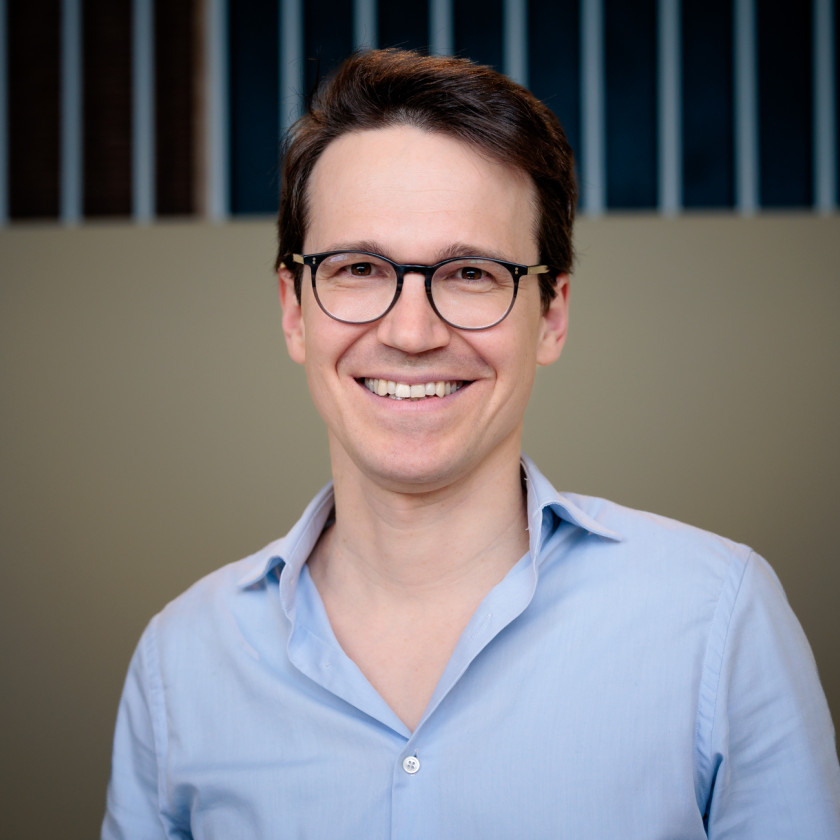
Inundated by spam calls, Ludwig Straub nearly missed the news that he’d won the prestigious John Bates Clark Medal.
The professor of economics had set his phone to ignore unfamiliar numbers. Only while scrolling transcribed messages did he discover “this one random voicemail” from someone who claimed to be with the American Economic Association.
Straub swiftly called back and learned he had won the Clark Medal, issued annually to an economist under 40 judged by the AEA to have made the most significant contributions to the field. The award is widely considered second only to the Nobel Prize in prestige, and many Clark recipients go on to become Nobel laureates.
“I did not expect it at all, but it’s wonderful, and I’m honored,” said Straub, 38, a low-key father of three who bikes to work and keeps a steady supply of chocolates on his coffee table for office hours. “I know many people that I would personally say deserve it much more, my co-authors among them. I view it as an award for the work that we have achieved together, and I’m happy I’ve found such great teams to work with.”
The citation hailed Straub’s wide range of work, “from the conceptual to the computational,” while specifically recognizing his creation of macroeconomic models that better reflect how real people at different levels of wealth and income respond to monetary and fiscal policy. Previous models relied on an average person (a “representative agent”) to predict behavior.
“Just like we have climate models that predict the weather, we want good models that predict the macro climate,” Straub said. “That’s really what my passion is, improving the models we use to make those forecasts to analyze what’s wrong with economies.”
Among other research, Straub has examined the relationship between low interest rates, inequality, and the widening savings gap between top earners and everyone else. He’s the second straight Harvard economist — joining Stefanie Stantcheva last year — and the department’s fourth in seven years to win the Clark.
“Ludwig Straub has made fundamental contributions to macroeconomics, spatial economics, public finance, and to the study of information and uncertainty in economic fluctuations,” said David M. Cutler, Dean of Social Science and Otto Eckstein Professor of Applied Economics, who called Straub “a terrific teacher, a generous adviser, and a great citizen.”
Straub said he relishes working with students at all levels — from the graduate students he has collaborated with on research to the undergrads in his advanced macro course, where he tries to get to know as many of the 130 students each semester as he can.
“It's been phenomenal to teach the undergrads here. They’re so nice and so smart,” said Straub, who earned his own bachelor’s degree at the University of Munich before pursuing graduate studies at Trinity College, Cambridge, and the Massachusetts Institute of Technology. He initially came to Harvard as a postdoctoral fellow in 2018 and joined the faculty the following year.
Edgerley Family Dean of Harvard’s Faculty of Arts and Sciences Hopi Hoekstra said Straub and the department have reason to be proud. “Celebrating alongside so many past Harvard winners speaks to the Economics Department’s tradition of excellence and the vital role it’ll play in shaping economic theory and policy for years to come.”
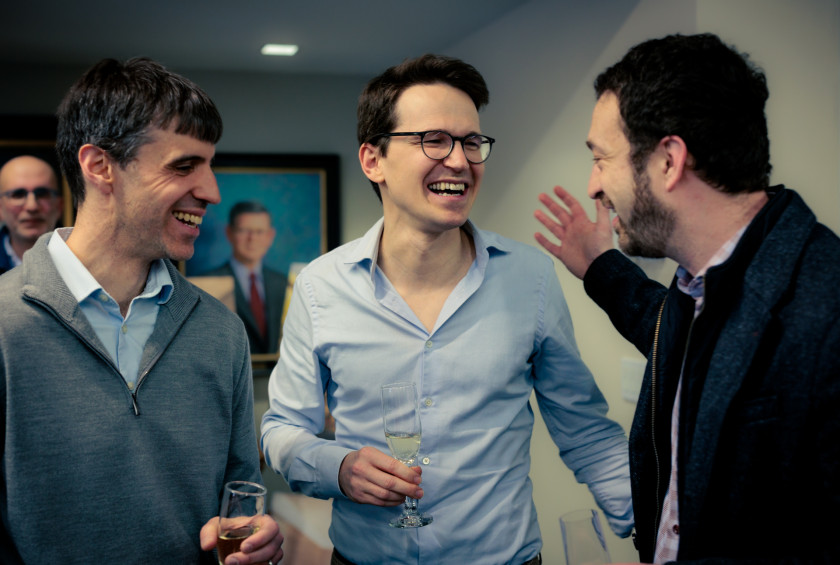
The department celebrated Straub with Champagne at a gathering late Tuesday. A packed room of faculty, grad students, and prospective grad students — the celebration closed a two-day preview period — whooped and cheered as department chair Elie Tamer announced, “Our own Ludwig Straub has won the Clark Medal!”
Gabriel Chodorow-Reich, George Fisher Baker Professor of Economics, explained some of Straub’s macroeconomic contributions and marveled at his body of work, including publishing three Jackson Hole Economic Policy Symposium papers with three sets of co-authors at a time when no one else even did two.
But to a person, each speaker said they especially cherish Straub’s fundamental decency and commitment to students. Tamer, the Louis Berkman Professor of Economics, called Straub “such a kind, gentle, humble, always-willing-to-help, and overall, just amazing human being.” Chodorow-Reich read a message from a grad student who had been stuck in a rut — with an economic model, and with personal confidence — before Straub stepped in, helping them find a path to success with twice-daily emails and encouraging phone calls.
Tilman Graff, another grad student, said Straub taught the single best class he’d taken in six years at Harvard — “sorry to everyone else in the room” — but especially shined as a mentor, both as Graff’s formal adviser and with feedback at weekly macroeconomics lunches. “The thing that’s missing dramatically from the Clark Medal citation is the most amazing thing about Ludwig as an economist, which is teaching and advising,” Graff said.
Straub spoke briefly, humbled by the outpouring. “Every morning I look forward to talking to our students, teaching the students something that hopefully they didn’t know about,” he said.
Addressing a crowd that included two Nobel laureates and multiple fellow Clark winners, Straub focused especially on the 24 admitted doctoral students who are considering Harvard. “Please, all come and join us,” he said. “It’s really wonderful here.”
Could frustration with billionaires and corporate power bring about a resurgence in American democracy? Taeku Lee believes it’s possible.

Joyce Chaplin’s “Rewilding Harvard” is reimagining the Harvard landscape.
The assistant professor of physics and applied math won the grant for cutting-edge neuroscience research.