Eric Moskowitz
Harvard Staff Writer
Award recognizes early career researcher’s neuroscience work
Harvard Staff Writer

Professor SueYeon Chung, Ph.D. ’17, whose Harvard lab investigates how the brain processes information, has been named a McKnight Scholar, winning a prestigious grant awarded annually to early-career researchers pursuing cutting-edge neuroscience.
“I’m deeply grateful,” said Chung, an assistant professor of Physics and of Applied Mathematics. “The McKnight Scholar Award supports bold work on significant problems in neuroscience, and it’s exciting to have our lab’s work recognized as part of that tradition.”
The McKnight Endowment Fund for Neuroscience awards $225,000 over three years to the labs of each recipient, with the 10 winners for 2026 selected from a highly competitive pool of 177 candidates. Chung’s award will support research that looks at how studying the complex patterns of thousands of neurons acting simultaneously can help unlock the mystery of how the brain works.
Chung, who grew up in Korea, majored in physics and math at Cornell University before coming to Harvard for graduate school in 2010, interested in the intersection of physics and biology. At Harvard, she discovered the field of computational neuroscience — and was immediately enchanted by the idea that researchers trained in fields such as physics, mathematics, and computer science could use models, simulations, and theory to gain new insights into the human brain.
“When I was starting out, I was really struck by the fact that you could even study such a thing, because it just didn’t seem humanly possible,” said Chung, an investigator affiliated with Harvard’s Kempner Institute for the Study of Natural and Artificial Intelligence. “But now that I’ve spent quite a bit of time in this field, I think we’re actually getting closer to tackling the question of how the brain works and how the brain processes information, and it’s thanks to a lot of interdisciplinary work.”
After Harvard, Chung completed one postdoctoral fellowship at MIT and another at Columbia University, then assumed a split position in 2022 as an assistant professor of neural science at New York University and an investigator at the Simons Foundation’s Flatiron Institute. She returned to Harvard last fall.
“It’s wonderful to be back and to join a community that shaped so much of my early scientific thinking,” she said. “This is where I began building the foundation for my research work, and it means a great deal to return now as a colleague.”
Chung’s research examines what happens when neurons in the brain — the building blocks of the nervous system — spike and send signals to each other in vast numbers at the same time. That creates high-dimensional neural activity in high-dimensional space. Considering the structure of that activity and relating it to the amount of information and efficiency of information can help to develop both a theory to describe what’s happening and a data-analysis tool at the same time.
“The grant from McKnight is recognizing the promise of this direction of studying the structure of neural population activities and their geometry, in relation to the underlying computation,” said Chung, who credited the graduate students and postdocs in her lab with the promising results and papers they have produced as a team. “I see this as one of the central questions for neuroscience in the upcoming decade. The award recognizes not just a project, but a research direction that our lab has been building together, especially through the work of our students and postdocs.”
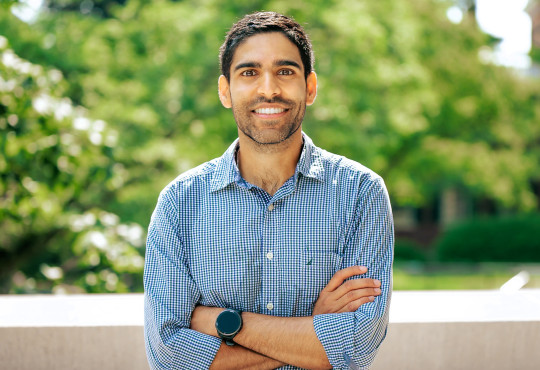
Being born a few days on either side of the school-enrollment cutoff date might seem like an arbitrary difference. But new research finds boys born just after the cutoff, who start kindergarten relatively old for their grade, enjoy far more advantages than previously known.
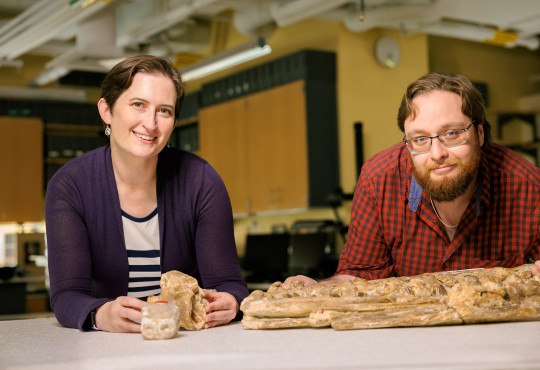
After 80 million years, a giant fossil jaw has quite a story to tell. Back in the age of the dinosaurs, Tylosaurus proriger was a fearsome predator — a bus-sized aquatic reptile with a crushing snout, daggerlike teeth, and knack for swallowing prey whole. How its bones wound up at Harvard is a tangled yarn involving a Wild West stagecoach station, the early western railroads, the infamous “Bone Wars” between rival fossil hunters, and a founding scholar of natural history.

New research by economist Rebecca Diamond found an increase in marriage among single women and an increase in employment rates among unemployed women after they started taking GLP-1 drugs for weight loss. Diamond says the pattern suggests that at least part of the female obesity penalty — the social and financial costs women bear due to their body size — is linked to first impressions.