Kermit Pattison
Harvard Staff Writer
A fossil from the age of dinosaurs, thought lost for decades, is sparking new scientific insights
/ Read time: 8 minutes
Harvard Staff Writer
After 80 million years, a giant fossil jaw has quite a story to tell.
Back in the age of the dinosaurs, Tylosaurus proriger was a fearsome predator — a bus-sized aquatic reptile with a crushing snout, daggerlike teeth, and knack for swallowing prey whole. How its bones wound up at Harvard is a tangled yarn involving a Wild West stagecoach station, the early western railroads, the infamous “Bone Wars” between rival fossil hunters, and a founding scholar of natural history.
For more than 150 years, one of the most important fossils of its kind sat quietly in the drawers of the Museum of Comparative Zoology (MCZ). Mistakenly reported as lost, the historic specimen was largely forgotten for half a century. Thanks to an offhand social media post, it recently was rediscovered by scholars, and, once again, the extinct hunter of the ancient oceans is making a big splash.
The saga began around 85 million years ago during the late Cretaceous epoch when the Western Interior Seaway covered interior North America from the Gulf of Mexico to the Arctic Ocean.
Through those warm waters swam a creature now called Tylosaurus proriger. Measuring up to about 30 feet long, it was one of the largest species of mosasaurs, an extinct group of apex predators with hinged jaws capable of engulfing entire prey.
“The way that I like to describe them to people,” said Amelia Zietlow, a paleontologist and lead author of a new paper on the specimen, “is take a Komodo dragon, scale it up to the size of a school bus, give it flippers, a shark tail, and an extra row of teeth. They were macropredators, basically eating anything and everything that moved.”
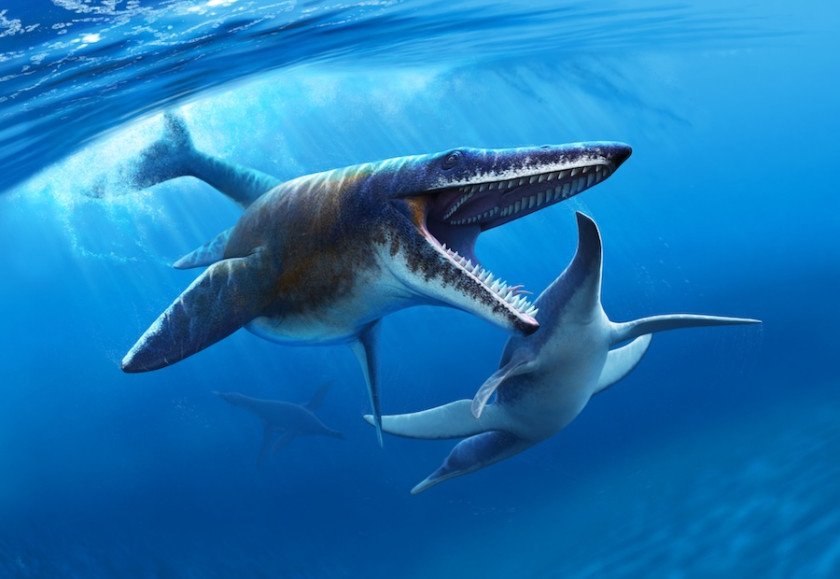
The remains of the particular Tylosaurus that made its way to the MCZ sank to the seafloor of what is now western Kansas to become entombed among the fossilized shells of microscopic marine plankton. And there it lay through the Cretaceous mass extinction, the rise of mammals, the ascent of modern humans, the emergence of civilizations, and the birth of the United States of America.
In 1868, the fossilized bones resurfaced. The exact circumstances of the discovery remain unclear, but evidence suggests the fossil eroded from a chalk formation in Monument Rocks, located near a stagecoach station and U.S. military fort. The find has been variously credited to an Army officer named John Conyngham or William Webb, a land manager for the Kansas Pacific Railroad.
The discovery included a partial skull with a five-foot-long jaw bearing nine teeth plus an assortment of vertebrae. The discovery of a “monster of the past” was described by Kansas newspapers in 1868. That year, the newly constructed railroad brought a party of visitors: government officials and Harvard professor Louis Agassiz.
A prominent paleontologist and geologist, Agassiz founded the MCZ. (The original brick building on Oxford Street still bears the name Agassiz Hall.) A pioneering natural historian, Agassiz left behind a mixed legacy due to his resistance to the theory of evolution and his embrace of scientific racism. In April 1869, he purchased the “fossil saurian” for the then-substantial sum of $500 and it entered the museum collection.
Not long afterward, the specimen was borrowed by paleontologist Edward Drinker Cope, who published a description with drawings and formally bestowed it with a scientific name. Two years later, his rival, the Yale professor Othniel Charles Marsh, published his own analysis, and the two paleontologists feuded back and forth about its proper name and classification. The fossil became another chapter in the scientific competition known as the Great Dinosaur Rush or Bone Wars.
“It had three or four different names at one time,” said Mike Everhart, co-author of the new paper and adjunct curator of paleontology at Kansas’ Sternberg Museum of Natural History. “The genus name is by Marsh and the species name is by Cope. You can’t get much more confused than that.”
Eventually, the two names were combined into one by paleontologist Joseph Leidy, a professor at the University of Pennsylvania and Swarthmore College, and the Harvard fossil became the type specimen (the exemplar used to formally describe a new type of creature) of a previously unknown species called Tylosaurus proriger. The first name refers to its genus and means “knob lizard,” while the second is the species name and means “prow bearing.” Both are references to its distinctive elongated snout. Since then, hundreds more Tylosaurus fossils have been found — including complete skeletons — from about 10 different closely related species in the genus.
These gigantic marine lizards were sinuous swimmers. Unlike most modern reptiles, they are believed to have been warm-blooded and gave birth to live offspring.
They were not very social. One Tylosaurus fossil from South Dakota preserves its stomach contents, including a smaller mosasaur. Another skull nicknamed “Lucky Mo” contains embedded teeth from a larger mosasaur who apparently killed it.
“They didn't get along very well,” said Everhart, author of “Oceans of Kansas: A Natural History of the Western Interior Sea” (2005). “We find a lot of instances of bites on the bones of the face and limbs that indicate they probably fought each other for territory or mates. You're talking about a 20- or 30-foot animal defending itself. With that much strength, teeth, and jaws, somebody is going to get hurt. They probably avoided each other as much as possible, and when they did get together, it was not generally a friendly thing.”
In 1967, paleontologist Dale Russell published a major study that became the bible on mosasaurs and mistakenly reported that the fossil had been lost. Many scholars took that to be the last word.
“The bones just went into a box and nobody really looked at them critically since they arrived at Harvard,” Everhart said. He noted that one scholar had photographed the specimen about 25 years ago, but it remained virtually unnoticed.
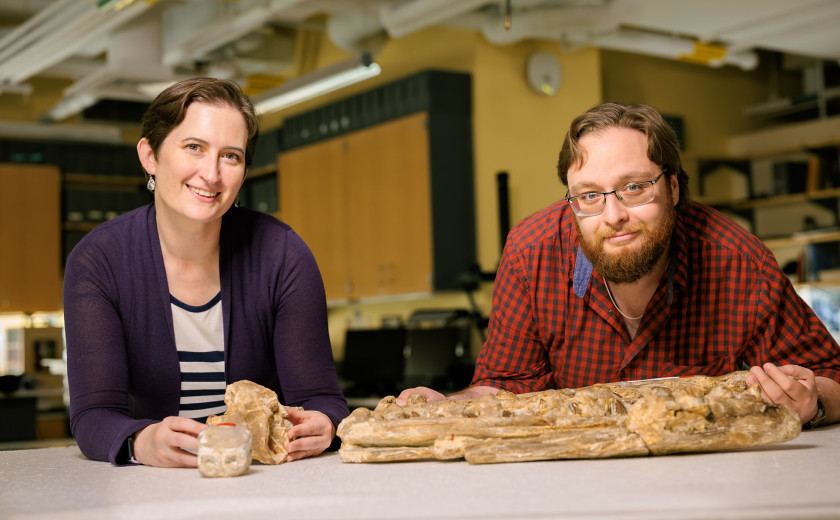
In 2020, Christina Byrd started a new job as collections manager at the MCZ. Before coming to Harvard, she had worked at the Sternberg Museum and managed a large collection of similar specimens. (Tylosaurus is so abundant in Kansas that the legislature named it an official state fossil.) Byrd was astounded to realize that the type specimen of the first known Tylosaurus was located at Harvard.

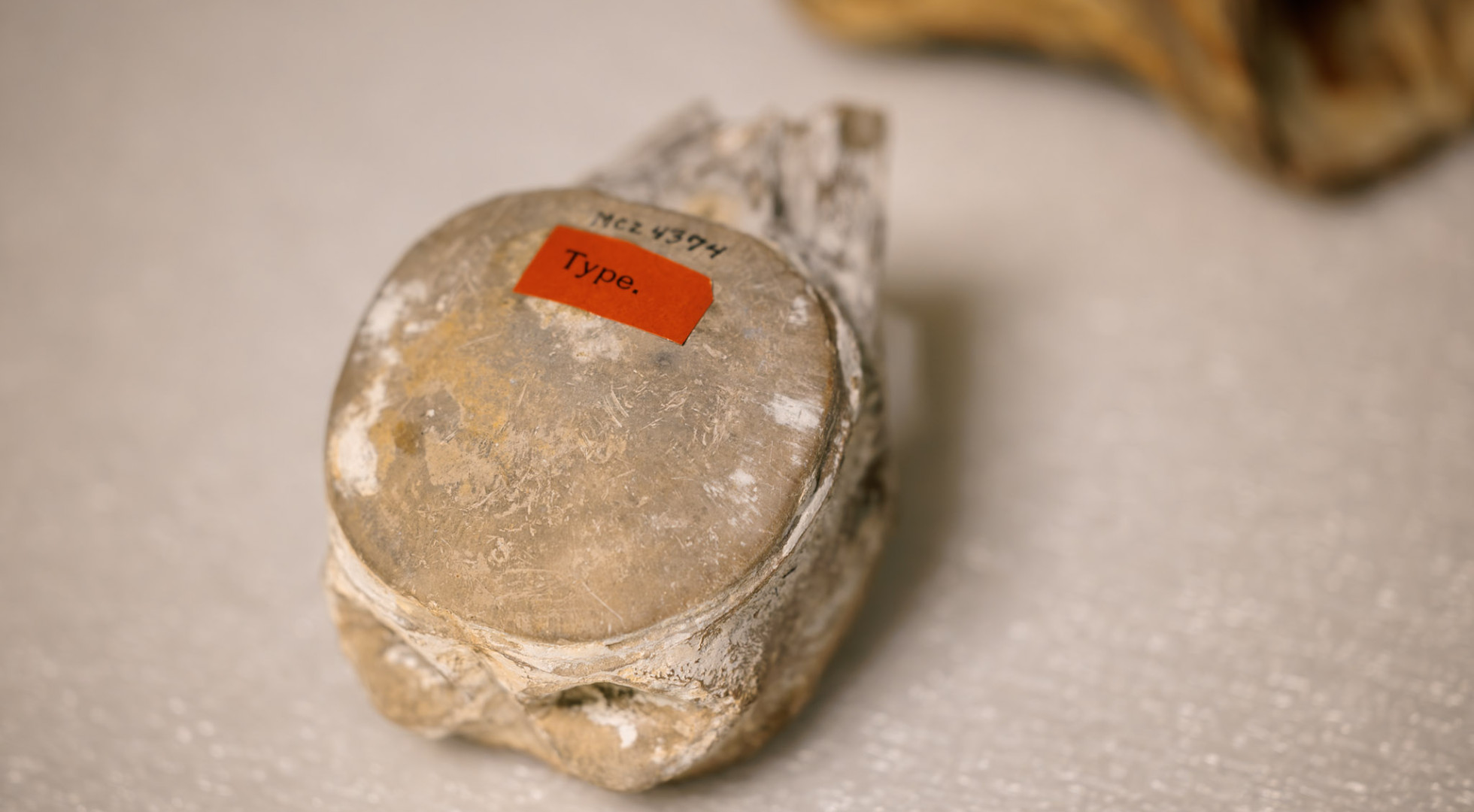
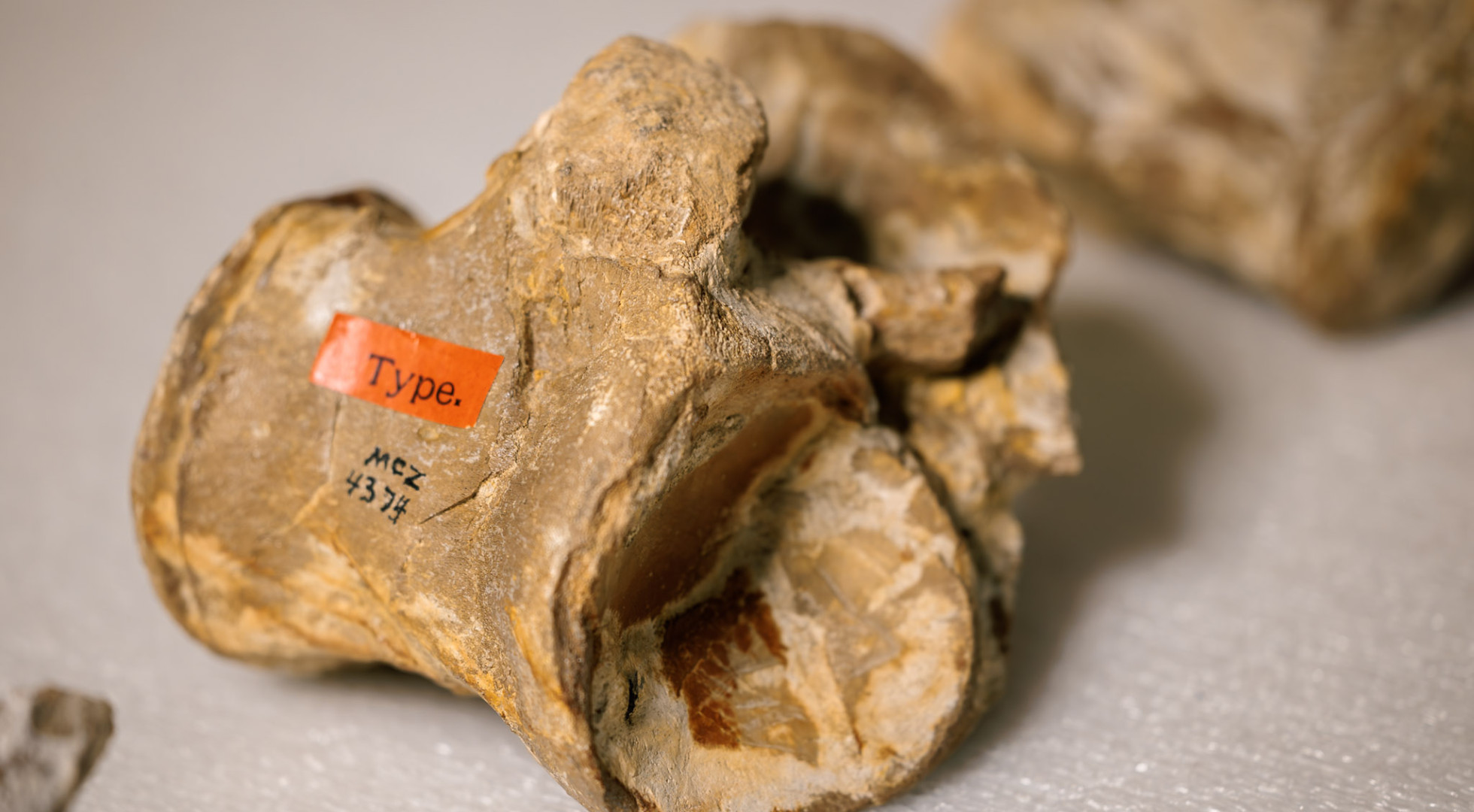
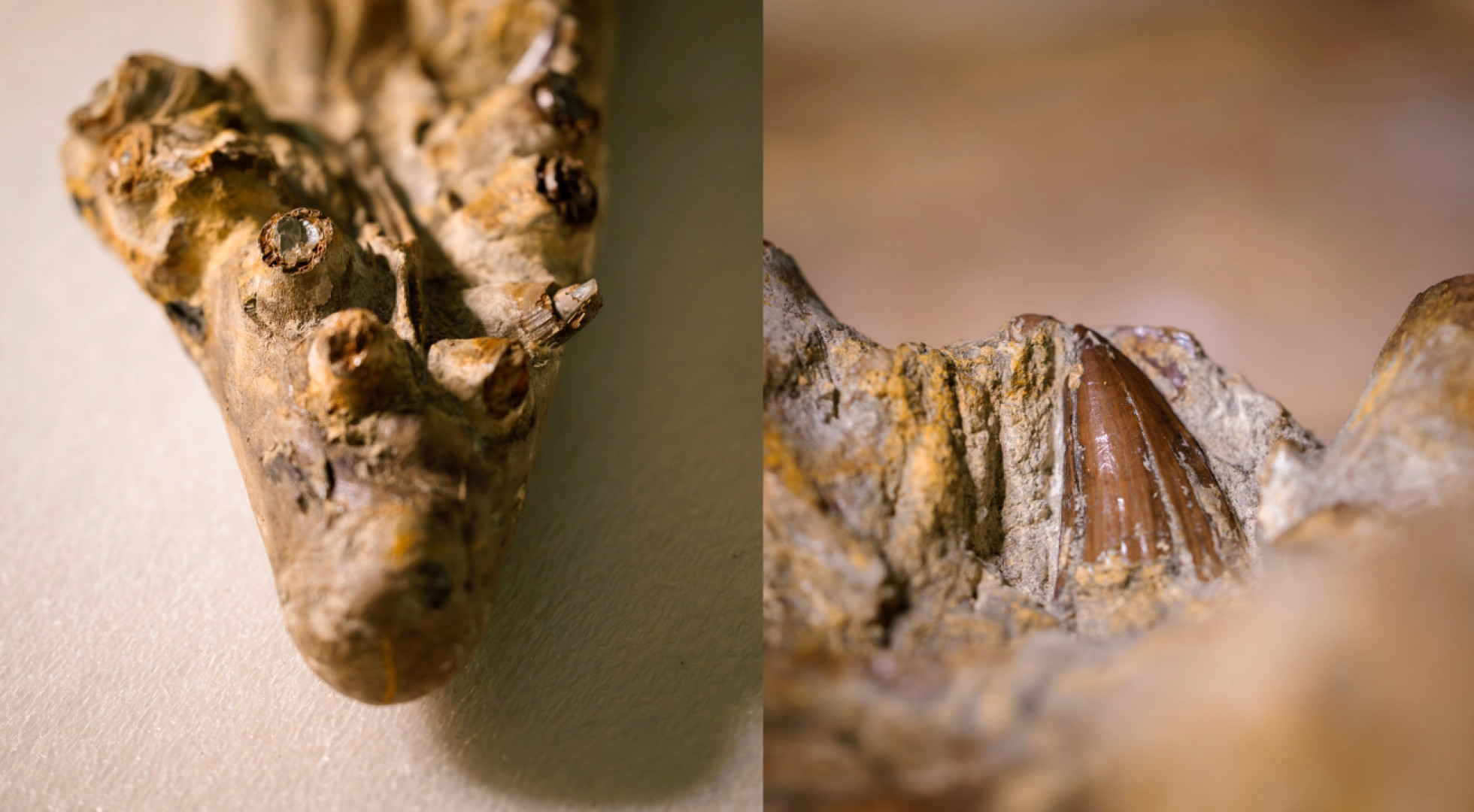
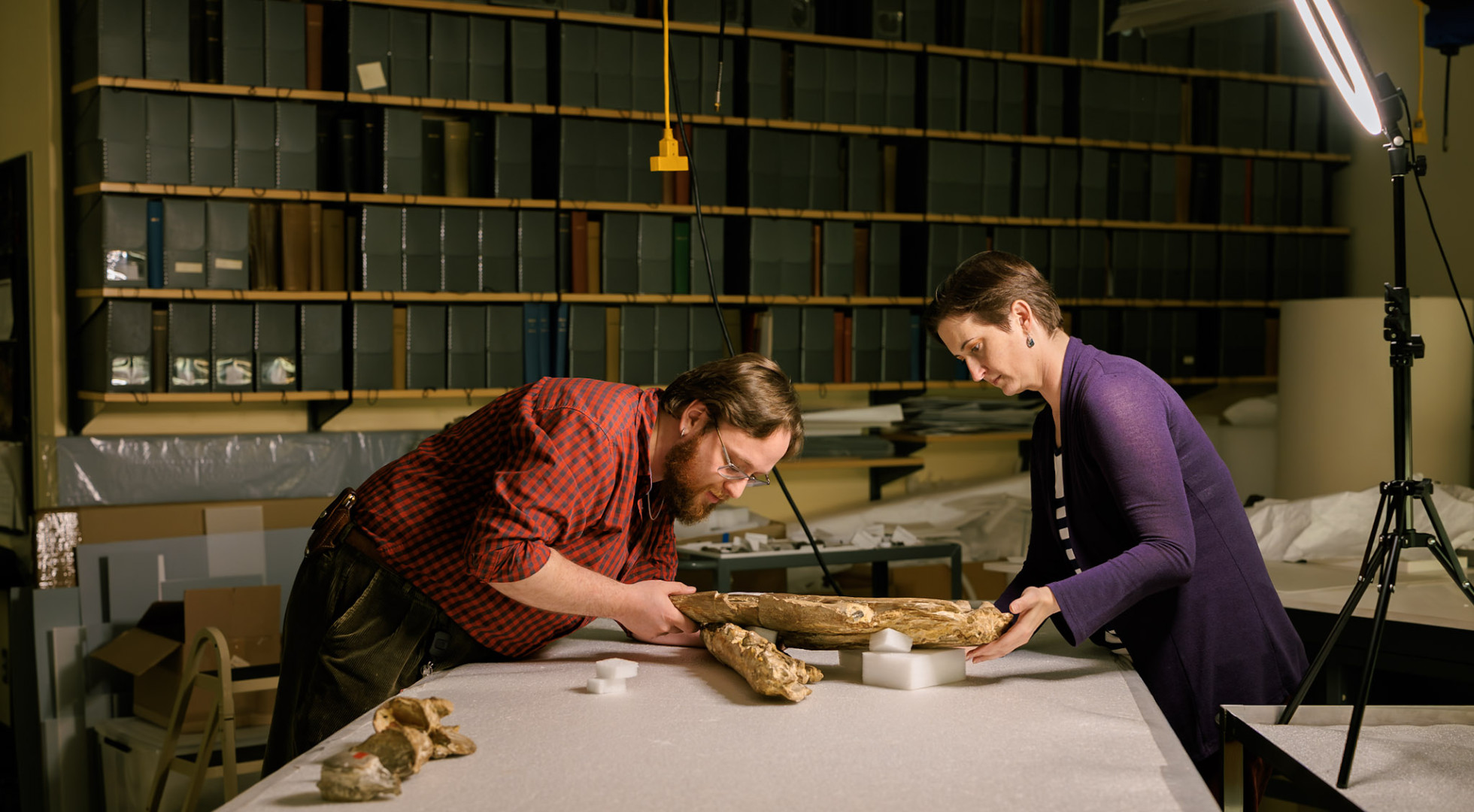
To celebrate the one-month anniversary of her new job, she snapped a selfie with the specimen and posted it on Twitter, proclaiming herself “fossil starstruck.” She had no inkling that the fossil had been reported as lost for half a century. In reality, it had been sitting safely in the museum collection all those years.
That tweet came as a surprise to Zietlow, a paleontologist who did her Ph.D. dissertation on mosasaurs at the American Museum of Natural History. She had assumed the valuable specimen had vanished long ago. Yet there was a photo of the original Tylosaurus in all its petrified glory.
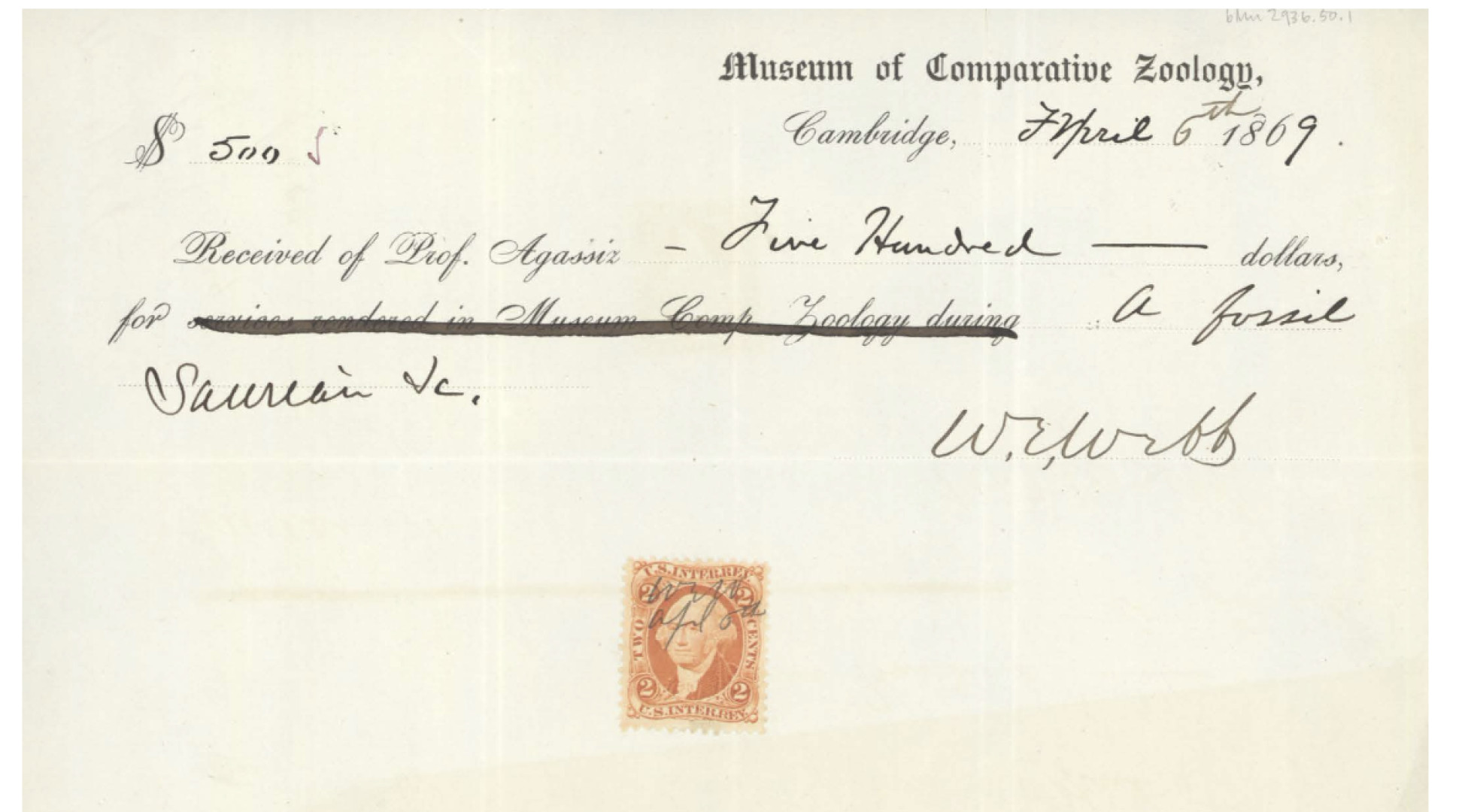
Drawing on years of digging by Everhart, the researchers pieced together the complicated backstory of the type specimen, also known in scientific jargon as the holotype. They gleaned clues from memoirs, old newspapers, the work of Cope and Marsh, and Harvard archives. With the help of Robert Young (special collections manager of the MCZ archives) and Jessica Cundiff (curatorial associate and collection manager), they even found the handwritten receipt of the 1869 purchase of the fossil by Agassiz.
Zietlow, Everhart, and paleontologist Michael J. Polcyn of Southern Methodist University conducted a wholesale reexamination of Tylosaurus in North America and Europe and bemoaned the “taxonomic havoc” wrought by the Bone Wars when species were named willy-nilly and described with inconsistent criteria. Some specimens ascribed to one species actually belonged to another; some really belonged to entirely new species that had not yet been recognized. “It’s a disaster,” Zietlow said.
“No study since the one that originally described the specimen in 1870 actually looked at the holotype itself,” Zietlow said. “This is a big problem, considering that the holotype is the representative of the species.”
At last, the historic specimen that has sat in the MCZ since the mid-19th century enjoyed some new attention and analysis with modern methods. “One takeaway is that historic specimens deserve the same amount of care and detail as flashy new discoveries,” Zietlow said.
One morning in the basement of the museum, Byrd and fossil preparator Scott Johnston admired the heavy jaw with the knobby prow, still marked in old ink with its catalog number, MCZ 4374, by the hand of a bygone curator. Its container included an assortment of bone chunks, bowl-sized vertebrae, and copies of the original anatomical drawings from 1870.
“Tylosaurus was enormous,” Johnston said with a note of awe. “It’s the second-largest mosasaur that we know of.”
The fossil is among 56 mosasaurs at the MCZ, which holds more than 21 million specimens in varied collections such as insects, birds, fish, mollusks, and invertebrates. But not many have such a colorful history.
Said Byrd: “It’s a pleasant surprise to see a specimen that I posted for fun actually aided a researcher and helped open the door to better understanding this species.”

New research by economist Rebecca Diamond found an increase in marriage among single women and an increase in employment rates among unemployed women after they started taking GLP-1 drugs for weight loss. Diamond says the pattern suggests that at least part of the female obesity penalty — the social and financial costs women bear due to their body size — is linked to first impressions.
When David Bakalar first set foot at Harvard, he was a 17-year-old child of immigrants commuting by bus from Lynn, his $500 “nonresident scholarship” covering tuition and a study space at Leverett House but not room and board.

The first-of-its-kind discovery is expected to set off a search for signs of life.