Eric Moskowitz
Harvard Staff Writer
Data on millions of Facebook users show these students reap lasting advantages in building social capital
/ Read time: 6 minutes
Harvard Staff Writer

Being born a few days on either side of the school-enrollment cutoff date might seem like an arbitrary difference. But new research finds boys born just after the cutoff, who start kindergarten relatively old for their grade, enjoy far more advantages than previously known.
These boys develop larger social networks by high school. They’re more likely to participate in extracurriculars and to assume school leadership positions. While the differences for women were negligible, men who had been “old” in school continued to make friends at a higher rate through their 20s. Data showed they were more likely to land careers in management or pursue entrepreneurship. Today, they are even more likely to be married.
The study’s two co-authors crunched data from millions of active Facebook users who came of age in the early days of social media. They found that boys born right after the cutoff date made 11 percent more friends in high school and were 42 percent more likely to hold student-council positions than male classmates nearly a year younger.
“Most of the prior studies that look at this have had to rely on survey-based measures, which we know suffer from problems around under-reporting and selection bias,” said lead author Matthew Jacob, a graduate affiliate of Harvard’s Opportunity Insights research lab and a final-year Ph.D. candidate in public policy on the economics track at Harvard Kennedy School and the Harvard Kenneth C. Griffin Graduate School of Arts and Sciences. “I think those reasons explain why we found larger effects than in the existing literature.”
Jacob, who came to Cambridge in 2018 as a predoctoral research fellow at Opportunity Insights, also earned a co-author credit on the landmark social capital papers published by William A. Ackman Professor of Public Economics Raj Chetty and his OI team in 2022. Those twinned papers analyzed billions of privacy-protected Facebook friendships to understand the kinds of connections that make a difference for socioeconomic mobility.
As a graduate student, Jacob has continued to think about social connections — not just why they matter, but how they materialize in the first place. “Who develops social connections? How do they form?” Jacob said in an interview. “That was always nagging at me, the question of who gets to develop more social capital.”
At the same time, Jacob — who’d been old for his grade growing up in Australia, conferring an early height advantage that tapered off to an eventual 5-foot-8 — was loosely aware that many outlying achievers, including CEOs, politicians, Nobel laureates, and professional athletes, tended to be old for their grade.
For athletes, the benefits are often attributed to being bigger, faster, and stronger in early competition, with a snowball effect from confidence and selection for specialized teams and training.
But when it comes to high-flying professionals, Jacob found existing literature largely credited the “human capital” effect of early academic achievement, with relatively older students scoring higher on tests in elementary school. That sounded like an imperfect answer to Jacob, given that the test-score advantage of being older has been documented to fade by high school.
Who develops social connections? How do they form? That was always nagging at me, the question of who gets to develop more social capital.
He thought social connections must play a role. But previous research, drawn from surveying methodologies with all their limitations, found only a modest contribution. Jacob wondered if Facebook data might uncover a fuller story.
Working with Mike Bailey — a Stanford-educated economist who founded Meta’s Social Capital Lab, which opens Facebook data to researchers studying economic opportunity and wellbeing — Jacob found a significant causal relationship between age, friendship networks, school leadership, and career pursuits. The effects were considerably more dramatic than researchers have previously demonstrated.
“We’re not the first paper to look at relative age effects, even on some of these outcomes,” Jacob said. “But what distinguishes us is using the massive-scale data set that is all of Facebook to be able to bring to bear big data to tackle this question.”
Facebook may seem trivial as a measure of real-world connections, but multiple studies have demonstrated that it’s a meaningful proxy, Jacob said. He and Bailey focused on U.S. students born between 1983 and 1997, meaning those who went to high school during or soon after Facebook’s introduction and peak usage among younger people, and who remained active users as of April 2026. They looked only at people who grew up in the 44 states with a universal cutoff, a pool of 33 million adults. That meant Massachusetts, where enrollment age is set at the district level, was excluded.
Jacob and Bailey examined Facebook friendships formed with people who went to the same school in the same or adjacent age cohorts — high school friends — as well as friendships formed later. Facebook Groups people had joined in school provided the researchers with a window onto extracurriculars.
Machine learning was used to clean and analyze occupations listed by the 30 percent of Facebook users who posted their job titles. (Those job titles aligned closely with the overall U.S. labor market, indicating a representative sample.) Also factored into the analysis was an array of granular economic data, including location, the percentage of a user’s school receiving free or reduced-price lunch, and the model of phone a person used to access Facebook.
Across socioeconomic lines, Jacob and Bailey found relatively older boys from high- and low-income families were similarly more likely than younger boys from comparable backgrounds to form social connections in school and wind up in leadership positions. They were more likely to participate in school sports and clubs, be selected for the National Honor Society, and get elected to student council.
The average male student had formed a little over 100 high school friends, with the spread between oldest and youngest working out to a difference of both 11 percent and 11 friends. Of those additional friends formed by older boys, nearly three-quarters were with girls. And while months of age difference might seem to matter less as kids enter adulthood, those comparatively older boys made an additional 1.77 friends per year as men between the ages of 21 and 30. The oldest boys were also 4.5 percent more likely than their youngest classmates to be married, and 5 to 10 percent more likely to work in management or entrepreneurship.
Conversely, the researchers analyzed the bios of nearly 200,000 accomplished researchers in the reference “American Men and Women of Science” and found they were more likely to be young for their grade. If test scores alone were at play, the opposite should be true. To Jacob, this tracks with the Facebook data, suggesting that early social capital — not early academic success — makes some people more likely to pursue careers that reward social skills (management, entrepreneurship) over more solitary pursuits such as research.
Notably, the relative age effects for girls were muted in terms of friendship, school leadership, and career pursuits, even though previous research has found older girls and older boys both enjoy test-score advantages in lower grades. “It’s hard to know exactly what to make of that,” Jacob said, surmising that being physically larger at a young age is more socially beneficial to boys than girls. “It poses more research questions, to unpack the reasons for the gender asymmetry in some of our results.”
Luis Armona, assistant professor of public policy at Harvard Kennedy School, is one of three advisers on Jacob’s dissertation committee. Armona admired the paper’s use of large-scale data to tease out an existing thread — that older students are more likely to become leaders — in greater detail and to connect it to social capital.
“Matt’s an excellent student, and I think he finds a very sweet spot with this paper of utilizing this large-scale Facebook data to better answer an existing question with a very credible identification strategy,” Armona said.
“The paper is interesting, timely, well-written and likely to have a very high impact,” added Danoff Dean of Harvard College David Deming, another of Jacob’s advisers.
The paper’s co-authors acknowledge that many parents — particularly affluent, well-educated parents — of boys with summer birthdays hold them back before starting kindergarten, a practice known as redshirting. Jacob and Bailey’s analysis assumes instead that everyone started school when they were eligible, meaning the real effects are likely even larger than the study found, as those redshirted students (and their outcomes) are counted here as being young for their grade.
Wondering if the U.S. might be an outlier for relative age effects, Jacob and Bailey also examined Facebook data from six other countries with national cutoff dates for kindergarten enrollment. Comparable effects were found in all: Canada, Finland, Japan, Norway, Sweden, and the United Kingdom.
Notably, kids start school at different ages across those countries, underscoring “that what matters is being older than one’s peers, not the exact age when school starts,” the authors wrote.
To Jacob, that suggests that policy proposals aimed at having boys start kindergarten later are not the solution, because relative differences will persist. “More promising approaches might focus directly on helping younger students build social connections, through encouraging participation in extracurricular activities and leadership opportunities,” he said.
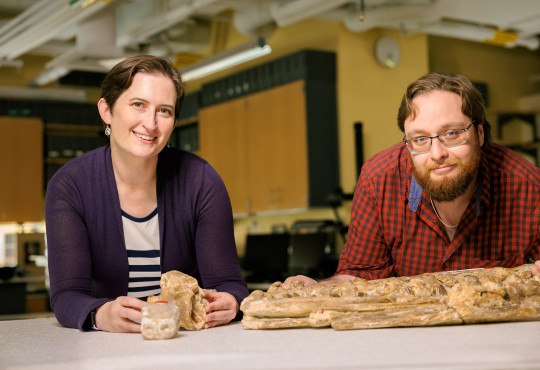
After 80 million years, a giant fossil jaw has quite a story to tell. Back in the age of the dinosaurs, Tylosaurus proriger was a fearsome predator — a bus-sized aquatic reptile with a crushing snout, daggerlike teeth, and knack for swallowing prey whole. How its bones wound up at Harvard is a tangled yarn involving a Wild West stagecoach station, the early western railroads, the infamous “Bone Wars” between rival fossil hunters, and a founding scholar of natural history.

New research by economist Rebecca Diamond found an increase in marriage among single women and an increase in employment rates among unemployed women after they started taking GLP-1 drugs for weight loss. Diamond says the pattern suggests that at least part of the female obesity penalty — the social and financial costs women bear due to their body size — is linked to first impressions.

When David Bakalar first set foot at Harvard, he was a 17-year-old child of immigrants commuting by bus from Lynn, his $500 “nonresident scholarship” covering tuition and a study space at Leverett House but not room and board.