Eric Moskowitz
Harvard Staff Writer
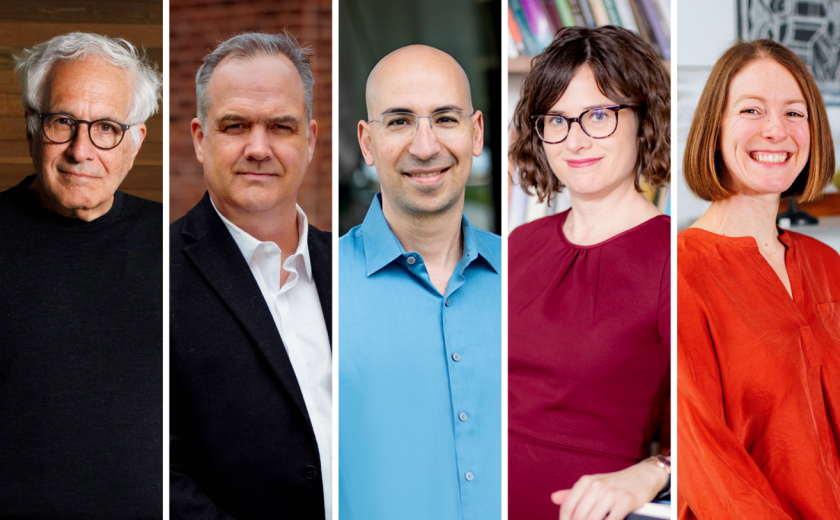
Awards for excellence in undergraduate teaching announced by FAS Dean Hopi Hoekstra at the May Meeting of the Faculty.
/ Read time: 8 minutes
Harvard Staff Writer
Five senior faculty members have been awarded Harvard College professorships for excellence in undergraduate teaching and for helping students “develop their intellectual passions.”
Hopi Hoekstra, Edgerley Family Dean of the Faculty of Arts and Sciences, announced the recipients at the May 5 Meeting of the Faculty. They are:
“Together, these faculty members exemplify an unwavering commitment to enriching the undergraduate experience,” Hoekstra said, highlighting each honoree.
Carpenter, a leading scholar of regulation and government organizations, “has superbly demonstrated his commitment to instilling intellectual vitality and civics,” she added, while embedding exercises to engage diverse viewpoints in his courses.
Lichtman, a pioneer of mapping the brain’s neural networks, has engaged thousands of undergraduates in his introductory neurobiology course. He recently developed the “Genuinely Hard Problems” seminar, which presents first-year students with “longstanding scientific conundrums and encourages them to use their fresh perspectives to attempt novel solutions.”
Marcus, an expert on the scientific and medical culture of early modern Europe and the relationship between faith and science, “embeds principles of civil discourse in her classes,” stoking lively discussions and delivering lectures that students describe as fascinating.
Matherne, who explores the relationship between perception and aesthetics through a historical lens, has seen enrollment in her course on Kant’s “Critique of Pure Reason” grow from 18 to 80. In her new class combining Jane Austen’s canon with philosophical texts, students “marveled at how much they happily read and how it helped them understand what makes philosophy philosophy.”
Procaccia, who investigates “broad and dynamic problems” related to artificial intelligence, economics, and society, has made substantial contributions to “undergraduate understanding of these increasingly impactful intersections through such topics as matching and exchange, fairness in machine learning, and the algorithmic foundations of democracy.”
Launched in 1997 with a gift from John and Frances Loeb, the Harvard College Professors Awards recognize tenured faculty for their distinguished contributions to undergraduate teaching. Awardees receive a five-year professorship and financial support that they can apply to their research, to an extra semester of leave, or as a summer salary supplement spread over the period in which they hold the title.
“Teaching and researching are inseparable,” Carpenter said in an interview. “In my life and my career, each has strengthened the other. I see deep complementarity between the two.”
A scholar of the history of petitioning as well as regulation and government organizations, Carpenter has developed multiple undergraduate classes in his 24 years at Harvard, including one on governance in Native America and another on bureaucratic politics. He enjoys them all, but he is best known for — and most relishes — teaching the popular “What is a Republic?” course that he introduced in 2005.
Carpenter, who is also chair of the Department of Government, starts by disabusing the class of the notion that 18th-century definitions of “republican” and “democracy” align in any way with the later founding of the Democratic Party (1828) or Republican Party (1854) or their shifting tenets and platforms.
“What I really try to do is get students, from the start, to think outside of their partisan lenses,” he said. “If we say, ‘Oh, the U.S. is a democracy, not a republic, or a republic and not a democracy,’ we’re committing not just a category error, but an anachronism of the highest order.”
The course traces systems of governance in republican Rome, medieval Europe, early modern England and France, the United States (state and federal government), and the Third Republic of France (1870–1940), while examining the historical origins and evolutions of representative legislatures, the rule of law, and the separation of powers.
Students read from the likes of Alexander Hamilton alongside Thomas Jefferson, Machiavelli alongside Montesquieu, and Angelina Grimké alongside W.E.B. Du Bois. Over the years, Carpenter has continued to tweak the syllabus much like a recipe, adding a dash of the Venetian Republic, subtracting a sprinkle of the contemporary U.S.
“We cover a lot of ground and do a lot of reading — some might say too much,” said Carpenter. “But the courses that I learned the most from in college and in grad school were the courses I worked hardest on.”
In 22 years at Harvard, Lichtman has taught thousands of students, in large lectures and intimate seminars alike. And right up until the rise of AI, the decorated neuroscientist thought of teaching as the ability to convey complicated material in a clear manner.
“We were the large language models,” he said, considering how easy it is now for students to find answers without consulting a library or even needing to do any reading. “What is the role of a teacher in a situation where all the things that were crammed into my head for me to regurgitate back in an exam is available to a student at whatever level they want to hear about it?
“I think this is really an existential threat to the way teaching has been done up until now, where the knowledgeable people had the information,” he added.
Tugging on that thread led Lichtman to design a first-year seminar called “Genuinely Hard Problems in Science,” which debuted last fall. With a different guest scientist each week, the seminar explores a series of unsolved problems awaiting true conceptual breakthroughs, such as finding the biological mechanisms that cause mental illness, reconciling quantum mechanics with gravity, or identifying how and where the brain stores information we can recall instantly, like the design of the American flag. “Do you know the answer to that question? You get a Nobel Prize if you do,” he said.
“If you go to a large language model, it can’t tell you the answer to these genuinely hard problems because they’re genuinely hard,” Lichtman said. “I thought, ‘Maybe this is what students should be thinking about in college, as opposed to spending their time doing problem sets where the answer is already known.’”
Teaching the course to first-years is particularly appealing, he said, because they’re not yet locked into the perspective of a particular concentration or a favorite set of professors and because the notion that experts are hardly closer to solving these problems than beginners can make science more approachable, not less.
Lichtman said teaching continues to inform his work. If he finds himself straining for clarity while trying to explain a scientific argument to students, it can reveal a wider lack of understanding by the entire field of neuroscience. “It helped me be a better scientist, because it allowed me to say, ‘There’s maybe something here that we really need to know, because we’re making an assumption that may not be true,’” he said.
For example, he found textbooks lacking when he started teaching microscopy optics. “As I tried to explain it to students, I couldn’t explain it until I really dove deep. Then I realized the way people were talking about it was wrong. I learned things about optics because I had to teach it,” Lichtman added. “It forces you into this mode that you don’t accept scientific work unless every step in the argument turns out to be more like an explanation than an argument.”
Growing up in Maine, Marcus thought she would go into K-12 education, like her mother. Then she discovered the thrill of archival research, and the rest, literally, was history. As an undergraduate at the University of Pennsylvania, she focused on the history of the book as material object — research she continued at Stanford University, where she studied early modern Europe and explored the censorship of medical and scientific texts in Italy.
Her zeal for hands-on learning through primary sources comes through in her classes today, as Marcus — a self-proclaimed “super user” of Harvard’s libraries, archives, and museums — prioritizes teaching with artifacts and objects. Even more, as faculty director of the Collection of Historical Scientific Instruments (CHSI), she encourages others to do so, too.
“All of the faculty in the History of Science Department used CHSI in their classes this year. That's really exciting. And we’re building partnerships with our colleagues in the sciences,” Marcus said, including in first-year seminars and with the Natural Science Lecture Demonstrations team, which visits classes in physics, chemistry, astronomy, and biology to provide dazzling visual demonstrations, pairing the team’s whizbang modern equipment with historical antecedents.
“I just feel totally delighted to be activating the collections for teaching and learning at Harvard, not just peering at objects behind glass,” she said.
Marcus, who last year won the Dan David Prize honoring early- and mid-career researchers and filmmakers for outstanding work on the human past, said receiving tenure gave her the confidence to focus even more on teaching and to become more creative with her class offerings, including a seminar last fall on Galileo (“Discovery, Faith, Ego, and the Making of Scientific Controversy”) and courses she’s developing, including on the occult in the premodern world.
“Teaching Galileo at Harvard is the most amazing experience, because the Houghton collections are so rich,” Marcus said. Consider Galileo’s “Sidereus Nuncius” (The Starry Messenger), published in Venice in 1610. Houghton owns multiple first editions: one that went to Frankfurt with a wider shipment, and one that stayed in Italy and got updated with “these little pasted-in slips of paper,” which helps illustrate complex stories of publication and distribution as well as a dispute at the time over the true publisher.
“We get to see the physical evidence for these arguments about creation, about disguised printing, and it’s just unbelievable. It’s the best!” she said.
Marcus said teaching makes her a more well-rounded scholar, and that she especially loves seminars for the “good questions and serious discussion” students bring to the table. She laughs about a course evaluation she once received — “Hannah really loves history” — and still isn’t sure if it was meant as a compliment. “My excitement is extreme,” she said. “If they’re enjoying this one-quarter as much as I am, it is a success.”
Matherne knew she wanted to be an academic the moment she met her first humanities Ph.D. students as an undergrad: “I thought, This is the perfect job! You get to read books. You get to write books. You never leave college.”
A grad seminar she took as a senior at the University of Pennsylvania with Kant scholar Paul Guyer ’69, M.A. ’71, Ph.D. ’74 set her on a professional path to becoming a philosopher, working on Kant and aesthetics, informing her passion and discipline. But when Matherne initially imagined that life of the mind, she equated being a professor with thinking and writing.
Now, after eight years at Harvard, teaching is central to her identity. “I’ve really come to find that teaching philosophy helps me understand who I am as a philosopher,” Matherne said.
Part of it was the release valve teaching provided from the stresses of scholarship before Matherne received tenure in 2024, offsetting the competition of the marketplace of ideas — trying to advance new insights on philosophical works that date to the 1700s — and the publish-or-perish pressure of being a junior faculty member.
“It would just be so fascinating to be teaching the exact same texts, like Kant’s ‘Critique of Pure Reason,’ that I normally research, but then be teaching it to undergrads and having it be so joyful,” she said. “It gave me a way to reground myself in what got me into it in the first place.”
Matherne’s classes attract students who aren’t averse to reading and who arrive eager to engage. Her “Philosophy of Jane Austen” course includes all six novels in the Austen canon, alongside an assortment of philosophical texts, to parse questions such as whether Austen was a philosopher or if her novels count as philosophy in another guise. Matherne has also relished being one of the professors to team-teach Humanities 10, the year-long, selective-admission course that steeps first-year students in seminal works from across the centuries.
“My mind as a philosopher got better being in that interdisciplinary context, talking to the students, talking about literature, talking about poetry, talking about plays,” Matherne said. “It’s such a profound joy to teach here and teach these students. So then to get the award, it’s being awarded for one of the things that I most love in life!”
Procaccia is part of the EconCS Group, a theoretical and experimental group at the intersection of economics and computation, with a personal focus on problems related to AI, algorithms, economics, and society. When he thinks about the areas that most excite him — as well as the ones he shies away from — they trace back to the best and worst teachers he encountered as an undergraduate or even in high school.
It’s why he takes both facets of his job so seriously.
“Research always takes a lot of time, but teaching is a big part of why we’re here, and it’s really important to me,” Procaccia said. “It’s pretty amazing to see the impact teachers have.”
Procaccia devotes much of his attention to questions of fairness, and he helped develop a not-for-profit online tool called Spliddit to enable people to harness the power of computer science, mathematics, and economics to fairly divide everything from Halloween candy and taxi fares to artwork and rent.
At Harvard, he has taught three courses: “Artificial Intelligence,” “Economics and Computation,” and “Optimized Democracy.” He had previously taught the introduction to AI at Carnegie Mellon University before coming to Harvard in 2020, and he inherited the “Economics and Computation” course here from colleague David Parkes, after Parkes became dean of the Harvard John A. Paulson School of Engineering and Applied Sciences.
But the third class — officially a graduate offering but perennially popular with undergrads, who fill half the seats — has become Procaccia’s signature course, tapping his interest in fairness and applying mathematical and algorithmic tools to the tenets of democracy, such as voting rules, redistricting, delegating, and representation. He appreciates the discussion afforded by the relatively small size, with the class capped at 45 students, though as many as 230 a semester have petitioned for admission.
“The first time I did it, I was awed by the quality of the discussion. It’s something I think can only be done at an institution of this caliber. The students are exceptionally gifted at communicating, and they’re incredibly broad, so they can bring insights from many different areas,” he said, marveling at the diverse perspectives of double-concentrators and of international students relaying the different forms of governing in their home countries. “It’s something that’s really special about Harvard.”
Being born a few days on either side of the school-enrollment cutoff date might seem like an arbitrary difference. But new research finds boys born just after the cutoff, who start kindergarten relatively old for their grade, enjoy far more advantages than previously known.
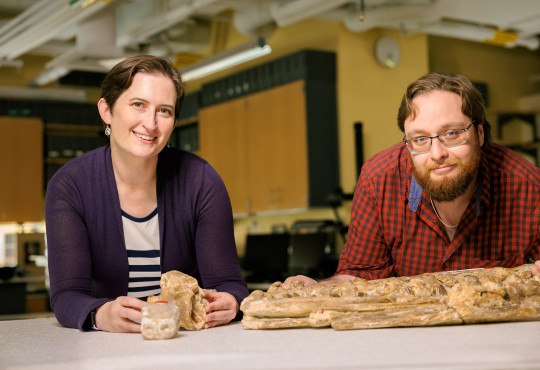
After 80 million years, a giant fossil jaw has quite a story to tell. Back in the age of the dinosaurs, Tylosaurus proriger was a fearsome predator — a bus-sized aquatic reptile with a crushing snout, daggerlike teeth, and knack for swallowing prey whole. How its bones wound up at Harvard is a tangled yarn involving a Wild West stagecoach station, the early western railroads, the infamous “Bone Wars” between rival fossil hunters, and a founding scholar of natural history.

New research by economist Rebecca Diamond found an increase in marriage among single women and an increase in employment rates among unemployed women after they started taking GLP-1 drugs for weight loss. Diamond says the pattern suggests that at least part of the female obesity penalty — the social and financial costs women bear due to their body size — is linked to first impressions.