Eileen O’Grady
Harvard Staff Writer
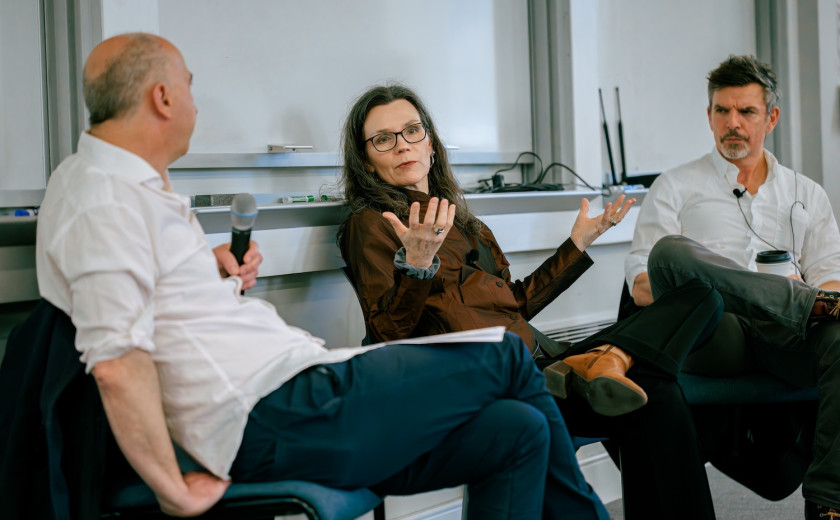
A recent event, hosted by the Public Culture Project, emphasized the real-world benefits of arts and humanities for unhoused and incarcerated populations.
/ Read time: 5 minutes
Harvard Staff Writer
For some, the act of putting pencil to paper is more than a creative exercise. It’s a lifeline.
James Parker has seen this dynamic firsthand at the Black Seed Writers Group, the weekly writing meetup he leads for homeless and housing-insecure people in Boston. Literature and the creative arts, The Atlantic columnist argued at a recent event, helps group members reconnect with their humanity, even when they’ve hit rock bottom.
“If you can write about your situation, you can step back from your situation,” Parker said. “That always gives you something — some way of getting out of the immediate crushing reality of it or at least taking a step aside. If you’re a poet, or if you can be journalistic about your life, then it gives you an edge that the guys who are completely enmeshed in it don’t have.”
The April 29 talk, titled “Arts and Humanities on the Edge,” was hosted by the Division of Arts & Humanities’ Public Culture Project and moderated by Professor of the Practice of Literary Criticism James Wood. It featured Parker in conversation with Hilary Binda, Founder and Executive Director of the Tufts University Prison Initiative of Tisch College (TUPIT) about the real-world impacts of arts and humanities amid enrollment declines at colleges and universities nationwide.
Dean of Arts & Humanities Sean Kelly gave an introduction. At Harvard, he shared, course enrollment in the Division has declined 17.5 percent over the last 20 years, and concentrator numbers have declined by 40 percent.
“It’s my goal to bring the arts and humanities back to the center of how we think about what we’re doing in colleges and universities and to promote them more broadly in the culture,” Kelly said. “I think if we don’t do that, we’re going to be putting out a generation of people ready for a midlife crisis 10 or 15 years from now. And I think that’s not going to be healthy for them or for our culture.”
“[The humanities are] seen as a luxury,” Binda said. “It’s seen as [something] for privileged people who don’t have to worry about jobs and money, right? ‘Oh, I want to be sure I take a Shakespeare class.’ It’s seen as extra now. It’s a devastatingly sad thing, because it is the way that we cultivate the capacity to reflect.”
Black Seed Writers Group was started in 2011, after Parker, who was volunteering on Tremont Street at the St. Paul’s Cathedral Monday Lunch, noticed a lot of people wanted to tell him their stories in a way that he compared to the Samuel Taylor Coleridge poem “The Rime of the Ancient Mariner.”
“I said, ‘We have to have a place, and we have to have a time. We have to have coffee, and we have to have paper, we have to have pens, and we have to have some kind of input from me,’” Parker said. “It’s not a classroom, it’s not a workshop, it’s not a ministry, it’s not art therapy, it’s not social work. It’s a space for writing.”
Some of the work produced at the Tuesday morning meetups, which ranges from poetry to memoir, reportage, and rants, is published in “The Pilgrim,” a quarterly literary magazine edited by Parker and Christie Towers, a poet and member of the cathedral’s pastoral staff.
Binda launched TUPIT in 2016 after volunteering in a prison. The program now has 73 prisoners working toward associate’s and bachelor’s degrees through Tufts University and Bunker Hill Community College. TUPIT also runs a civic studies re-entry program called MyTERN.
“Whether it’s [James] Joyce or Sylvia Plath or James Baldwin, something about reading together is really how you get to know somebody,” Binda said. “It’s really how you connect. If you’re sharing how you interpret something and how something hits you, you’re really showing someone who you are and what your background is and what you bring to it.”
But even in spaces where the benefit is clear, Binda said she still feels like she is in a “constant state of battle” to prove the value of these literature classes, as she says there is “no mission alignment” between higher education and corrections, and an extreme lack of buy-in from correctional officers.
Binda cited staff’s frequent complaints about the free education prisoners receive. “It’s true that it’s awful how much education costs,” she said. “But you would never trade places with this person, so let’s support what we’re doing in here.”
Wood asked the speakers whether the humanities humanize, a question he noted may seem basic, but isn’t always obvious to people deep within academia.
The consensus answer was yes.
“It’s just amazing — the life, the connection, the bonds, the community, the power that’s cultivated through these humanities classes, and the sense of self,” Binda said. “The sense of confidence, the ability to reflect on ‘What do I want to do in the world?’ ‘I now understand all these systems and what my position has been in it, and how stacked against me everything has been.’ For people behind the wall, this is very empowering and important.
“And the moment you understand that the more you realize how important it is to make change.”
Being born a few days on either side of the school-enrollment cutoff date might seem like an arbitrary difference. But new research finds boys born just after the cutoff, who start kindergarten relatively old for their grade, enjoy far more advantages than previously known.
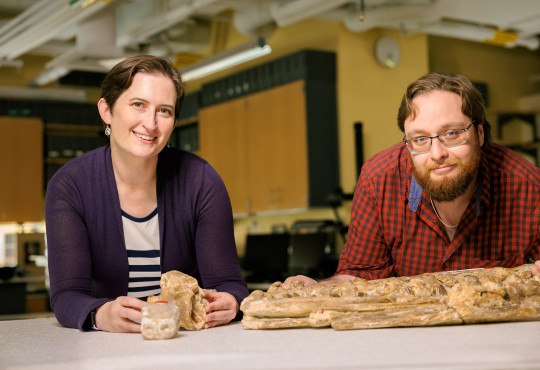
After 80 million years, a giant fossil jaw has quite a story to tell. Back in the age of the dinosaurs, Tylosaurus proriger was a fearsome predator — a bus-sized aquatic reptile with a crushing snout, daggerlike teeth, and knack for swallowing prey whole. How its bones wound up at Harvard is a tangled yarn involving a Wild West stagecoach station, the early western railroads, the infamous “Bone Wars” between rival fossil hunters, and a founding scholar of natural history.

New research by economist Rebecca Diamond found an increase in marriage among single women and an increase in employment rates among unemployed women after they started taking GLP-1 drugs for weight loss. Diamond says the pattern suggests that at least part of the female obesity penalty — the social and financial costs women bear due to their body size — is linked to first impressions.