Clea Simon
Harvard Correspondent
Pulitzer Prize -winning professor’s new book shows how a digital communications infrastructure increasingly came to control public life
/ Read time: 6 minutes
Harvard Correspondent

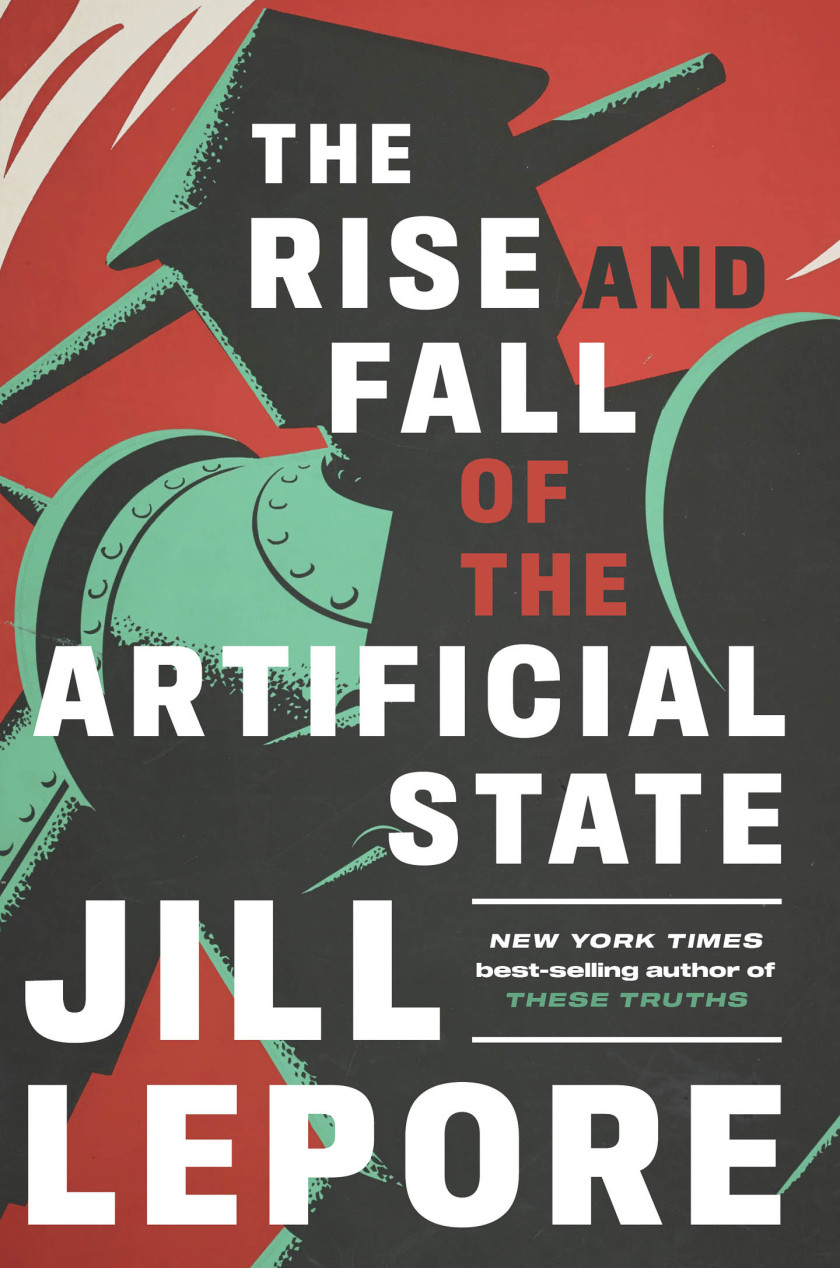
How did we cede control of our democracy to the machines, and can we get it back? These are the questions Jill Lepore, David Woods Kemper ’41 Professor of American History, asks in her latest book.
“The Rise and Fall of the Artificial State,” a study of our fascination with technology and its repercussions, grew out of Lepore’s earlier work and the Tanner Lectures she gave at Yale earlier this year.
“The subject of the Tanner Lectures is human values,” explained Lepore, who is also a professor at Harvard Law School and staff writer for the New Yorker. “That seemed to me an occasion to try to think structurally and historically about where we are in the history of the liberal nation state.”
The new title finds Lepore, who used to teach a course at the College titled “The Rise and Fall of the Machine,” charting the ascent of what she calls the artificial state: the digital communication infrastructure by which governments and private corporations automate and ultimately control public discourse.
Following her Pulitzer Prize win for “We the People: A History of the U.S. Constitution” (2025), “I wanted to think about whether liberal constitutional democracies can survive this moment in time,” Lepore shared in a phone interview.
As a historian, she explained, “I wanted to explain how we got here and think about where we’re headed.”
For inspiration, Lepore drew on writer Hannah Arendt’s 1958 work “The Human Condition,” the follow-up to her seminal “The Origins of Totalitarianism” (1951). Arendt “was interested in exploring many things, but among them the idea that both totalitarianism and automation have in common rendering humans superfluous,” Lepore observed. “She was really interested in how that worked, and so am I.”
After re-reading “The Human Condition,” Lepore was struck by how the book was written “in the shadow of Sputnik.” Reporters at the time, Lepore noted, reacted as if the first artificial satellite was the first step toward an “escape from the prison of the Earth.”
Arendt found this contention astonishing. “The rhetoric around the idea of technological progress had become so strange to her and so out of touch with how people live and what change brings,” Lepore said.
Seeing parallels with the “current ChatGPT moment,” Lepore found herself asking: “Who are the people who are clamoring to be replaced by machines, to have movies made by machines, and novels written by machines?”
And who, she continued, is pushing for our government to be determined by these machines?
In the book, Lepore notes that technological tools are increasingly influencing elections around the world. Chronicling the use of mechanized data from the late 1950s to today, she writes of “the reduction of politics to the digital manipulation of attention-mining algorithms.” The result, she continues, is that “[w]ithin the artificial state, nearly every element of American democratic life is vulnerable to subversion.”
“Of course, using the best possible tools to help you run a campaign is not a terrible idea,” Lepore acknowledged during the interview. But it’s a slippery slope from replacing conversations with constituents to extracting data from machines.
However, she sees the 2026 U.S. midterms as an inflection point. In a recent piece in the Financial Times, Lepore wrote, “This year marks the first AI election. Voters are asking chatbots how they should vote. Campaigns and activists are using AI to analyze the electorate, send micro-targeted messages, produce tailored ads and even deepfakes.”
While her book details how the artificial state undermines representative democracy, it leans more into how the U.S. and other democracies have come to this pass. “I’m a historian, so the book offers a history to each of these kinds of transformations that we are very much in the throes of,” she said, describing these processes as “headlong,” “ceaseless,” and “proceeding at speeds we can barely even fathom.”
We, the people, she maintained, are complicit.
“The day that you tweet something about politics, but don’t manage to go down to the polling station and cast your ballot in-person and buy some cookies from the Girl Scouts and talk to the women from your neighborhood who are credentialing the ballots, something in your commitment to living in a democratic society dies,” she said.
In addition, “The Rise and Fall” explores how, although the artificial state appears to be machine-driven, it is in fact steered by a handful of billionaires, including OpenAI’s Sam Altman, Meta’s Mark Zuckerberg, and Tesla/SpaceX’s Elon Musk.
While tracing these figures’ rise and increasing influence, Lepore also offers a critique of their reading comprehension skills. Instead of receiving the cautionary messages in “The Hitchhiker’s Guide to the Galaxy,” for example, many of these powerbrokers appear to have interpreted Douglas Adams’ 1979 book as a “fantasy that machines would be able to replace people with machines in deciding how we live our lives,” Lepore said.
Lepore stresses in the book that “nobody should trust historians to make predictions,” but she believes it’s possible for democratic citizens to wrest back control. Referencing proposals such as New York’s data center moratorium law, Lepore ends by describing a “growing and increasingly noisy tech backlash.”
“It’s not foreordained. This isn’t inevitable,” she said during the interview. “I think there’s a growing sense of, ‘Okay, enough.’”
The leading stem cell scientist calls the $46 million award “dream-come-true opportunity.”

For more than three decades, the Harvard College First-Year Arts Program has served as incoming students’ first encounter with the breadth of artistic people, places, and pursuits awaiting them on campus.

New research from Erin Hecht’s Evolutionary Neuroscience Laboratory analyzes how human influence has shaped the canine brain to make dogs better communicators.