Scholars from around the United States recently gathered at Harvard to crack an unsolved problem in mathematics: how to make the subject more relevant to undergraduates.
The traditional ways of math instruction no longer add up. Many students spend hours laboring over problems that could be solved instantly by the phones in their pockets. Math curricula must adapt to advances in artificial intelligence, data science, machine learning, and myriad other disciplines.
“The landscape has been changing for a long time, but our curriculum is still rooted in the 1950s and 1960s,” said conference organizer David Kung, executive director of Transforming Post-Secondary Education in Mathematics. “If you look at the curriculum that most students get, you would think that the goal is to beat the Soviet Union into space armed with our pencils.”
Hosted by Harvard, the invitation-only conference gathered a group of key stakeholders including mathematicians from small colleges, community colleges, large research universities, professional associations, and funders such as the Gates Foundation.
Jenna Carpenter, president of the Mathematical Association of America and dean of the School of Engineering at Campbell University, said curricular reform was long overdue but often runs up against resistance from higher education itself. Many aspects of math teaching have been outdated for years, she explained, and AI represents only the latest crisis.
“There’s all this inertia and roadblocks to doing things in a different way,” Carpenter said. “I think AI is really forcing our hands, because it makes much of what we’ve been doing completely obsolete. I’m hoping that AI is going to give the system a shove, so that all the ideas bubbling from below finally have a way to make some change.”
The calculator upended math education. And at that moment, people were very worried that there would be the deterioration of numeracy and people’s ability to do calculations. Right now, we’re at a similar moment with AI, except now it’s not just calculation — it’s reasoning.
Brendan Kelly
Director of Introductory Mathematics
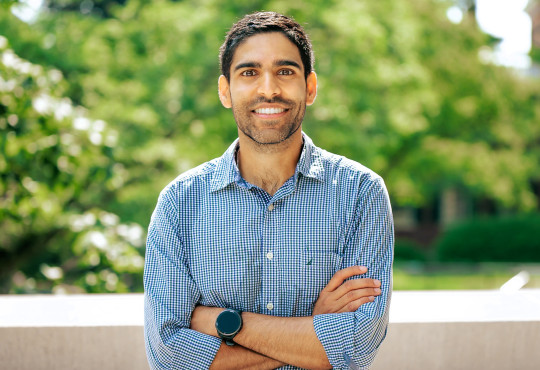
Brendan Kelly, director of introductory mathematics at Harvard and another of the conference’s organizers, said the conference sought to make the subject more applicable and engaging for today’s undergraduates. “The calculator upended math education. And at that moment, people were very worried that there would be the deterioration of numeracy and people’s ability to do calculations,” he said. “Right now, we’re at a similar moment with AI, except now it’s not just calculation — it’s reasoning.”
Kelly said math educators must demonstrate that quantitative reasoning is an essential skill for many disciplines — and for society as a whole. He noted that Harvard has long played a leading role in shaping undergraduate math education, including spearheading the calculus reform movement of the 1990s.
“AI is going to change how we do science and how we do mathematics,” Kelly said. “We need to make sure we’re training young people to have good judgments, to have the knowledge base to use these tools effectively, to amplify the skills that they build, to have intellectual ownership over the ideas that they can then use the tools in effective ways.”
For example, the Harvard Mathematics Department offers courses that emphasize mathematical modeling tailored to specific disciplines in the life sciences, economics, and other social sciences. “We are part of the bigger picture of change,” Kelly said. “What we are offering here is leading the way … and we are trying to put our curriculum out there, open source.”
Even before the conference, more than 450 mathematicians recently signed an open letter calling for wholesale changes to undergraduate math education. They noted that calculus remains an important skill for STEM students, but it has been eclipsed by other areas of mathematics deemed to be of greater importance. At the same time, many STEM majors still take calculus but are never trained in new technologies required for modern tasks.
Instead of standard college algebra, many students would be better served by good quantitative reasoning courses tailored to their areas of study. STEM majors need training in technologies involving large datasets — education that is sometimes skirted by undergraduate math courses. Modern research increasingly involves computer programming, machine computation, and AI technologies.
At the summit, Michael Brenner, Catalyst Professor of Applied Mathematics, Applied Physics and of Physics, explained that much of the work he has done over his career now can be replicated by machines.
“It’s not slowing down, and it scares the hell out of me,” he told the audience. “What I don’t know — and this is what we have to solve together — is, How are we going to make it so that people still learn at the same level of depth that they did before?”
Brenner also struck a note of optimism. With new technologies, science can achieve much more than it could before — but only if students continue to master the material and gain sufficient expertise to provide effective oversight.
“That only is possible if students learn,” Brenner said. “I have absolutely no idea how to do that part, so I’m glad you're all meeting … We have no choice. We simply can’t teach the way that we did before, even as of last fall.”
In the wake of the summit, the group plans to produce a white paper that will provide guidelines to math educators around the world. The group also drafted a list of core principles such as making students feel more welcome (and “intellectually safe”), teaching specific content (greater emphasis on modeling, data science, and computational thinking), and incorporating new technologies (training students to use tools helpful to their subjects).
“I’m personally drawn to be a math educator because of how much mathematics offers our society,” Kelly said. “Unfortunately, we have a culture problem where young people don’t see mathematics as relevant to their lives, and it becomes a barrier to success and completing college. If we could get the math curriculum into better shape, we would contribute to the social good.”
Bigger benefits for kindergarten’s oldest boys uncovered
Being born a few days on either side of the school-enrollment cutoff date might seem like an arbitrary difference. But new research finds boys born just after the cutoff, who start kindergarten relatively old for their grade, enjoy far more advantages than previously known.
How a giant predator of prehistoric seas was discovered — twice
After 80 million years, a giant fossil jaw has quite a story to tell. Back in the age of the dinosaurs, Tylosaurus proriger was a fearsome predator — a bus-sized aquatic reptile with a crushing snout, daggerlike teeth, and knack for swallowing prey whole. How its bones wound up at Harvard is a tangled yarn involving a Wild West stagecoach station, the early western railroads, the infamous “Bone Wars” between rival fossil hunters, and a founding scholar of natural history.
Women more likely to marry, land jobs after taking GLP-1s
New research by economist Rebecca Diamond found an increase in marriage among single women and an increase in employment rates among unemployed women after they started taking GLP-1 drugs for weight loss. Diamond says the pattern suggests that at least part of the female obesity penalty — the social and financial costs women bear due to their body size — is linked to first impressions.
With college math stuck in the 20th century, work begins on a new formula