Eric Moskowitz
Harvard Staff Writer
Recognized for excellence in undergraduate teaching
Harvard Staff Writer
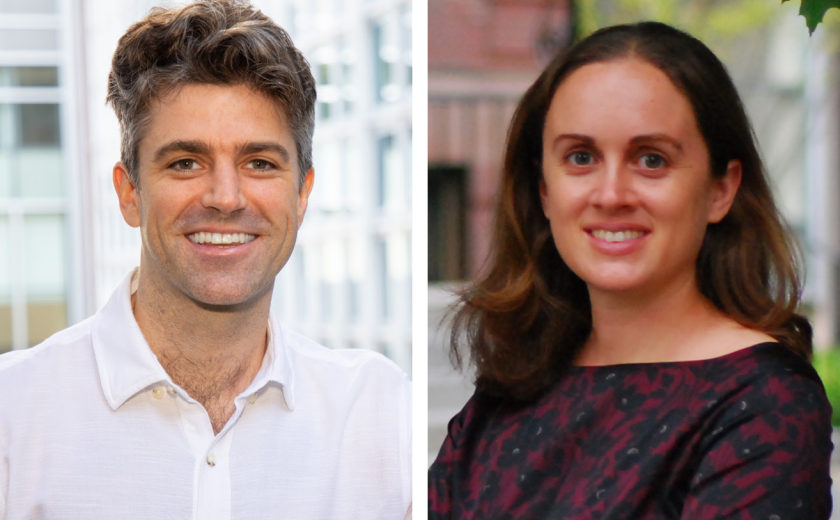
Gage Hills and Julia Mundy ’06, M.A. ’06, have been named as winners of the 2026 Roslyn Abramson Award, given to tenure-track faculty members for excellence in teaching undergraduates.
Hopi Hoekstra, Edgerley Family Dean of the Faculty of Arts and Sciences, announced the award at the May 5 Meeting of the Faculty, noting that both winners were selected “based on their ability to communicate with and inspire undergraduates, their accessibility, and their dedication to teaching.”
The annual award, which includes a monetary prize, was established three decades ago with a gift from Edward Abramson ’57 in honor of his mother.
Coincidentally, the two honorees this year are contemplating a collaboration. Hills is an electrical engineer who works on developing energy-efficient and environmentally sustainable computing systems. Mundy is an experimental condensed matter physicist who works on materials synthesis. The two are considering using materials developed in Mundy’s research group for some of Hills’s devices.
An associate professor of electrical engineering in the Harvard John A. Paulson School of Engineering and Applied Sciences (SEAS), Hills shares his excitement for circuits in the introductory course known as “Circuits, Devices, and Transduction,” because it’s the first time many of the students have ever worked with electrical devices.
With technology all around us, it’s easy to tap a smartphone or stare into a flat screen without contemplating it at all, or to “pass this stuff off as just being kind of like magic,” Hills said. But learning how a transistor works, what it’s made of, and how millions of tiny transistors form the building blocks of electronic devices is truly revelatory, he added. “That’s what’s really cool.”
When Hills first inherited the introductory course, he had ample expertise with the transistors known as MOSFETs (metal-oxide-semiconductor field-effect transistors) that form the basis of most modern computer chips, especially for energy-efficient computing. But when digesting the syllabus, he saw that it also invoked a less common type, the bipolar junction transistor (BJT), which he’d never studied.
Teaching himself so that he could better teach undergraduates, Hills was fascinated to learn that shining light through a BJT speeds up or slows down the travel of that light. That related directly to his research on sending data through optical pulses. Now a doctoral student in his lab is conducting her own Ph.D. research on the optical properties of the bipolar junction transistor.
Hills still remembers what it felt like as a Yale University undergrad when he surprised himself with a perfect score on a challenging midterm; the professor, handing back the exam, told him he should consider becoming an electrical engineer. It changed the course of his life.
Recently, Hills experienced the same exchange from the other side when he was invited to a Classroom to Table meal by a group of graduating seniors. One student recalled how Hills had complimented his question in class, telling the student he could be a circuit designer, a moment Hills hadn’t immediately remembered. But it loomed large for the student — who immediately told his mom what his professor said, and who embarked on an academic journey that will lead next to graduate school for electrical engineering at the University of California, Los Angeles.
“Small moments like that” are the best part of teaching, Hills said. “I can’t teach them everything in one semester, but if I can get them excited about the material, they’ll want to go off and learn on their own.”
Before pursuing her Ph.D., Mundy spent two years as a high school science teacher with Teach for America. That experience informs her approach in the classroom today, as John L. Loeb Associate Professor of the Natural Sciences in the Department of Physics and of Engineering and Applied Sciences at SEAS.
“When you teach high school, it’s critical to engage students in the course material and to meet them where they’re coming from,” she said. “If you don’t do that in high school, then it’s not successful. And I think in college it’s also the case.”
That’s partly why no two versions of Mundy’s “Introduction to Solid State Physics” course are quite the same, even if the syllabus remains consistent. Mundy makes sure to gauge where the students — primarily first-year prospective concentrators — “are coming from and where they want to go.” She also organizes the material around collaborative problem solving. “Every semester is a little different, depending on the students who are in the course and how we come together as a team,” she said.
With her joint appointment, Mundy has also taught a version of introductory physics for engineering students. “My goal is not to make a bunch of physics concentrators but to have everybody be able to engage with the material,” she said. “If they want to apply it to other disciplines, there’s a lot of exciting areas in SEAS that use physics.”
Still, when Mundy thinks most about the ways she has supported and engaged with undergraduates, it’s not in the classroom but in her research lab, where she has mentored 32 undergraduates over the last eight years. They have formed an essential part of the Mundy Group team, working alongside graduate students and postdoctoral fellows as well as Mundy and a research scientist. Even if they arrive without experience, they engage immediately in meaningful work and are treated as peers, with some developing cutting-edge independent projects of their own.
“We’re really proud of that,” she said. “They’re engaged at a very serious intellectual level.”

The Harvard theoretical physicist and neuroscientist has won the Dirac Medal and Prize, one of the highest honors in physics.
Deep in the woods of Petersham, Mass., the Harvard Forest Summer Research Program in Ecology is cultivating a renewable resource — future generations of scientists.

Forget about the ancient Greek myth of Icarus. For the last 10 years, Jenna Samra, Ph.D. ’18, and her colleagues have been pushing technology to fly closer to the hottest part of the sun. Samra, an astrophysicist at the Center for Astrophysics, an institution jointly run by Harvard and the Smithsonian, leads a scientific quest to study the solar corona.