Eileen O’Grady
Harvard Staff Writer
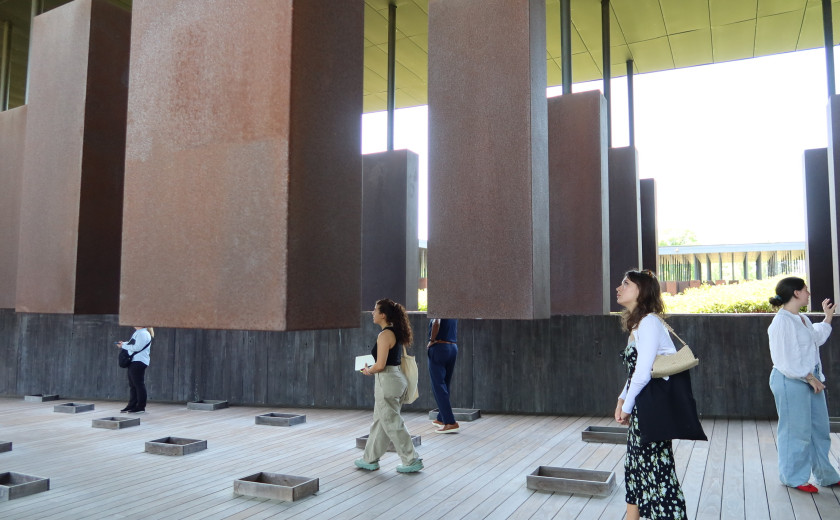
Students studying the intersections of art and racial justice traveled to Montgomery this semester.
/ Read time: 6 minutes
Harvard Staff Writer
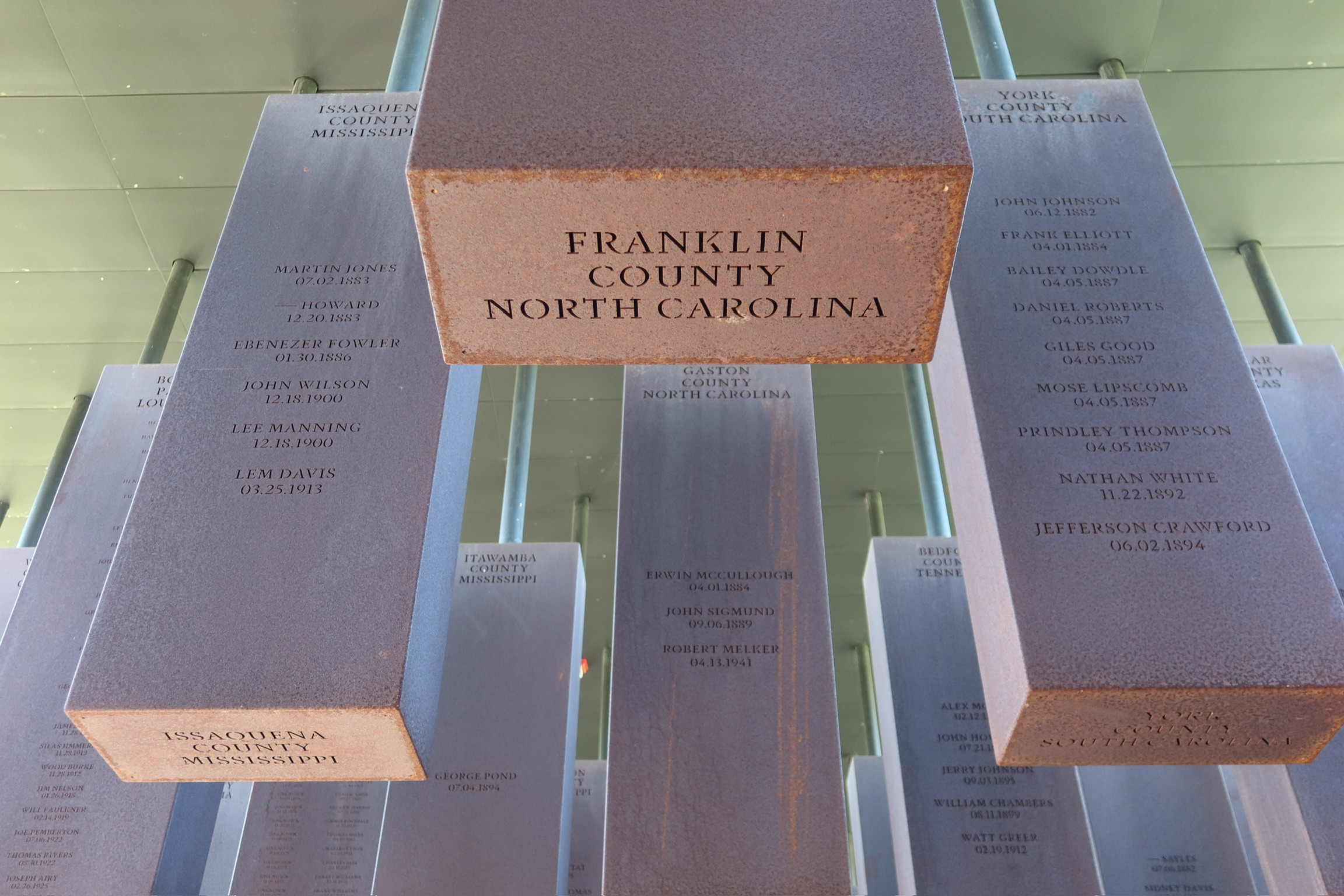
Uzochi Orji took her time walking through the National Memorial for Peace and Justice. She wanted to read every name on each of its 805 markers.
At first, the rows of steel beams, engraved with the names and locations of Black Americans killed in lynchings, appeared below eye level. But as the first-year and her classmates walked further into the country’s first comprehensive memorial to the victims of racial terror, the floor slanted downward. Eventually the markers were high overhead, the names too distant to be discerned.
“That was powerful, because the history is so deep and violent that you don’t know everything,” Orji said. “Even trying to acknowledge everybody who experienced these heinous crimes — you can't do it fully. By each marker getting higher and higher to the point that you can’t even see or acknowledge the names, you know you’re not acknowledging all.”
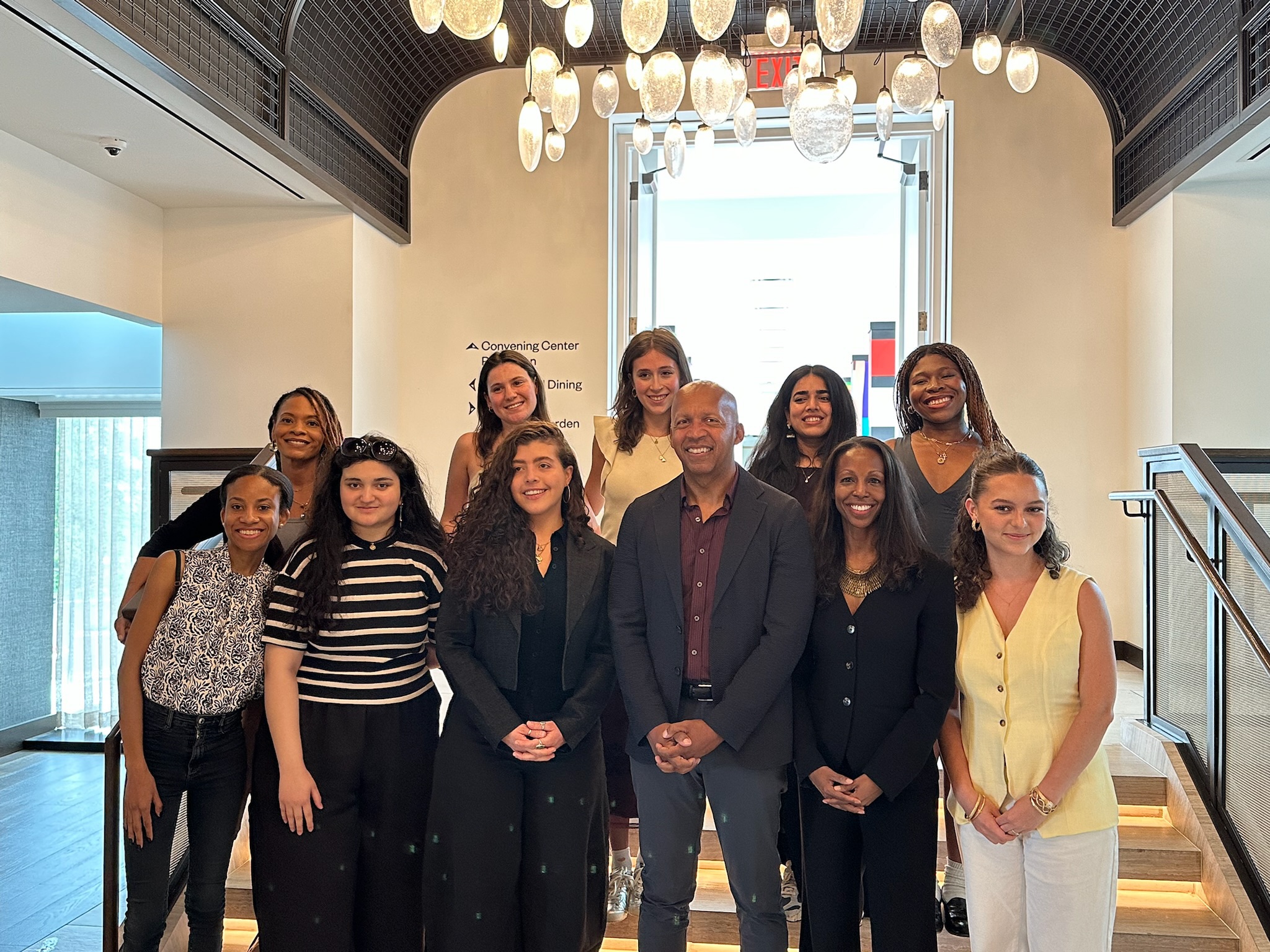
Orji and a group of seven other students led by Sarah Lewis, John L. Loeb Associate Professor of the Humanities and Associate Professor of African and African American Studies, traveled to Montgomery, Ala., last month to meet with the memorial’s mastermind, Bryan Stevenson J.D./M.P.P. ’85. The public interest lawyer founded The Equal Justice Initiative (EJI), the nonprofit responsible for launching a series of Legacy Sites in Montgomery over the past eight years.
“I’ve never, in over 10 years of teaching, seen students transform more,” said Lewis, a leading scholar on the role of visual culture in expanding racial equality. “I saw students both grateful and empowered, focused and inspired, reflective and determined. If every student at Harvard had the opportunity that we were granted, life pathways would transform for the highest good of all concerned.”
Taking the trip were undergraduates from Lewis’s first-year seminar “Can Art Inspire Justice?” and graduate students from her “Art, Race & Politics” course. Over three days, the group toured the National Memorial for Peace and Justice, visited The Legacy Museum, which tells the history of U.S. slavery and its aftereffects, and explored the Freedom Monument Sculpture Park.
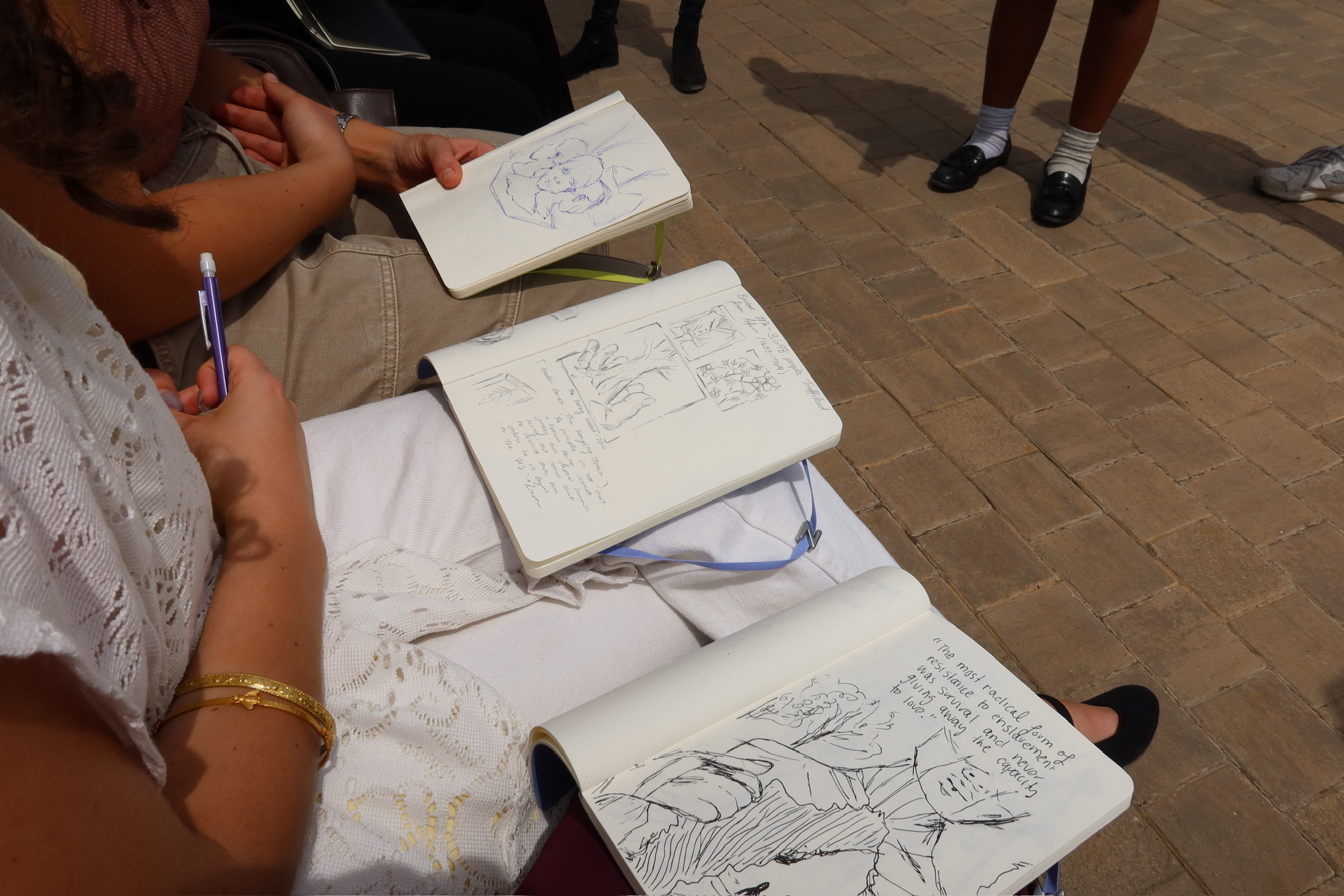
Photography is prohibited inside the museum and sculpture park, leaving students to experience the sites without phones. Lewis provided each with a Moleskine notebook to document thoughts and observations. Every few hours, the professor offered a writing prompt designed to generate reflections on what they had seen.
Maia Posternack ’26, an applied mathematics concentrator on the digital humanities track, said the notebook helped her to stay present.
“In these hours, in these spaces, in our thoughts, we were able to write down all our ideas,” said Posternack, who is pursuing a secondary in computer science. “Instead of taking photos we drew drawings, and this allowed a much more personal connection between ourselves and the artworks that we were interacting with.”
Stevenson and EJI Deputy Director Tera DuVernay spoke with the students about their approach to storytelling at the Legacy Sites, and about their efforts to change the narrative around some of the most difficult chapters in American history. Stevenson, author of the best-selling “Just Mercy” (2014), is known for his work fighting racism through the courts. His book was adapted into the 2019 film starring Michael B. Jordan.
“Everything about [the memorial] is so intentional and so strategic,” Posternack said. “Mr. Stevenson really has planned out a very precise story arc and takeaways for viewers to understand. The memorial itself has steps that are meant to convey different emotions that allow you to confront the history of lynching in varying ways.”
In a moment of serendipity, students were also able to meet Michael Murphy M.Arch. ’11, who worked on the memorial as a principal architect at MASS Design Group. He happened to be on site leading a separate tour group.
On the trip’s final evening, the students also met with Montgomery artist Michelle Browder and viewed her “Mothers of Gynecology” monument, a memorial to enslaved Black women subjected in the 1840s to nonconsensual medical experimentation by gynecologist J. Marion Sims. The Harvard group visited the former office building, now owned by Browder, where Sims conducted painful surgeries on women without anesthesia or pain relief.


Orji, who hopes to study medicine, said it was deeply meaningful to learn more about the history of racial disparities in health care. “This really reinvigorated my interest for medicine,” she said. “It was interesting to be there, remembering that these are real histories and real places, that those treatments happened.”
Once back in Cambridge, Lewis and her students watched EJI-produced videos about the Legacy Sites, weighing whether their learning experience could have been achieved without leaving the classroom. The consensus answer was no.
“It's about the embodied experience,” Posternack said. “A lot of what we do at Harvard is seek to intellectualize things that are fundamentally very physical, emotional, and personal. Learning about things in books — even through art — does not replace that actual experience itself.
“The lack of phone, and the knowledge that we had been building up throughout the semester, really allowed true and complete presence in these moments.”
After meeting with Stevenson, Orji wrote in her notebook about experiencing a renewed sense of hope. In a world shaped by previous generations who were hopeful for a better future, she noted, sustaining that hope is the responsibility of those living today.
“[The trip] has completely shaped the way I look at the world and interact with the world,” Orji said. “Something is very powerful in acknowledging things that are difficult and hurtful, and not staying in the difficulty, but being able to push past and persevere through it.”

Why do so many people feel lonely in a world designed for connection? As Ian Corbin sees it, Americans are experiencing a crisis of belonging, which he attributes to some fundamental misunderstandings about what humans need to flourish.


Weiss, professor of the classics and an expert on ancient Greek culture plans, to prioritize the expansion of educational resources.