Eric Moskowitz
Harvard Staff Writer
How the world rewrote Jefferson’s words
Harvard Staff Writer
In the 250 years since Thomas Jefferson drafted the Declaration of Independence, hundreds of other nascent nations — whether ultimately successful, failed, or somewhere in between — have drawn inspiration from America’s founding document.
The words from Jefferson that reverberated across that considerable “genre” of declarations are not the ones Americans tend to cherish — those self-evident truths “that all men are created equal, that they are endowed by their Creator with certain unalienable Rights, that among these are Life, Liberty and the pursuit of Happiness.”
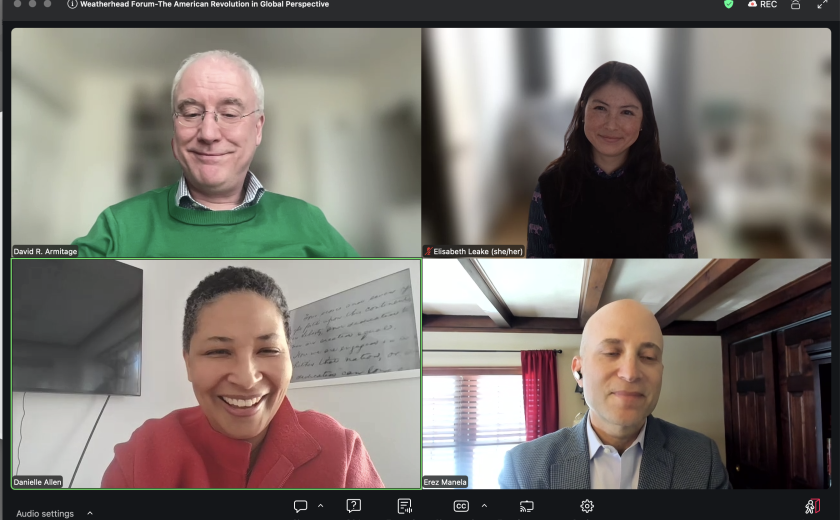
Instead, all but two American-inspired declarations have focused on Jefferson’s first and last paragraphs, treating the 250-year-old source as an assertion of the rights of a seceding state, not individual equality, said historian David Armitage, in a recent Weatherhead Forum, “The American Revolution in Global Perspective,” which explored the impact of the Declaration of Independence on international affairs.
“The Declaration outside the United States is read very differently from the Declaration within the United States,” said Armitage, Lloyd C. Blankfein Professor of History and author of The Declaration of Independence: A Global History. “Since 1776, declarations of independence have overwhelmingly diagnosed the existence of restrictive imperial or colonial systems and represented resistance against them.”
Armitage pointed to Liberia (1847) and Vietnam (1945) as the two exceptions; their declarations also proclaimed the inalienable rights of individuals, in response to the injustices of slavery and colonization.
That’s no mere matter of verbiage, said Elisabeth Leake, from Tufts University’s Fletcher School of Law and Diplomacy, who joined Armitage and Harvard political scientist Danielle Allen, James Bryant Conant University Professor.
The “paradox of the United States,” Leake said, is that the original Declaration was encoded with a universalist message of human rights, and the U.S. became an emblem of democracy. But “a declaration of independence is not the same as a rejection of empire.” The tensions in the original “between its specificity and its universalisms” help explain why the U.S. and so many subsequent independent nations have engaged in aggressive expansion, displacement of indigenous peoples, and support for authoritarian allies.
Allen, author of the forthcoming Radical Duke: How One Aristocrat — And the American Revolution — Transformed Britain, traced the link between the original Declaration, an exceedingly rare copy her team unearthed in England, the first bill seeking universal male suffrage, and the unlikely link between that enlightened effort in England and the expansion of empire.
On June 3, 1780, the third Duke of Richmond, Charles Lennox, became the first lawmaker in the world to introduce legislation to extend voting rights to all adult males, regardless of property ownership or other restrictions. Committed to the lives of everyday Englishmen, Lennox wanted to make government more representative and check the powers of the king. His bill got little notice that day, subsumed by a massive anti-Catholic riot that stormed Parliament, but it planted the seed for the 19th century movement to extend the franchise.
Lennox also advocated for American independence, though broadly he favored a vision resembling the future Commonwealth of Nations, a network of colonies empowered with independent legislatures but retaining a tie to the Crown. Except that would add power to the King he wanted to check. So for Lennox, Allen said, “the puzzle of the Revolution had a very specific form, different than the kind of form it had for others.” His solution? Extend the vote to all men in England, to make Parliament a true counterweight to the Crown.
“The paradox of universal manhood suffrage is that it emerged as a solution to the project of how to build a colonial empire,” Allen said.
Allen also connected that “Sussex Declaration” she unearthed — the only known ceremonial-scale parchment copy of the American Declaration anywhere outside of our National Archives, not to be confused with typeset copies — to the relationship she pieced together between the duke and Thomas Paine, recently detailed in The Atlantic.
In the online forum, last in a 2025–26 series hosted by the Weatherhead Center for International Affairs, Armitage shared a word cloud of the original Declaration, noting the prevalence of words such as “laws,” “states,” and “government,” and the absence of “America,” “American,” and “independence” (though “independent” appears). It wasn’t even called “The Declaration of Independence,” a title added later. That choice of words attests to the lack of any national identity. “Having made the United States of America, it was now necessary to make Americans,” he said.
As much as this nation is now celebrating its 250th anniversary, Armitage is holding out, as a declaration of independence is only valid when it’s “confirmed by the incumbent power.” (Otherwise, it’s the “sound of one hand clapping” — he noted while sharing a meme from “The Office,” like when Michael Scott “declared” bankruptcy by shouting it.)
“Accordingly, a strict historical and legal account would properly defer the American semiquincentennial until Sept. 3, 2033, and the 250th anniversary of the Peace of Paris,” he said. “I hope we’ll all reconvene, therefore, in seven years.”

The Harvard theoretical physicist and neuroscientist has won the Dirac Medal and Prize, one of the highest honors in physics.
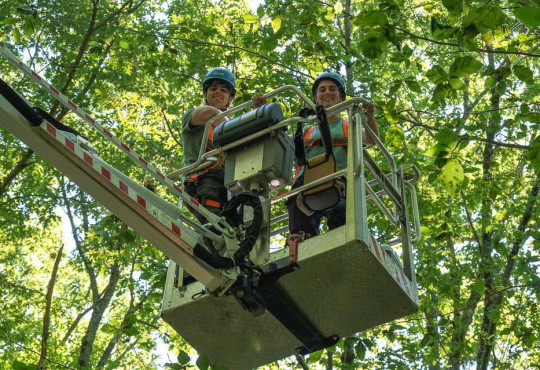
Deep in the woods of Petersham, Mass., the Harvard Forest Summer Research Program in Ecology is cultivating a renewable resource — future generations of scientists.

Forget about the ancient Greek myth of Icarus. For the last 10 years, Jenna Samra, Ph.D. ’18, and her colleagues have been pushing technology to fly closer to the hottest part of the sun. Samra, an astrophysicist at the Center for Astrophysics, an institution jointly run by Harvard and the Smithsonian, leads a scientific quest to study the solar corona.