Christy DeSmith
Harvard Staff Writer
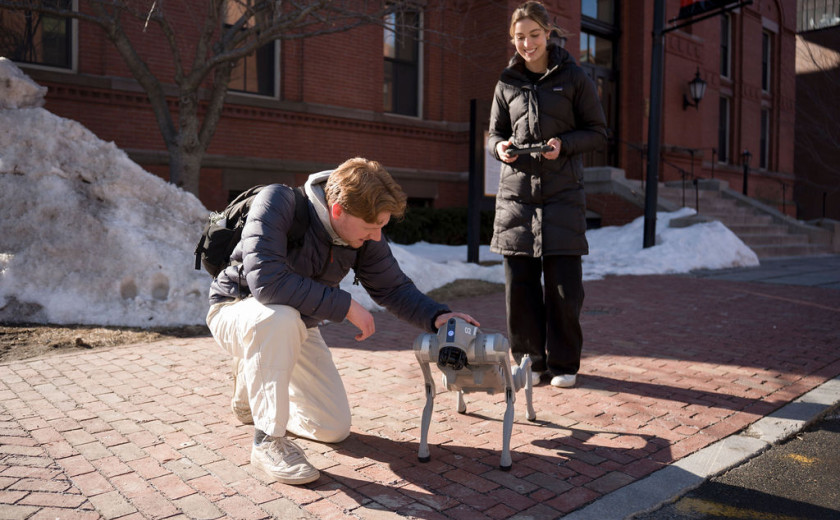
Anthropology professor Ryo Morimoto advances a human-centered droids course, open to students from a diversity of concentrations
/ Read time: 8 minutes
Harvard Staff Writer
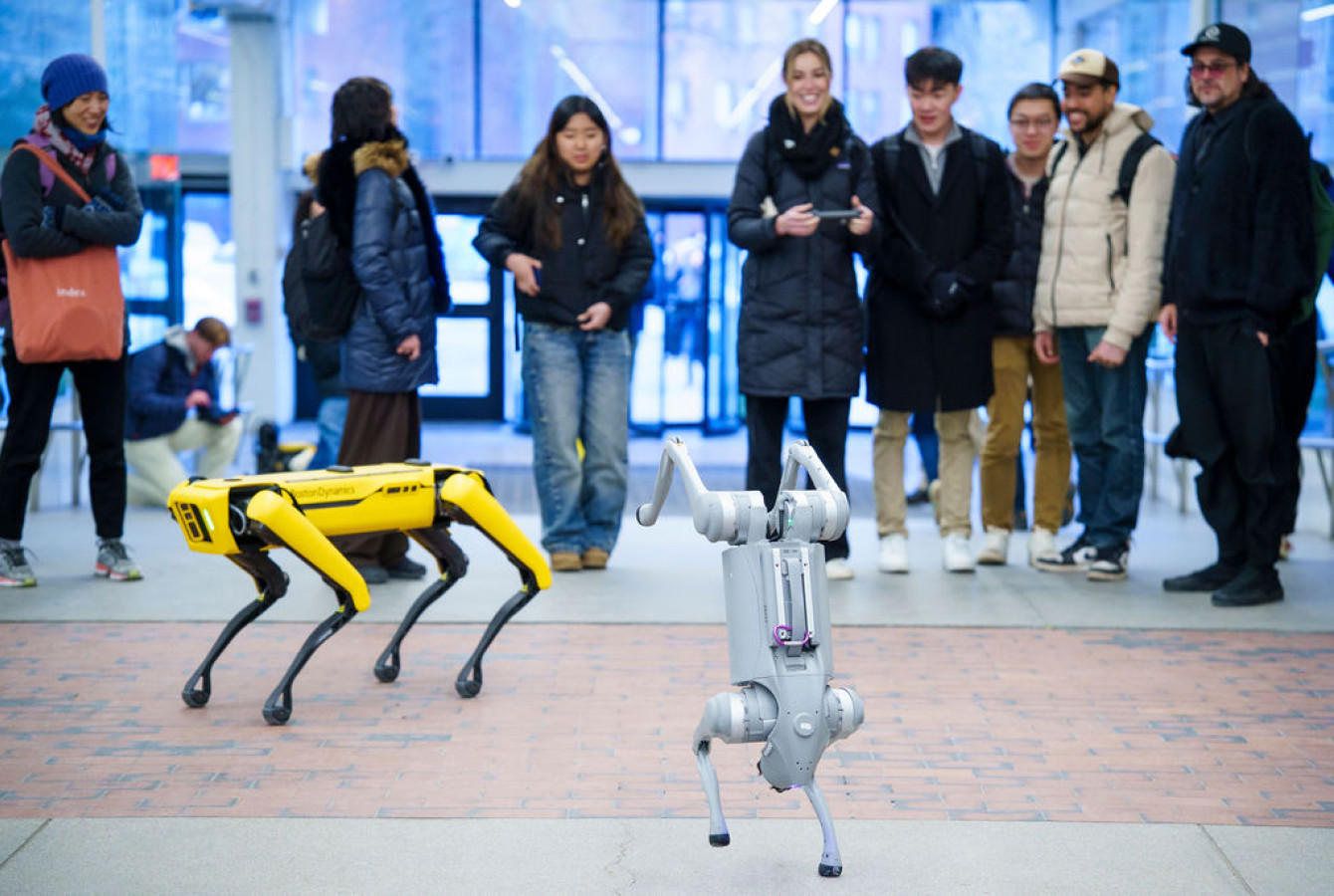
Three robots walked into the Science Center, their human handlers trailing several feet behind.
Within seconds, a crowd circled the cute one, a jaunty silver contraption. A toy poodle came to mind as it trotted about the building’s red-brick arcade on four spindly legs.
“Good boy,” chirped one woman, wearing an enormous grin. She whipped out a smartphone and collected several selfies.
A man, who said he had two dogs at home, stepped up to confirm the robo-dog could beg, sit, and perform other familiar tricks. “Good bot,” he said as it returned a high-five.
“It’s so weird,” exclaimed another passerby, turning sharply on her heel. “I don’t like it.”
Robots elicit an array of human reactions. This semester, a new course is leading students to consider how the machine’s appearance, gestures, job function, and even media portrayals shape the human-robot relationship. “Robots in Human Ecology,” led by assistant professor in anthropology Ryo Morimoto, invites engineering and computer science concentrators to contemplate the technology’s past, present, and future alongside those studying government, sociology, and visual arts.
“With many technologies in the past, conversations about the social stuff, the political stuff, the cultural stuff all comes after the fact — when it's already too late,” Morimoto said. “What I’m trying to do is encourage interdisciplinary conversations early on.”
The anthropology seminar, with just 20 undergraduate and graduate students, has been approved as a First-Year Seminar for the 2026–27 academic year. But it will remain as the rare robotics course anchored outside the STEM fields, its syllabus rich with contributions from the humanities and social sciences. The goal is to advance a more human-centered approach to robot innovation and ethics.
“Anthropology, as a discipline, really cares about the reflections of each individual,” Morimoto explained of his approach. “We’re constantly thinking about who we are in relation to the object or subject we’re engaged with. We acknowledge that our presence matters in what we’re studying.”

Young people today can pore over the painstakingly crafted showcases of robots dancing or performing kung fu that circulate on social media. But students in Morimoto’s course get to encounter the technology close-up, many for the first time.
“I had seen clips of robots used in factories and in war zones,” recalled Anna Umeda, a sociology concentrator (with a secondary in East Asian Studies) from Tokyo. “But I didn’t really understand the mechanisms or limitations of robots until I spent some time with them.”
Assignments include three to seven days of “fostering” the poodle-like robot, a product of the Chinese company Unitree. Its official name is Go2 Edu, but some in the course defaulted to pet names for the 27-inch-long charmer. Think: Go-Go, or the video game-inspired Blitz.
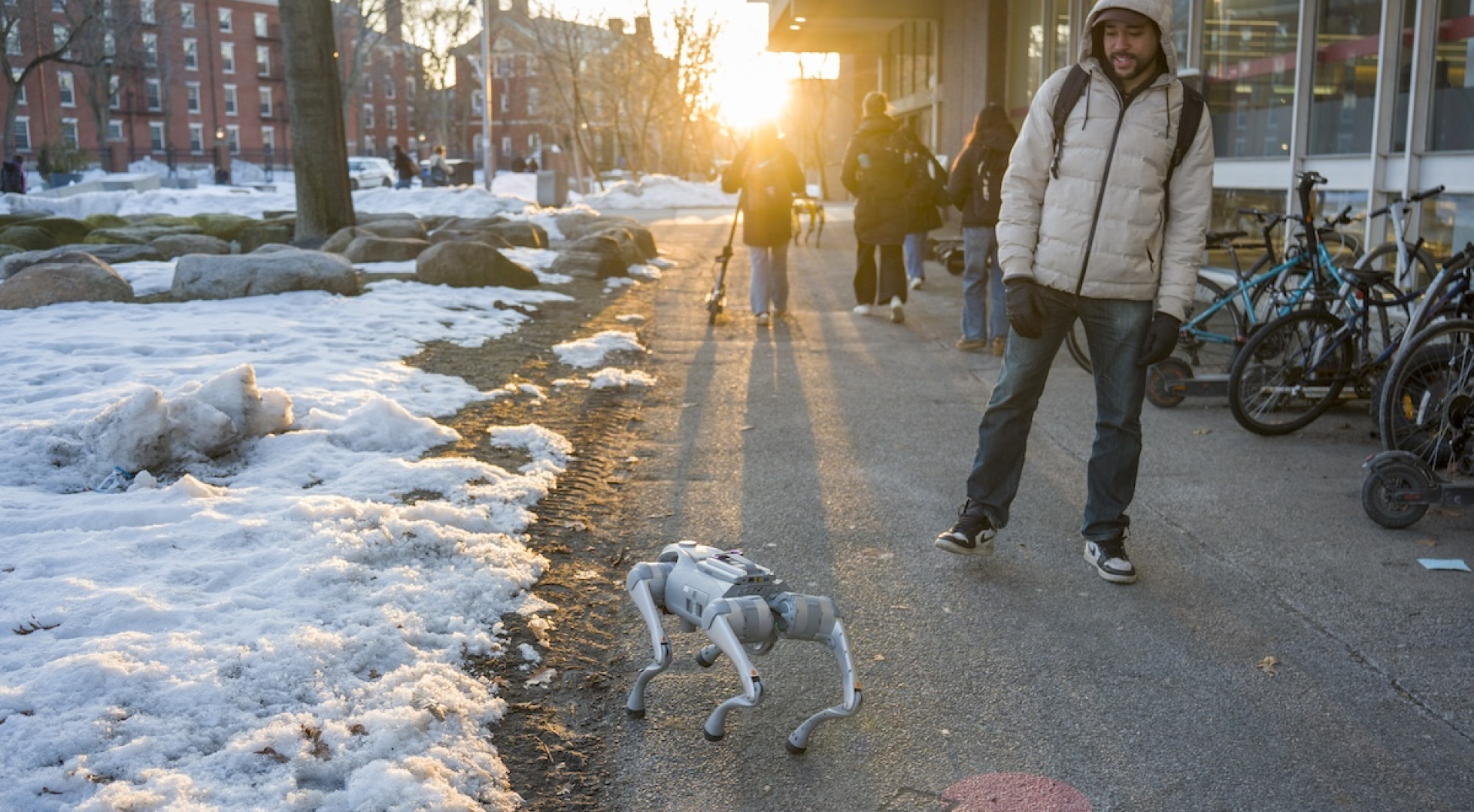
Delight was a common reaction when students took their tablet-controlled sidekick into the wild, with people on the street frequently requesting photographs or drawing comparisons to beloved pets. The constant attention was reported to be exhausting — to the humans, at least.
Students also fielded skeptical takes while taking Go2 shopping or riding on the T. Some passersby specifically cited fears of surveillance or job displacement. Others causally hurled insults.
“Someone shouted from their car, ‘Buy yourself a real dog,” recalled Paweł Pieniążek, who is graduating this spring from the Harvard Kenneth C. Griffin Graduate School of Arts and Sciences’ Russia, Eastern Europe, Central Asia Master’s Program.
Anna Grace Keller ’26, a government concentrator from Jacksonville, Fla., confessed to a fear of robots as she entered the course. But assigned reading covering everything from history to the ethics of incorporating robotics into society, with many selections covering a burgeoning sub-specialty called “human-robot interactions” (or “HRI” for those in the know), opened her eyes to the cultural specificity of that thinking.
“I’ve learned that my perspective was shaped by media and not by true robotics,” said Keller, a member of the Reserve Officers’ Training Corps (ROTC).
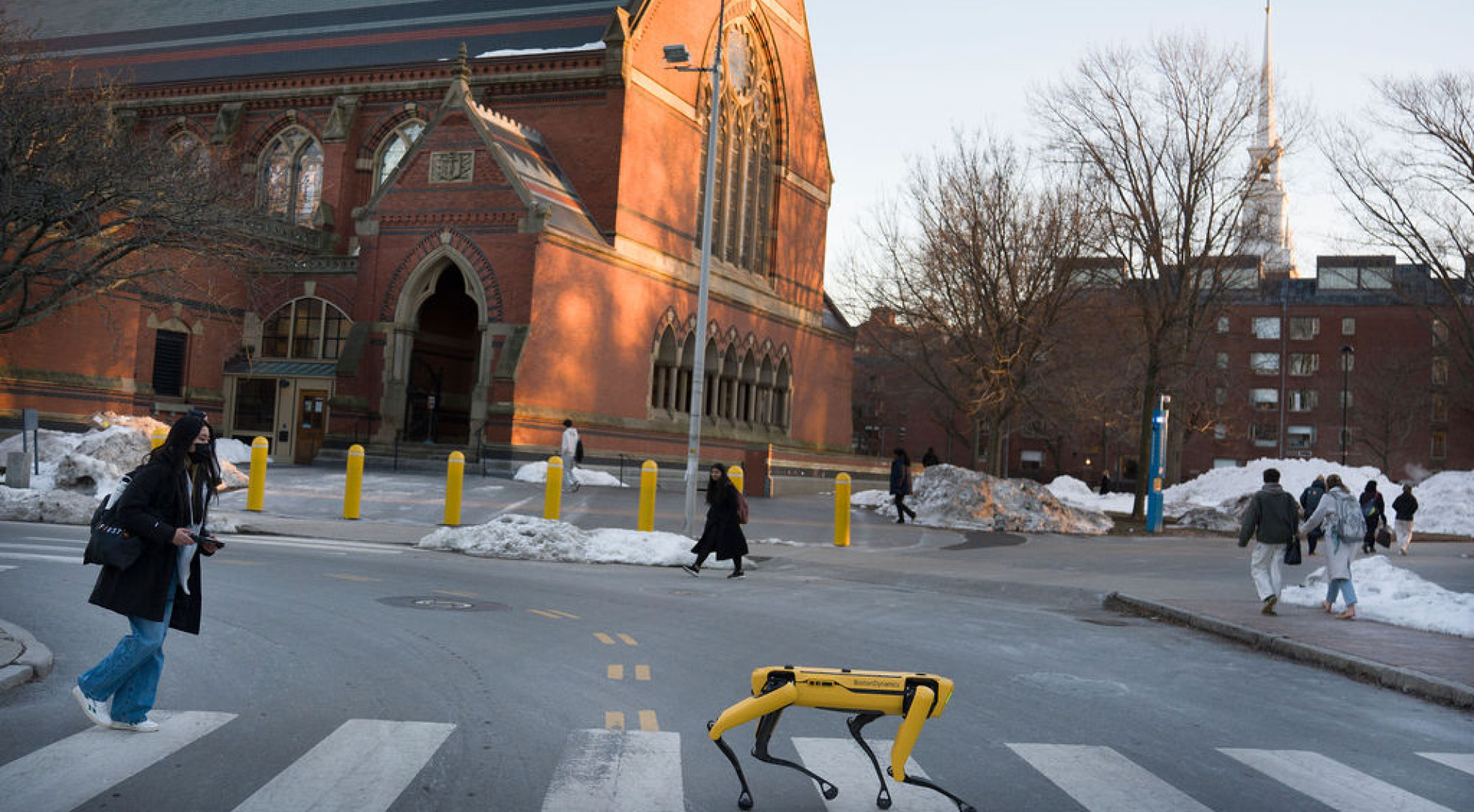
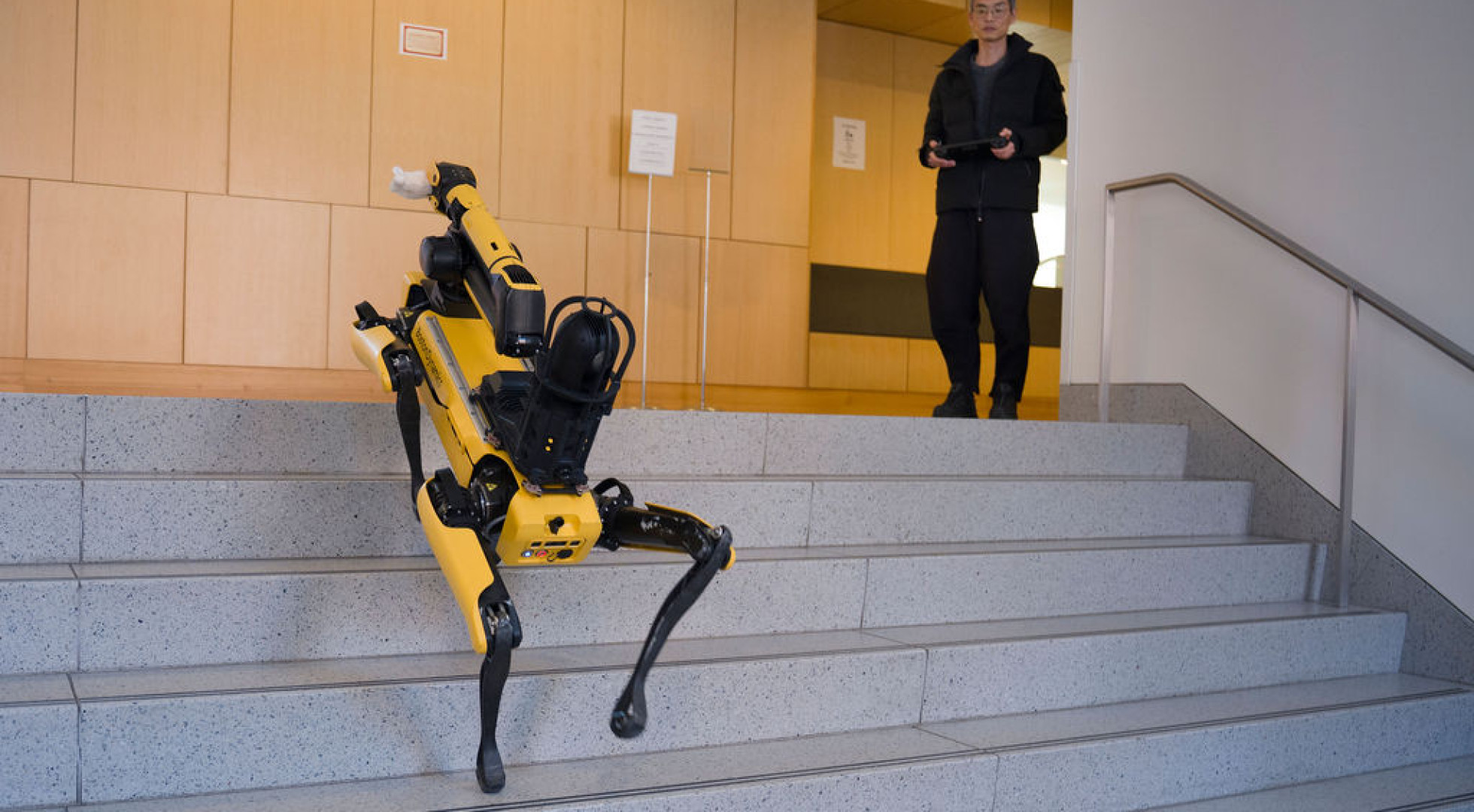
Students can gain additional experience by booking lab time with two iterations of Boston Dynamics’ Spot, another four-legged product, this one reminiscent of a yellow Labrador. An early model, popular with automakers and other manufacturers, was lent to the course by Latanya Sweeney, Daniel Paul Professor of the Practice of Government and Technology at Harvard Kennedy School. A newer version, now attached with an arm that resembles the long neck of a brontosaurus, was made available by Spot’s Waltham-based parent company. Additional hardware, and other supports, were provided by the Reischauer Institute of Japanese Studies.
David Robert, the former director of human interaction and design for Boston Dynamics, visited Morimoto’s class the day they traversed campus with Go2 and two iterations of Spot. Robert talked about making design choices that put human users at ease. One memorable example looked like little more than a box, but it was responsive to the application of Velcro letters, numerals, and musical notes.
“So far, the class has covered things like proximity — is the robot behind or in front of you? How does the robot look?” said Alisona H. Le ’28, an electrical engineering concentrator from Cliffside Park, N.J. “These are things that kind of sat in the background when I thought about robotics before. But now I see they really shouldn’t stay in the background. These decisions really matter.”
Morimoto, author of “Nuclear Ghost” (2023), is an expert on human interactions with nuclear materials, especially the 2011 explosion of a power plant in Fukushima, Japan. From 2016–18, Morimoto managed the Reischauer Institute’s Japan Disasters Digital Archive as a postdoctoral fellow.
From the start, Morimoto noted, nuclear technology evolved alongside robotics. “Without the invention of the arm manipulator, which afforded physical distance between human bodies and the radioactive material,” he said, “the nuclear industry wouldn't have been possible.”
To this day, humans working at Fukushima cannot enter the sites of the nuclear meltdown, still filled with radioactive debris. During his class remarks, Robert fondly remembered one employee there, a top video gamer, who proved remarkably adept at guiding Spot’s clean-up efforts from distances of several kilometers.
“The site offers an ideal environment for roboticists,” said Morimoto, who worked for a time with Boston Dynamics as a liaison to the Fukushima project, “because they don't have to worry about the liability to humans.”
The first-generation college graduate from Kurashiki, Japan, came to adopt a “practical, pragmatic” approach to studying human-robot relations. He recognizes the inevitability of the technology’s advancement.
“Instead of pushing robots away and saying ‘Oh, they’re going to take over the world,’ we need to look at their actual state in order to fully understand what the human-robot relationship can look like,” Morimoto said.
Many in the course are destined for tech jobs. Umeda plans to return to Tokyo, where she has already secured a job dealing with artificial intelligence. Le, who once captained her high-school robotics team, has started to hunt for internships in the robotics industry.
“That’s how much this class has impacted me,” she said. “It reminded me how much I like robotics.”
Pieniążek, a former journalist with bylines from multiple conflict zones, is applying for Ph.D. programs. He wants to complete an ethnographic study of Ukrainian soldiers who operate drones. The technology provides them with intimate glimpses of their targets just before impact.
“I became really interested in the contradiction,” Pieniążek said. “They can’t feel their victims’ breath, but they can see the panic in their eyes. They can see their faces.”
Morimoto was an assistant professor at Princeton when he introduced “Robots in Human Ecology” with a co-instructor in 2023. The project-based curriculum always invited critical engagement with what kinds of roles robots fulfill. At Harvard, the course ends with group efforts to deploy Spot and Go2 for purposes that meaningfully serve the campus community.
“In the beginning, obviously, the robots are the center,” Morimoto said of the course. “But by mid- to late-semester, the measure of success is whether students are no longer treating robots as this spectacular entity, but as something that disappears into the background because their conversations have become central.”

The Harvard theoretical physicist and neuroscientist has won the Dirac Medal and Prize, one of the highest honors in physics.
Deep in the woods of Petersham, Mass., the Harvard Forest Summer Research Program in Ecology is cultivating a renewable resource — future generations of scientists.

Forget about the ancient Greek myth of Icarus. For the last 10 years, Jenna Samra, Ph.D. ’18, and her colleagues have been pushing technology to fly closer to the hottest part of the sun. Samra, an astrophysicist at the Center for Astrophysics, an institution jointly run by Harvard and the Smithsonian, leads a scientific quest to study the solar corona.