Christy DeSmith
Harvard Staff Writer

Analysis reveals unhappy marriage of lower productivity and higher prices amid wobbly regulation
/ Read time: 5 minutes
Harvard Staff Writer
According to a deep well of research, inconsistencies in economic policy, like yo-yoing tax rates, drag down the entire economy. Investors hesitate. Developers postpone. Consumers pause.
James Stock, Harold Hitchings Burbank Professor of Political Economy, wanted to know whether climate policy uncertainty worked any differently.
“You might think that it would,” offered Stock, who also serves as Harvard’s Vice Provost for Climate and Sustainability and director of the Salata Institute for Climate and Sustainability. “Because climate policy uncertainty is about sectoral shifts between fossil fuel consumption on the one hand and renewables on the other. It’s rather different than passing a tax cut.”
With a new working paper, Stock and his co-authors confirm the macroeconomic harms of fluctuating clean energy subsidies and litigation over emissions rules in the U.S. As their research reveals, the country is left with reduced industrial production and lower levels of investment, just as economists have found with rollercoasting monetary policy.
But the impacts differ in one key area. In a surprising result, the research shows rising prices amid ambiguity around government actions on climate.
“We find the effects are quite large,” Stock summarized. “We find climate policy uncertainty is bad for the economy.”
The combination of inflation and reduced economic exchange, he said, resembles stagflation, that painful mix of low growth, high unemployment, and steep inflation famously seen in the 1970s. But the macroeconomist and energy policy expert stressed the need for further research to meet strict definitions of the term.
Climate change has broad implications for the environment, human health, and core industries like farming and tourism. Under President Biden, mitigating the harms meant lowering emissions by expanding clean energy subsidies via the 2022 Inflation Reduction Act. Under President Trump, who saw unfair advantages for the solar and wind industries, most of that support was dismantled with 2025’s One Big Beautiful Bill.
Stock and his co-authors, including Northwestern University economist Diego Känzig, began their analysis by quantifying all episodes of climate policy uncertainty since the mid-1980s. Scraping 7.87 million news articles from publications including the New York Times, Los Angeles Times, Wall Street Journal, and Washington Post enabled the researchers to identify 146 episodes of major U.S. climate policy shifts. Triggers include international agreements, policy debates, regulatory disputes, and court challenges.
Next, they charted levels of climate policy uncertainty from 1985 to 2025. Their index showed a few spikes during the 1990s and early 2000s, including the 1995 government shutdown that threatened Environmental Protection Agency funding. A sharper rise appeared in 2007, when several climate and energy bills, including efforts to implement cap-and-trade limits on carbon emissions, were introduced by members of Congress.
But the 2016 election marked a sea change. President Trump’s withdrawal from the Paris Climate Agreement in 2017 registers as the index’s first monster wave. Another surge lands in 2019 with federal lawmakers sparring over the Green New Deal and California’s stringent vehicle emissions standards. From there, the index roils from an elevated baseline through changes brought by the Biden and second Trump administrations.
The researchers used what Stock described as “standard time series econometric methods” to capture the relationship between episodes of climate policy uncertainty, industrial output, prices, and more. The period they studied also saw volatility on international trade, geopolitical risks, and financial markets, they noted. Results were verified by zeroing in on the effects of more isolated episodes, like federal court decisions on whether the Clean Air Act of 1970 could be used to regulate carbon emissions.
If you’re thinking of building an EV manufacturing plant, and there’s a debate going on about EV subsidies, you’re just going to wait.
“We found that climate policy uncertainty suppressed industrial production and aggregate demand measures,” Stock said. “That isn’t a surprise, because the same is true for economic policy uncertainty. If you’re thinking of building an EV manufacturing plant, and there’s a debate going on about EV subsidies, you’re just going to wait.”
Between 2016 and 2020, the co-authors show a roughly 50 percent increase in U.S. climate policy uncertainty. According to their model, that level of confusion correlated over this period with a 0.5 percent decrease in economic output, a 2 percent drop in private investments, and a 0.2 percent increase in unemployment.
Prices generally fall with fluctuating tax and interest rates, because researchers have shown that economic policy uncertainty serves to disrupt consumer demand. Climate policy uncertainty appears to work differently. As Stock’s model revealed, a 50 percent increase in climate policy uncertainty has historically caused a 2.9 percent climb in commodity prices plus a 0.2 percent bump in consumer prices.
The paper goes into further detail about the impacts on individual firms, uncovering reduced productivity and Research and Development spending even in the fossil fuels sector. Taken together, the findings suggest climate policy uncertainty registers as a shock to the supply-side of the U.S. economy.
It also leaves the co-authors with a compelling hypothesis regarding high energy prices.
“If we’re thinking of building a wind farm, we don't know whether we’re going to get a subsidy; we don't know whether the subsidy will be taken away; we’re just not going to do it,” Stock explained. “But the country is still going to demand that energy from somewhere. If we demand that energy from oil or gas, we’re going to bid up the price.”
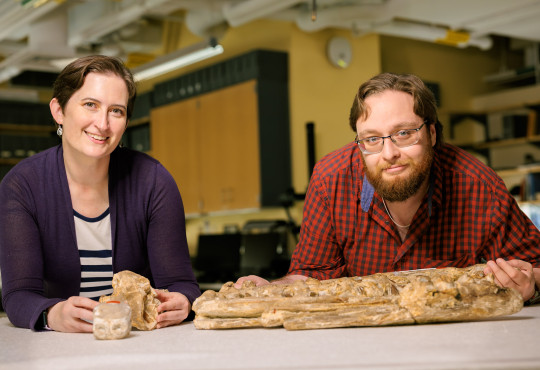
After 80 million years, a giant fossil jaw has quite a story to tell. Back in the age of the dinosaurs, Tylosaurus proriger was a fearsome predator — a bus-sized aquatic reptile with a crushing snout, daggerlike teeth, and knack for swallowing prey whole. How its bones wound up at Harvard is a tangled yarn involving a Wild West stagecoach station, the early western railroads, the infamous “Bone Wars” between rival fossil hunters, and a founding scholar of natural history.

New research by economist Rebecca Diamond found an increase in marriage among single women and an increase in employment rates among unemployed women after they started taking GLP-1 drugs for weight loss. Diamond says the pattern suggests that at least part of the female obesity penalty — the social and financial costs women bear due to their body size — is linked to first impressions.

When David Bakalar first set foot at Harvard, he was a 17-year-old child of immigrants commuting by bus from Lynn, his $500 “nonresident scholarship” covering tuition and a study space at Leverett House but not room and board.