Nicholas Economides
Harvard Correspondent
Track’s hammer and throw team weigh the dynamics of making metal magic
Harvard Correspondent
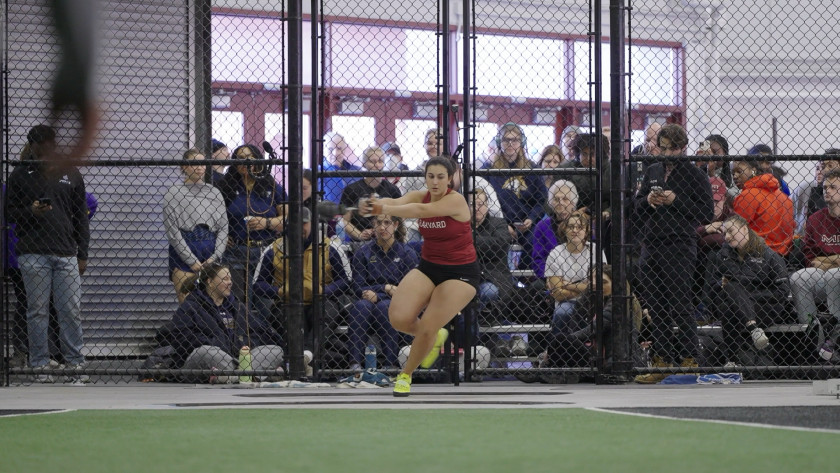
Hurling a 16-to-35-pound metal ball attached to a long piece of wire might not sound balletic, but the hammer and weight throw is one of the most graceful — and thrilling — events in track and field.
Alice Mihas, captain of Harvard’s team of eight throwers, describes the sport as “truly a yin and yang.”
“I have to talk myself through a throw,” said the junior studying applied mathematics. “I always want to focus on the two cues that are on my mind and talk through them. When you’re in the throw, you just want to get your feet down and push it.”
The origins of the hammer and weight throw can be traced all the way back to 1800s B.C. in the British Isles, as myth tells the tale of Cú Chulainn twirling a wheel of a chariot around his body and hurling across the fields at the Tailteann Games. The event would become standardized in the 1870s by the British, who first used a 16-pound weight for competition. Today, the hammer throw is contested during the outdoor track season with a lighter weight and a longer wire, whereas the weight throw uses a shorter wire and heavier weight during the indoor season.
“What makes it unique is that, depending on who you are, you have to get through three or four rotations. That repetition and the same motion to get to the release is one thing that sets the hammer and weight throw apart,” Mihas said. “You get six attempts to get it right, and you have to stay in it for an hour between throws and all that effort goes into just six seconds for a throw.”
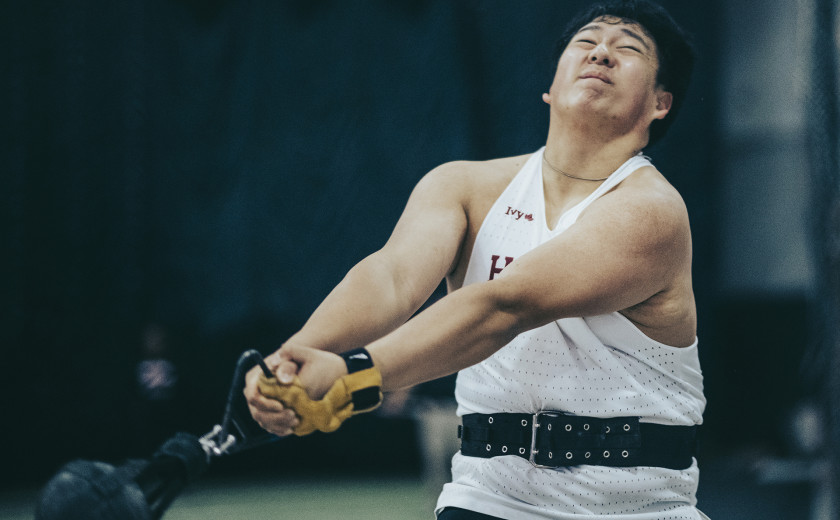
“For the weight and hammer throw, with the additional rotations, there’s a lot more to work on,” Daniel Ye, a first-year thrower, said. “There’s also a lot more that can go wrong. At any point, if you mess up that first turn, or the second or the third turn, most of the time the whole throw can be gone.”
As physics go, the hammer and weight throw is a true full-body exertion. Most athletes implement a technique that features three or four full turns, using their arms to swing the ball and their lower body to generate momentum. It all leads to the “catch”: the moment when the spin reaches its apex, and the thrower launches the weight at the perfect angle.
“While it looks to the layperson that the hammer and weight is just twirling faster and faster with each turn. Each can be broken down into a series of movements,” said assistant coach Fletcher Brooks. “These movements should be seamless, and the second and ultimately third heel turn repeats the same technique, only faster and faster. The final turn, or ‘finish,’ transitions from a turn to a release of the implement where instead of turning on the heel of the left foot, the left side stops moving [or] blocks putting all the rotational force into the implement and the thrower releasing the implement. From start to stop, the hammer throw takes at most three seconds, but there are a lot of different positions/movements that need to be optimized to convert the rotational energy into measurable distance.”
While it may only be a 3-second throw, with the amount of finite and technical movements, the mental aspect of the hammer and weight throw is key. While the weight and hammer throw are individual events, the team aspect of the larger track and field helps throwers work through issues and sustain a high level of excellence over the course of a meet.
While the weight and hammer throw are individual events, the team aspect of the larger track and field helps throwers work through issues and sustain a high level of excellence over the course of a meet. “It’s really amazing and we are super close. We always spend time with each other in and out of competition,” Mihas said. “When I am in a meet and I see every one of my teammates cheering me on, that’s super special. In that hour between my throws, they can help keep my mind steady.”
Said Ye: “I am very grateful every day to be around such talented and hardworking people. One of the things is that we truly support each other in all aspects. I really appreciate the bond we have and having people that truly want you to be better is a huge positive.”
Harvard boasts a rich history in both the weight and hammer throw, as the Crimson is only Ivy League program to have both a men’s and women’s hammer throw NCAA national champion (Stephanie Ratcliffe ’23 and Kenneth Ikeji ’25). The focus now is to continue to build upon that rich and storied throwing tradition.
“It’s really amazing to look at the legacy of the program,” Mihas said. “It’s amazing to be a part of something that is truly growing. The drive and passion of the previous generations is still here today, and we are working to keep raising the bar.”

The Harvard theoretical physicist and neuroscientist has won the Dirac Medal and Prize, one of the highest honors in physics.
Deep in the woods of Petersham, Mass., the Harvard Forest Summer Research Program in Ecology is cultivating a renewable resource — future generations of scientists.

Forget about the ancient Greek myth of Icarus. For the last 10 years, Jenna Samra, Ph.D. ’18, and her colleagues have been pushing technology to fly closer to the hottest part of the sun. Samra, an astrophysicist at the Center for Astrophysics, an institution jointly run by Harvard and the Smithsonian, leads a scientific quest to study the solar corona.