Clea Simon
Harvard Correspondent
Microbes help lay down shell in an increasingly acidic ocean
Harvard Correspondent
For an oyster, creating an internal environment for calcification that forms its distinctive hard shell is essential. But new Harvard research in Proceedings of the National Academy of Sciences has found that these bivalves may outsource the work, coordinating with microbes in a manner that may shed light not only on oysters but on how microbes might help with resilience in a changing ocean.
Originally, Andrea Unzueta Martínez — a postdoctoral fellow in the Girguis Lab for Ecophysiology, Biogeochemistry, and Engineering and first author on the paper — was looking at how oysters function in the ocean. Oysters, she explained, are able to regulate their internal pH, which means they can maintain homeostasis — a stable internal environment — even as the pH of their watery outside environment changes with the tides. Following her doctoral work, which looked at oysters’ resident microbes, she then posited the question of what roles these microbes might play.
“I wanted to start taking a look at what the microbes were doing for the animal host in terms of chemistry regulation,” she said.
She started by assessing the bivalve’s own ability to maintain homeostasis, especially during high tides when their outside environment is more acidic.
“We know that the oyster can regulate its internal chemistry,” Unzueta Martínez said. “They have all of the genetic machinery in order to do that, but we never even considered the possibility that microbes could actually be contributing in a meaningful way.”
She focused on microbes that live in a pocket of fluid between where the oyster’s soft body connects to its shell. “This fluid is completely closed off from the environment so that there’s no way that a random seawater microbe could just float its way in there,” she said. “We have no idea how these microbes got in there in the first place.”
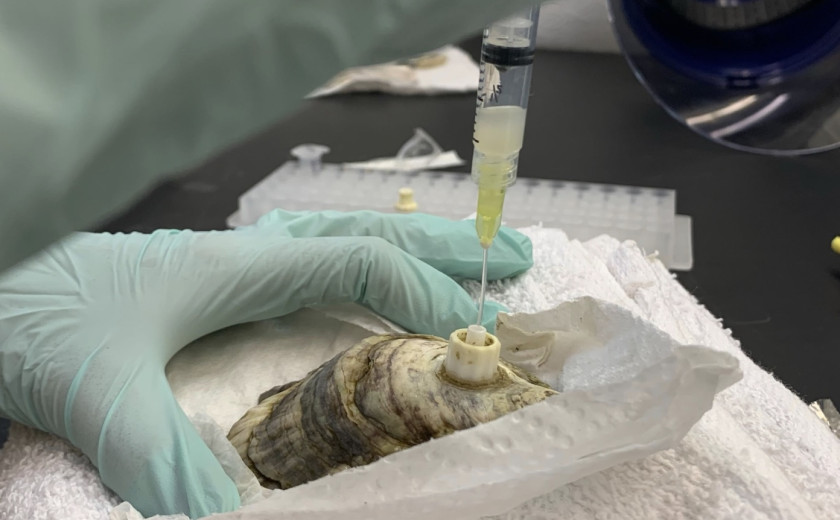
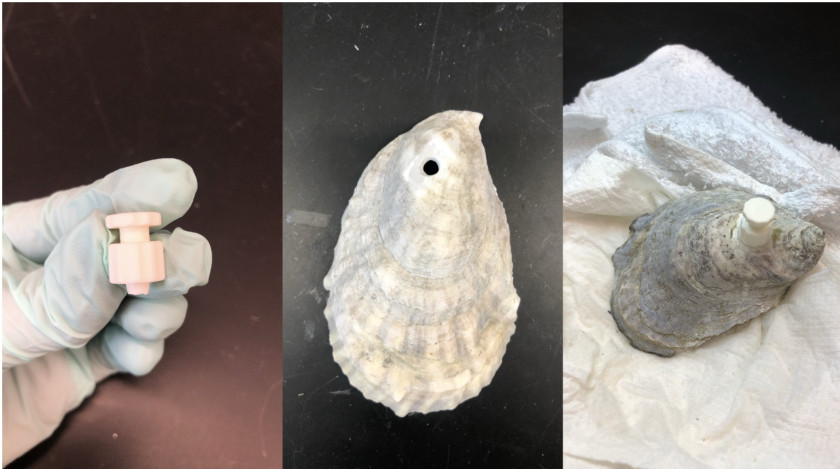
To get to these microbes, Unzueta Martínez devised a kind of catheter, installing a watertight port to allow one-way access through which she could sample the microbe-filled fluid.
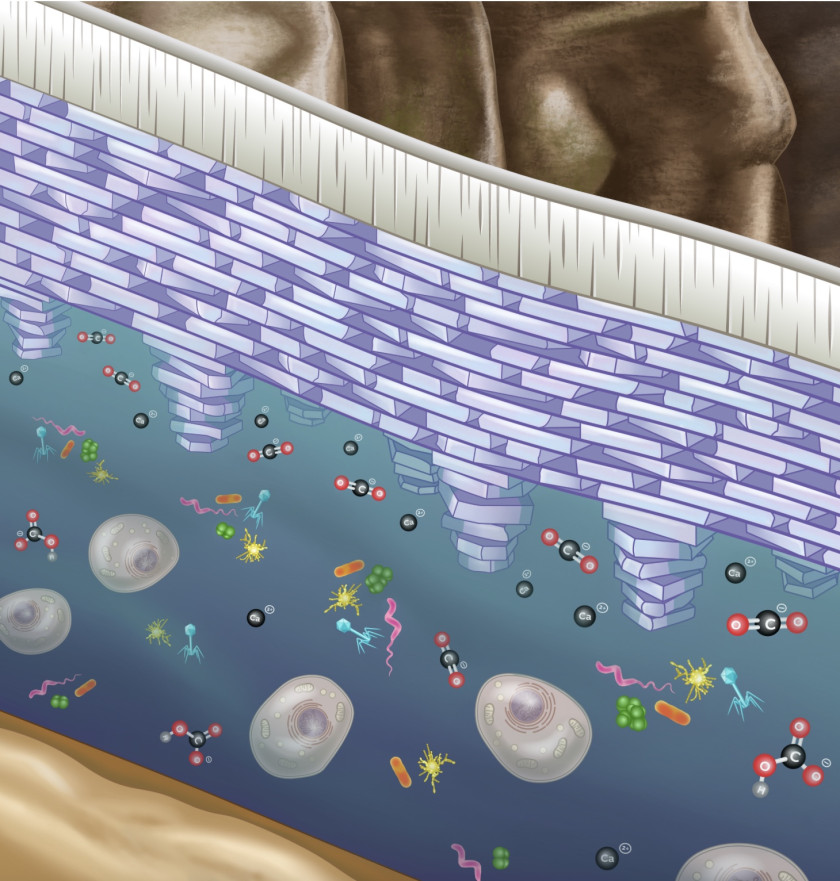
Examining the microbes and the oysters, she found that the microbes and the oyster itself were simultaneously co-expressing genes — that is, having genes activate at the same time. More surprisingly, “the microbes were expressing genes that are known to help precipitate calcium carbonate,” she said. “And calcium carbonate is the material that the shell is made out of.”
Remarkably, when the microbes were activated, the host oyster started expressing genes related to its neuroimmune system, the system that detects foreign bodies, such as microbes. These systems can play a role in eliminating microbes, but some animals use them to “talk” to beneficial microbes through chemical communication.
Unzueta Martínez described the discovering as “very exciting” and found herself asking, “What's going on? Are they coordinating? Can the host somehow communicate with its microbiome via the neuroimmune system to coordinate in regulating chemistry?
“It raises more questions than answers,” she said.
To continue this work, she hopes to look at deep-sea bivalves such as Bathymodiolus mussels and Calyptogena clams, which live around hydrothermal vents in some of Earth’s most extreme habitats. “These animals are thriving and they also have microbiomes,” she said. “This is a great opportunity to take a look at this trifecta of the host and the microbiome and environmental chemistry regulation across different environments.”
Such research, said Peter R. Girguis, professor of Organismic and Evolutionary Biology and co-director of the Harvard Microbial Sciences Initiative, puts a new focus on organism-microbe cooperation. “We often think of animals as doing all the heavy lifting on their own, and sometimes that may be true,” he said. “But more often than not, when we look somewhere, we find microbes playing some role in an animal process.”
“It's a reminder that all of us as animals live in this microbial world,” he said. That microbe could be saving the oyster the energy it would otherwise expend on making its own shell. Or, he added, it could be playing some other role that we have yet to discover.
It’s a finding that has implications for higher life forms as well. Too often, Girguis said, we associate microbes in our own bodies with pathogens or illness. “But the overwhelming majority of microbes that play a role in human life confer advantages to us,” he said, noting microbes’ role in digestion, for example. “If we can start to disentangle the ways that a simple oyster, which has a much simpler immune language, is ‘talking’ to the microbes,” we can better understand the oysters’ resilience.” That is, he explained, the ways the oyster is “taking advantage of the biochemical sophistication of microbes.”
As the ocean becomes more acidic, such partnerships may prove vital. “As ocean pH gets lower, it costs an animal more energy,” explained Girguis. “But if that can be shared even just a tiny bit by microbes that are helping make the conditions favorable for shell growth and the microbes benefit by having a place to live where they’re not preyed upon, then that’s the start of a really good relationship.”
Andrea Unzueta-Martínez, Jennifer A. Delaney, Kate Morkeski, Abby Ross, Zhaohui Aleck Wang, and Peter R. Girguis, Proceedings of the National Academy of Science [PNAS] 123, no. 11 (2026): e2521539123.
Researchers in the Department of Chemistry and Chemical Biology combined biophysics, structural biology, and simulation to solve a manufacturing question.
In a new milestone for stem cell research, Harvard neuroscientists have set a record for keeping alive lab-grown human brain “organoids” and proven that they mimic key developmental stages seen in living people.

The Harvard theoretical physicist and neuroscientist has won the Dirac Medal and Prize, one of the highest honors in physics.