Bethany Carland-Adams
Harvard Staff Writer
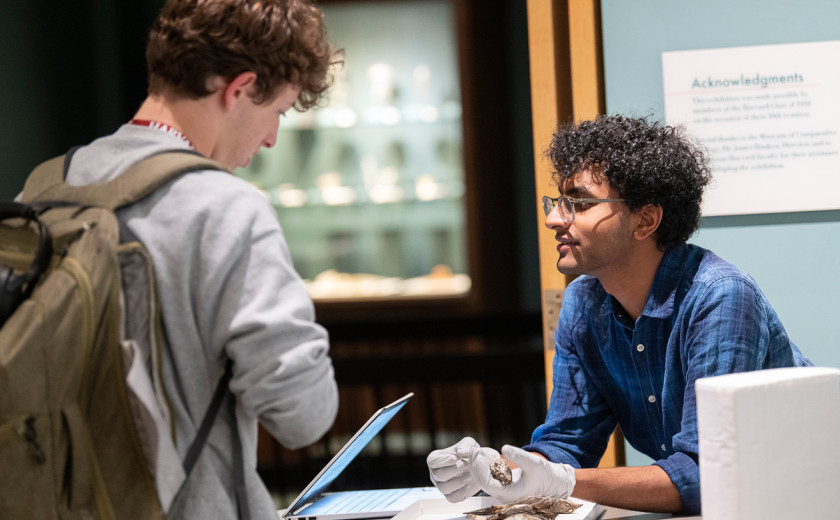
Early interest in nature shaped Ashwin Sivakumar’s academic interests and work with Harvard Museums of Science & Culture
/ Read time: 4 minutes
Harvard Staff Writer
Ashwin Sivakumar ’26 wanted to understand how birds evolved such a diversity of wing shapes.
Working with the Edwards Lab, led by Alexander Agassiz Professor of Organismic and Evolutionary Biology Scott V. Edwards, Sivakumar used CT technology to scan a variety of wings. The results, outlined in his senior thesis, revealed a separation in the evolutionary roles of bones and feathers.
Feathers, he found, drive differences in wing shape between subspecies, while bones eventually start to contribute to their shape over millions of years. “It is surprising and interesting to find that adaptation in a trait as complex as wing shape has left a noticeable signature in patterns of genetic diversity,” the integrative biology concentrator shared.
Sivakumar is a lifelong birder, a passion encouraged by his parents from an early age. He recalls spotting tufted puffins on Cannon Beach, just outside of Portland, Ore. “I always thought of puffins as a high Arctic sort of creature,” he said. “The realization that there were colorful, clownish puffins nesting just an hour from where I lived ignited my curiosity.”
After his family moved to Southern California, the young birder started scouring parks, overgrown lots, and the banks of the Los Angeles River. Working with paleoecologist Alexis Mychajliw at the La Brea Tar Pits Museum, a teenage Sivakumar was also able to pour these interests into fieldwork.
“I see a little flutter of a bird, hear a fragment of birdsong, and I ask questions beyond the reach of my observation, such as: How many of them are there? Why do the ones here look different from the ones there?” he recalled of his duties. “Over time, I realized that the answers to these questions require a truly all-encompassing approach, spanning the dynamics of the genome and ecosystems.”
Also formative was a family visit to the Q?rius display at the National Museum of Natural History in Washington, D.C. The permanent exhibit features drawers with thousands of specimens which visitors are encouraged to handle and examine under magnifying glasses and microscopes.
Sivakumar spent hours there studying everything from bird skin studies and feathers to fossils and insect mounts. “It felt personal and exploratory in a way that staring at mounts in a glass case couldn’t capture,” he recalled. “As soon as I learned that many museums had vast specimen collections off display, I knew I wanted to work with them in some way.”
At Harvard, he enrolled in a first-year seminar exploring behind-the-scenes complexities in the world of natural history museums taught by Professor of Organismic and Evolutionary Biology Charles C. Davis, who is also the curator of vascular plants in the Harvard University Herbaria. Davis encouraged Sivakumar to get involved with the Harvard Museums of Science & Culture’s student board.
“Since I knew my scientific career would largely be impacted by this, I thought it would be an exciting opportunity to be involved in the public-facing side of museum collections through the student board,” Sivakumar said.
He ended up organizing and helping to run student collection tours at the Museum of Comparative Zoology and the Collection of Historical and Scientific Instruments, and he got involved with planning student-facing events during Visitas and First-Year Orientation. He also contributed to the HMSC student board’s social media strategy and has appeared in playful posts on the group’s Instagram feed.
At Visitas, the annual weekend for admitted College students, he relished showing off the Song Sparrow specimens he has worked with regularly in the Edwards Lab. At the annual Zagmuk party at the Harvard Museum of the Ancient Near East, which celebrates the ancient Mesopotamian new year, he helped craft trivia questions before serving as the dramatic announcer of all answers — and victors at the event’s conclusion.
“Ashwin has such a broad view of how to engage with museums,” said Wendy Derjue-Holzer, HMSC education director and student advisory board facilitator. “Sometimes it’s the scholarly insight into collections that we see when he’s talking about his ornithology research. Other times it’s a sense of playfulness that comes out in things like our Zagmuk party.”
As the winner of a 2026 Marshall scholarship, Sivakumar is off to the University of Cambridge next year to pursue a Ph.D. in evolutionary genetics and study the cichlid family of fish. He will employ his experience using CT scans, whole genome sequences, as well as new statistical methods to better understand genetic variation between these species.
“I am excited to observe how scientific and academic institutions operate and interact with the public in the UK,” Sivakumar said.

The Harvard theoretical physicist and neuroscientist has won the Dirac Medal and Prize, one of the highest honors in physics.
Deep in the woods of Petersham, Mass., the Harvard Forest Summer Research Program in Ecology is cultivating a renewable resource — future generations of scientists.

Forget about the ancient Greek myth of Icarus. For the last 10 years, Jenna Samra, Ph.D. ’18, and her colleagues have been pushing technology to fly closer to the hottest part of the sun. Samra, an astrophysicist at the Center for Astrophysics, an institution jointly run by Harvard and the Smithsonian, leads a scientific quest to study the solar corona.