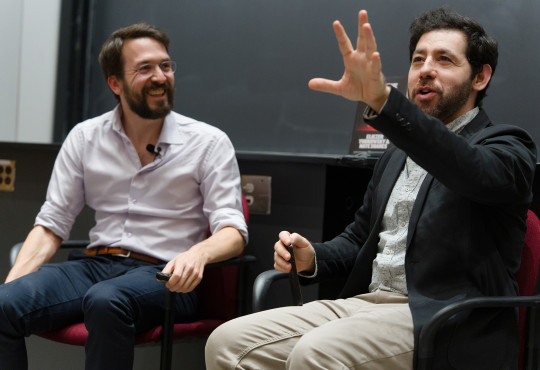
‘Silicon Valley has seen a ghost’
To a packed audience, author of “If Anyone Builds It, Everyone Dies” talks real stakes of “superhuman” AI threats.
To a packed audience, author of “If Anyone Builds It, Everyone Dies” talks real stakes of “superhuman” AI threats.
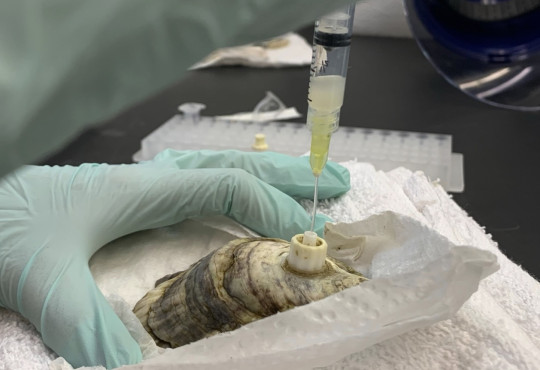
For an oyster, creating an internal environment for calcification that forms its distinctive hard shell is essential. But new Harvard research has found that these bivalves may outsource the work.

Three robots walked into the Science Center, their human handlers trailing several feet behind. Within seconds, a crowd circled the cute one, a jaunty silver contraption.

Childhood is understood as a time to learn and grow. What Christopher Kuzawa’s research shows is that learning and growing are interconnected.
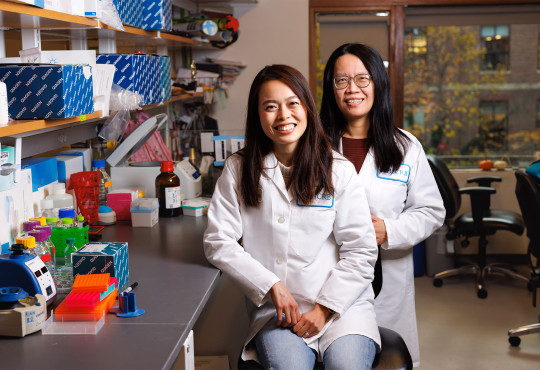
New findings by Harvard stem cell biologists suggest it may be possible in the future to regrow wounded skin without scarring.

Can a river be a living entity? Harvard College senior Hassan Looky, a joint concentrator in anthropology and history, is asking this very question as he focuses his thesis on the rights of the Yarra River (Birrarung) in Melbourne, Australia.

Neurobiology concentrator Sean Meng ’26 is fascinated by how individuals see the world. He first became aware of how differently people can experience the same environment while serving as a teaching assistant at a school in Lawrence, Massachusetts. There, he met Elmer, a first grader with severe autism who was, for the most part, overlooked. After spending more time with him, Meng found that Elmer truly “was seeing the world in very different ways.”